


Jewish Onliner is an independent publication. If you find our work valuable, please consider becoming a paid subscriber.
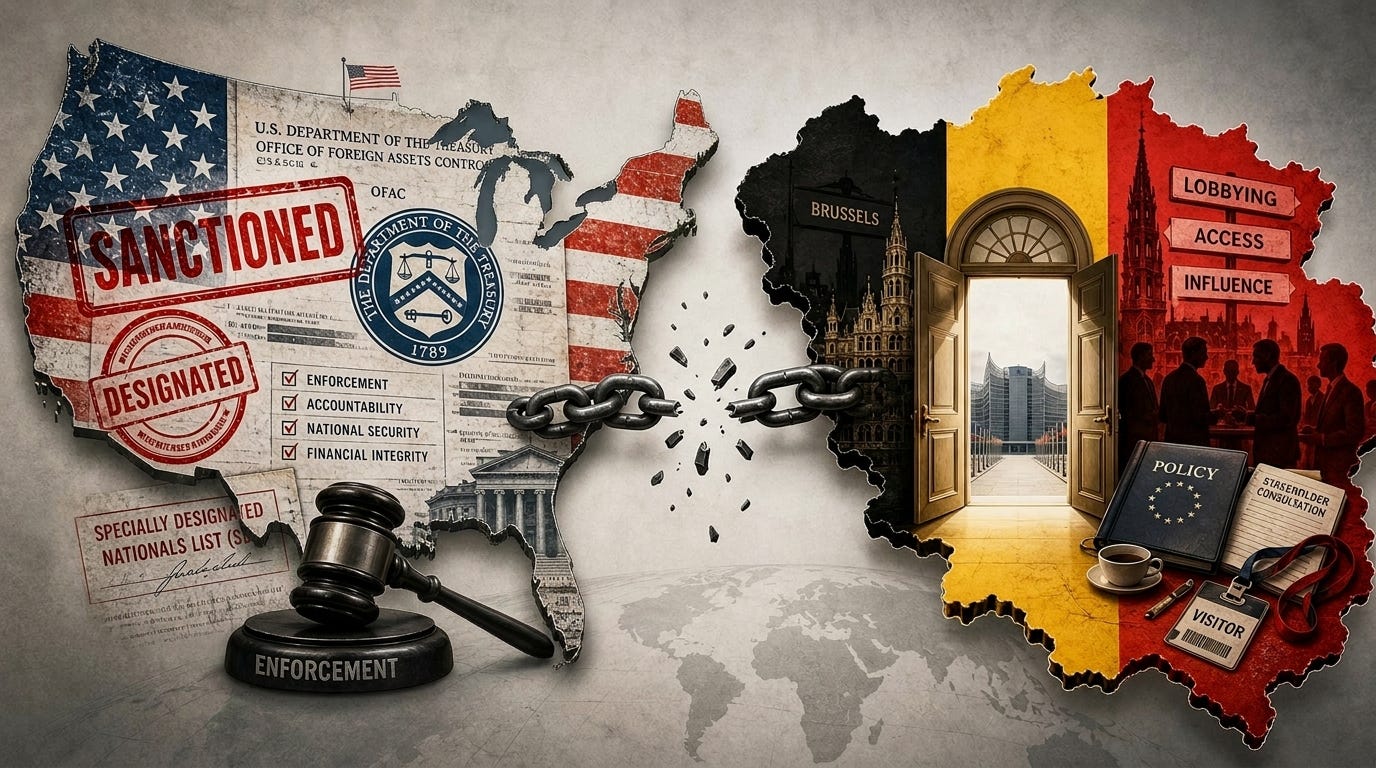
On May 6, 2026, a Brussels-based organization calling for the suspension of the EU–Israel Association Agreement released a policy study estimating that such a move could cost Israel billions of euros in trade losses.
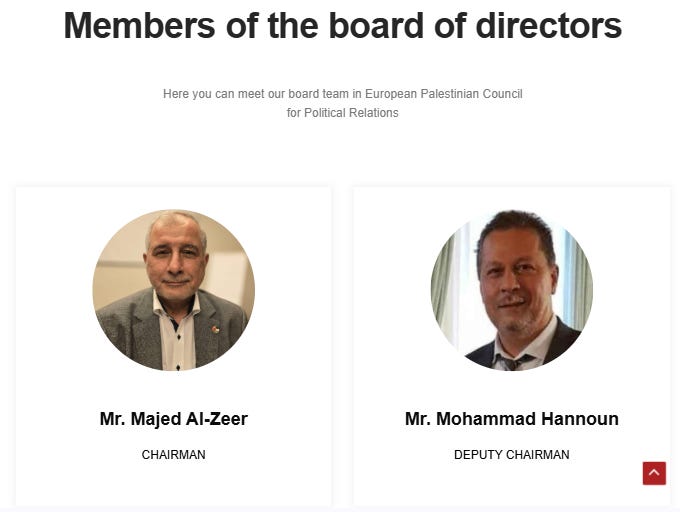
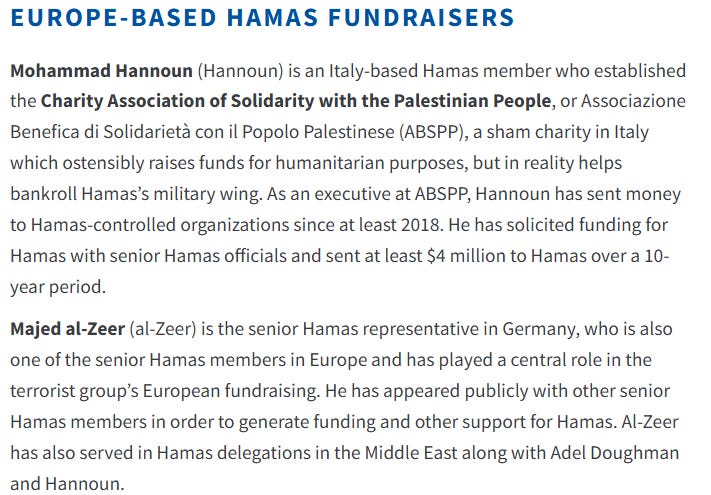
The organization behind the study, the European Palestinian Council for Political Relations (EUPAC), is a Brussels-registered association sans but lucratif (ASBL), Belgium’s nonprofit association structure, that presents itself as a bridge between European policymakers and the Palestinian cause. Its top officers, however, are Majed Al-Zeer and Mohammad Hannoun, two men the U.S. Treasury sanctioned on October 7, 2024, for what it described as prominent roles in Hamas’s international fundraising network.
Al-Zeer has also been reported to be the subject of a German European arrest warrant over allegations tied to Hamas activity in Europe. Hannoun, meanwhile, was arrested in Italy in December 2025 as part of a nine-person investigation into an alleged Hamas financing network that prosecutors said moved roughly €7 million through ostensibly humanitarian channels.
Despite the U.S. designations and subsequent law-enforcement actions, EUPAC’s website continues to list Al-Zeer as chairman and Hannoun as deputy chairman.
A U.S.-Sanctioned Figure Pushes Into the EU Trade Debate
On May 6, 2026, roughly one year after Al-Zeer was reported to be wanted under a German European arrest warrant and just over four months after Hannoun’s arrest in Italy, EUPAC released a study from Brussels analyzing the potential suspension of the EU–Israel Association Agreement. The paper argues that Israel, “as an occupying power,” should be subject to WTO standards, including standard customs tariffs on Israeli goods, which it says would have an immediate effect on their competitiveness and overall cost.
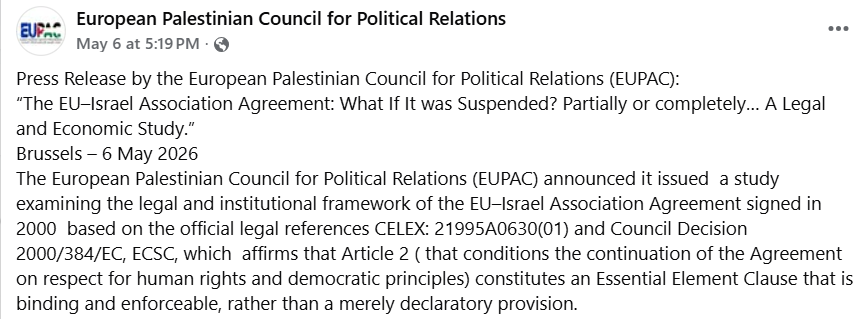
EUPAC’s study estimates potential Israeli losses at approximately €2.15 billion annually under partial suspension and around €14.3 billion in the first year under full suspension. Al-Zeer is quoted throughout as EUPAC chairman, despite public reporting that he is wanted under a German European arrest warrant.
A Front Hidden in Plain Sight
According to the Belgian Official Gazette, EUPAC was established as an ASBL in 2022, formally registered for sports and cultural activities tied to Morocco. On its public-facing website, however, it describes itself as the “European-Palestinian Council for Political Relations,” dedicated to influencing European “political, scientific, cultural and civil society” engagement with the Palestinian cause through conferences, reports, and “bilateral and group meetings with actors in the European and Palestinian arenas.”
In February 2024, Belgian Justice Minister Paul Van Tigchelt acknowledged, in response to MP Michael Freilich, that groups in Belgium were operating on Hamas’s behalf through lobbying and fundraising. He did not publicly name specific organizations, but warned that dissolving such groups “is not simple according to Belgian law,” a position Freilich called “a disgrace.”
Al-Zeer: U.S.-Designated Hamas Representative in Germany
The U.S. Treasury identified Al-Zeer as “the senior Hamas representative in Germany” and a figure who “has played a central role in the terrorist group’s European fundraising.” Israel had already designated him a Hamas operative in 2013, and German intelligence publicly named him Hamas’s secret representative in Germany.
In May 2025, the Jerusalem Post, citing Swedish reporting, reported that Al-Zeer was wanted under a European arrest warrant issued by Germany over allegations that he coordinated Hamas activity across Europe, including fundraising and attack planning. Before founding EUPAC, Al-Zeer chaired the London-based Palestinian Return Centre, which Israel declared an “unlawful association” in 2010 over its Hamas ties. On social media, Al-Zeer has characterized the October 7 massacre — in which 1,200 people were murdered and 240 taken hostage — as an act of “self-defense.”
Hannoun: Treasury-Designated Figure in Italian Hamas Financing Case
EUPAC’s deputy chairman, Mohammad Hannoun, founded the Charity Association of Solidarity with the Palestinian People (ABSPP), which the U.S. Treasury described as “a sham charity in Italy which ostensibly raises funds for humanitarian purposes, but in reality helps bankroll Hamas’s military wing.” Treasury assessed that Hannoun “sent at least $4 million to Hamas over a 10-year period.”
On December 27, 2025, Italian anti-terrorism prosecutors arrested Hannoun and eight others, alleging the network “diverted to Hamas-linked entities around 7 million euros” raised through ostensibly humanitarian channels. Police seized more than €1 million in cash from charity offices and suspects’ homes, alongside material supportive of Hamas.
Brussels’ Blind Spot
EUPAC’s continued operation underscores a striking gap between U.S. enforcement and Belgian legal practice. As the Treasury noted, “Hamas considers Europe to be a key source of fundraising,” and the group may be receiving “as much as $10 million a month” through donations channeled via front charities.
Yet EUPAC, a Brussels-registered ASBL whose top officers include two men designated by the U.S. Treasury as Hamas-linked fundraisers, continues to publish policy material and seek influence in the European debate over Israel. The organization has become a test case for the gap between U.S. sanctions enforcement and Belgium’s slower legal process for addressing groups suspected of operating within Hamas’s European support infrastructure.