



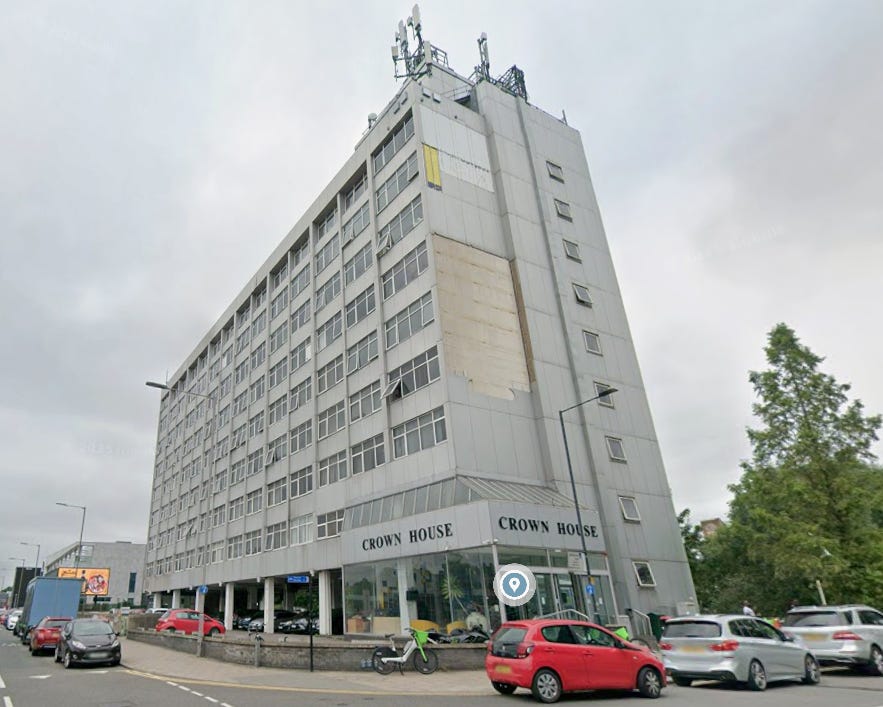
Suite 702 at Crown House, a drab office block near Wembley Stadium, is listed as the registered address for a cluster of companies and organizations tied, through shared directorships, trusteeships, and corporate filings, to individuals sanctioned by the U.S. and UAE over alleged links to the Muslim Brotherhood and Hamas, according to an investigation published by The National.
The report describes an address that appears quiet on inspection but repeatedly surfaces in public records connected to sanctioned figures. It argues the pattern is less about a visible “headquarters” and more about a paper infrastructure, registered offices, rotating directors, and overlapping roles, that can persist even as individual entities become dormant or dissolve.
Treasury Designates PCPA as a Hamas front
On Jan. 21, the U.S. Treasury Department’s Office of Foreign Assets Control (OFAC) announced action against what it called Hamas’s “covert support network,” including the designation of the Popular Conference for Palestinians Abroad (PCPA). Treasury said the PCPA “purports” to represent Palestinians abroad but is “clandestinely controlled by Hamas,” alleging it operates in line with Hamas directives and has backed flotillas attempting to access Gaza.


In the same action, OFAC added Zaher Khaled Hassan Birawi, described by Treasury as a UK-based senior PCPA official and founding member, to the Specially Designated Nationals (SDN) list. Treasury said Birawi was designated for materially assisting, sponsoring, or providing support to the PCPA. The action also appears in the U.S. government’s Federal Register public inspection notice.
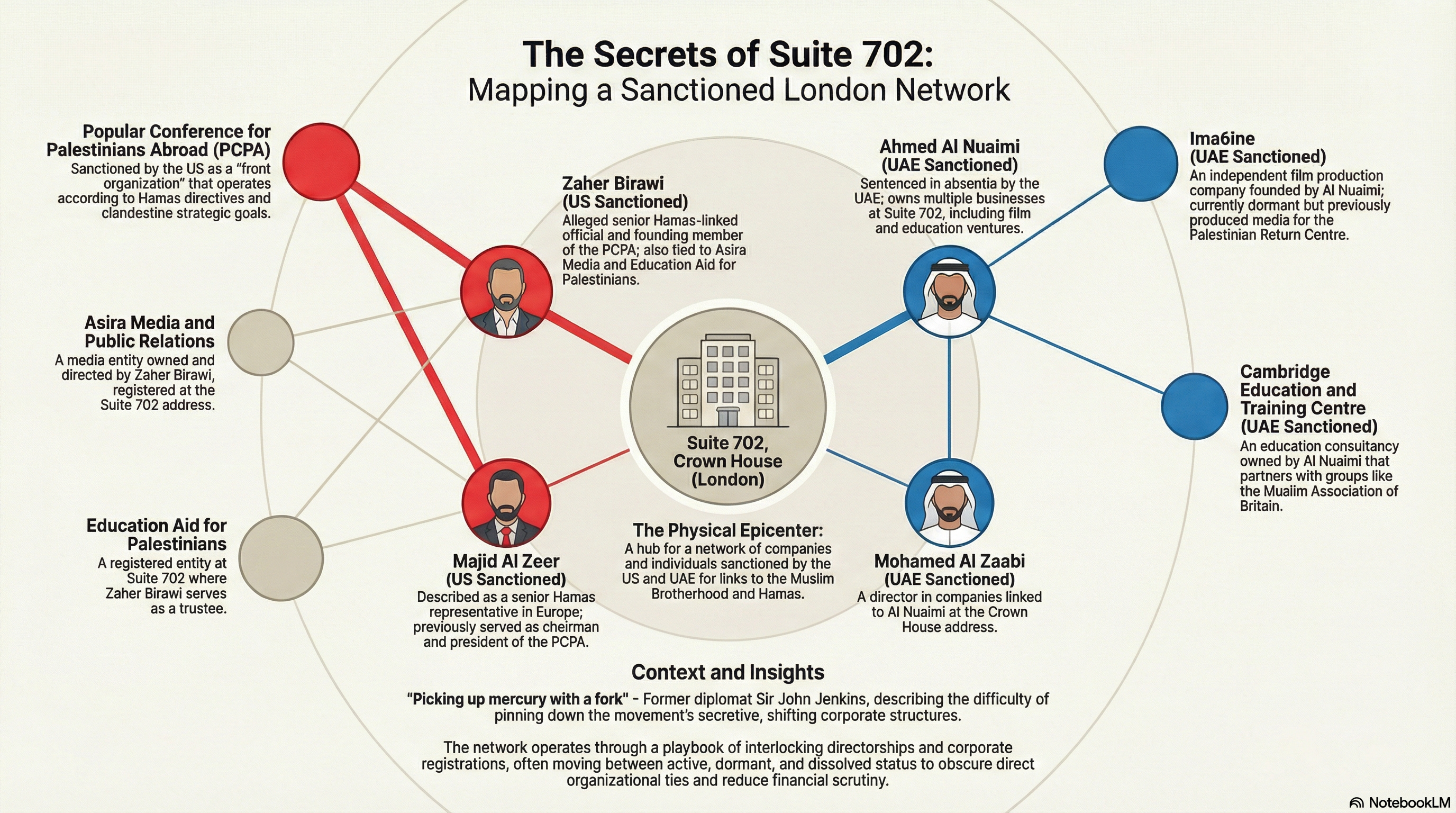
The National reports Birawi is linked to Suite 702 through U.K. registrations, including a directorship/ownership role in Asira Media and Public Relations (registered at the suite) and a trustee role in Education Aid for Palestinians (also registered there). Birawi told The National he rejects the designation and is consulting lawyers to challenge it.
Overlapping Leadership in the Network
The Wembley address is presented as part of a broader organizing method: individuals connected to one entity appear across others, and leadership roles overlap in ways that can expand reach while complicating accountability.
A key example cited is Majid (Majed) al-Zeer, previously sanctioned in an earlier U.S. Treasury action that described him as central to Hamas fundraising in Europe. In that Oct. 7, 2024 Treasury release, OFAC described al-Zeer as the “senior Hamas representative in Germany” and said he played a “central role” in Hamas’s European fundraising, alongside other sanctioned figures.
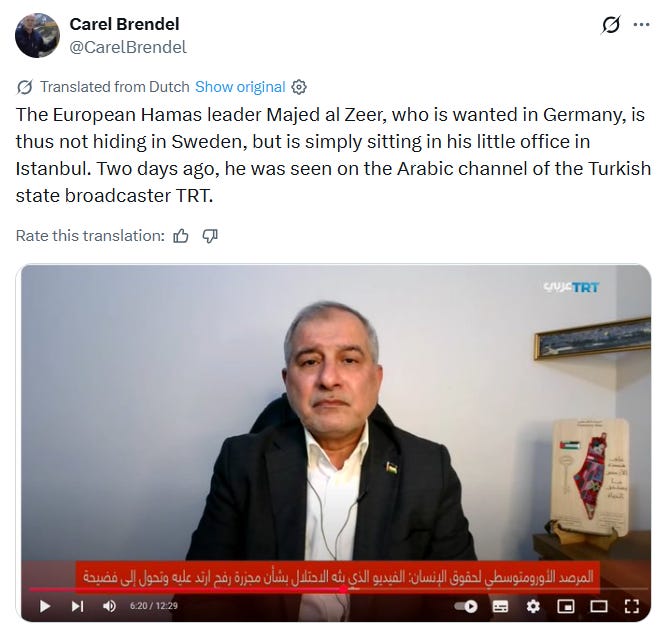
The National links al-Zeer to Crown House through the Palestinian Return Centre, which is located in the same building (though on another floor).
UAE-Proscribed Figures in the Network
Separately from U.S. Hamas-related designations, The National also describes a cluster of companies registered at Crown House tied to Ahmed al-Nuaimi, who it says was tried in absentia in the UAE, sentenced, and later placed on a UAE terrorist list in connection with Al Islah, a group proscribed by the UAE and accused by Emirati authorities of Muslim Brotherhood alignment.

The report points to multiple businesses connected to al-Nuaimi registered at the address, including Ima6ine (a film company later described as dormant) and Cambridge Education and Training Centre (described as an education consultancy). A notable detail is how modest or short-lived some of the entities appear in filings, dormant statuses, dissolutions, and low turnover, while still functioning as formally incorporated vehicles that can open accounts, contract services, and maintain a legitimate-looking UK footprint.
Why Policymakers Care
Experts quoted by The National argue that interlocking structures, entities coming and going, directors rotating, and public-facing legitimacy paired with opaque backend relationships, match known organizational playbooks used by Islamist movements operating in Europe.
The practical challenge for authorities is pace and proof. Networks can reconfigure faster than enforcement actions, and U.K. legal thresholds for bans or restrictions are difficult to meet when contested activity sits in a gray zone between political organizing, advocacy, and alleged material support.
The Crown House reporting underlines how sanctions designations increasingly function as more than financial enforcement. They also become a form of mapping, flagging addresses, personal links, and organizational ecosystems that may warrant tighter due diligence by banks, platforms, counterparties, and regulators.