


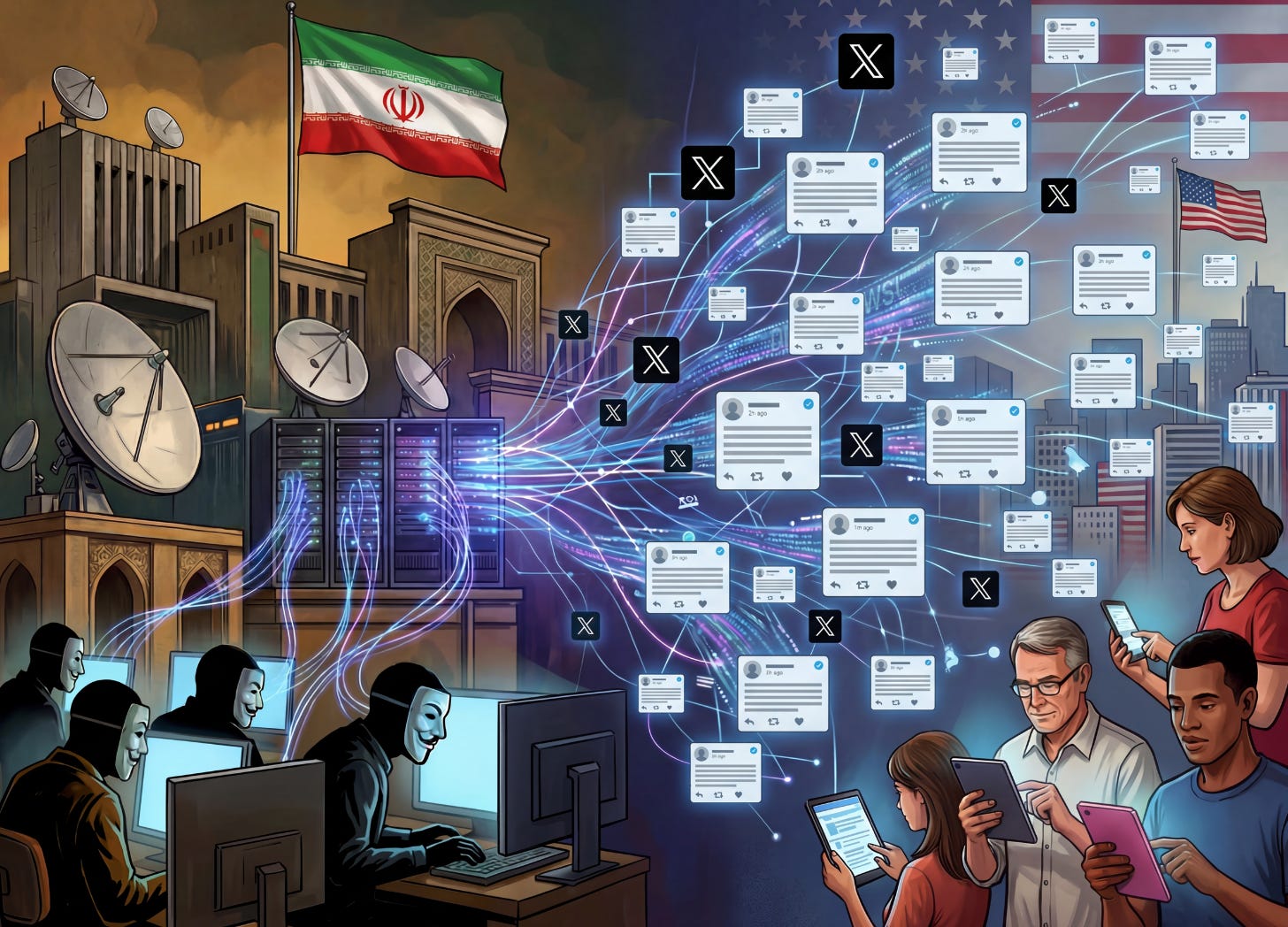
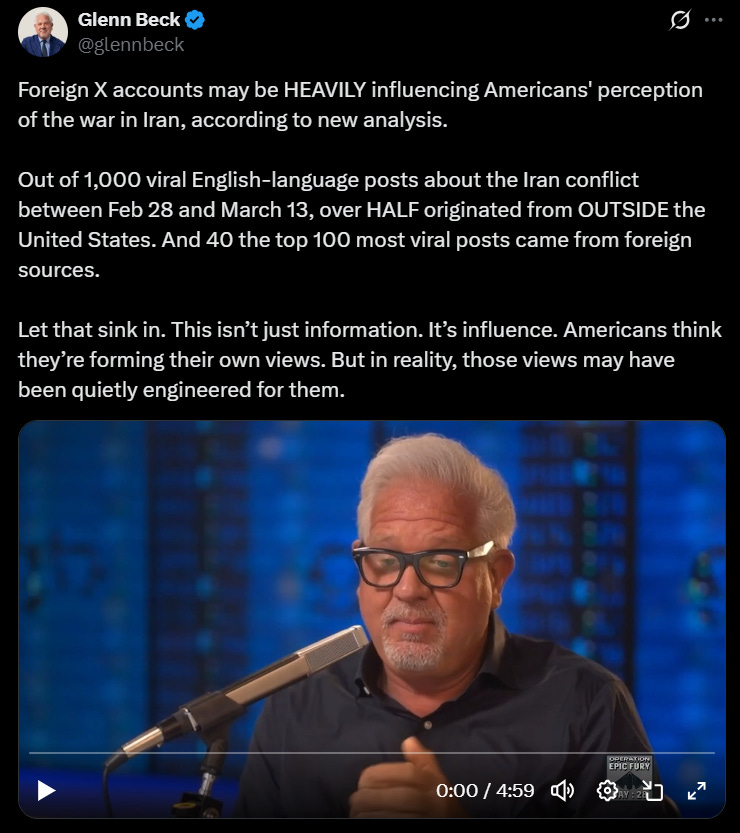
Online data from February 28 to March 13 reveals a coordinated foreign influence operation systematically flooding X with anti-U.S. and pro-Iranian regime messaging, according to research by Ryan Mauro, president of The Mauro Institute and senior fellow for counter extremism at the Capital Research Center.
The findings, featured on Glenn Beck's program, expose a three-pronged propaganda assault targeting American and English-speaking users: domestically-originating English posts amplifying foreign narratives, misleadingly-attributed overseas posts masquerading as American commentary, and automatically-translated non-English content algorithmically surfaced to Western audiences.
The Foreign Origin Problem
Of the 1,000 posts analyzed, 559—more than half—originated from non-U.S. accounts, collectively generating over 650 million views and nearly 22 million interactions including reposts, likes, and replies. Among the top 100 most-viral posts, 40 originated from outside the United States, indicating that overseas accounts punch disproportionately above their weight in shaping discourse.
A randomly sampled subset of 150 posts revealed that 72% of all viral Iran-related content was negative toward U.S. interests. However, the sentiment disparity between foreign and domestic posts was stark: only 10% of non-U.S. viral posts were positive, while 64% were negative. The remaining portion was neutral.
“The non-U.S. subset was overwhelmingly negative,” Mauro’s analysis concluded. U.S.-based users frequently amplified foreign messaging, with many parroting Iranian government narratives and quoting hostile overseas accounts as sources of authority.
Platform Mechanisms Amplifying Foreign Propaganda
X’s introduction of automatic post translation via Grok approximately nine months before this analysis created an additional vector for foreign influence. English-speaking users now encounter substantial volumes of non-English content—automatically translated and algorithmically prioritized—without explicit notification that the source material originated overseas or context about its origin.
This technical feature compounds the visibility problem. Western audiences receive hostile foreign propaganda through three simultaneous channels: U.S.-based posts repeating foreign talking points, overseas-based English posts that superficially appear domestic, and translated non-English content lacking source attribution.
The Narrative Architecture
Two dominant narratives emerged from the analysis of negative posts: first, allegations that a “Zionist conspiracy” manipulated or coerced President Trump into authorizing Operation Epic Fury, and second, claims that the military campaign functioned as a “Wag the Dog” distraction from evidence purportedly implicating Trump in the Jeffrey Epstein scandal while reversing declining approval ratings.
The concentration of amplification power proved significant. Just 10 accounts generated 32% of all views across the 1,000-post sample, while the top 20 accounts generated 43%.
The highest-impact accounts included The White House (144 million views across 18 posts), BRICS News—labeled an “independent media company” which formerly listed its location as the UAE until recently changing it to the U.S. (87 million views across 31 posts), and Globe Eye News listing South Asia as its location (58 million views across 13 posts).


Among individual accounts, Jackson Hinkle—a Moscow-based podcaster and former pro-Trump influencer who co-founded the American Communist Party and attended Hezbollah founder Hassan Nasrallah’s funeral—generated 31 million views across 26 posts.
Hinkle has documented associations with Russian intelligence-linked intellectual Alexander Dugin, whose stated focus is influencing Western conservatives, libertarians, and Christians.


Sarah Abdallah (@sahouraxo), who identifies as an “independent Lebanese geopolitical commentator,” generated 22 million views across 10 posts while openly advocating for the Iranian regime, its proxy organizations, and the Russian government. According to Mauro’s analysis, there is reasonable suspicions linking her account to Hezbollah.


The Reality Gap
Mauro’s analysis documents a profound disconnect between social media discourse and measurable American public opinion. Polling data shows 81% of MAGA Republicans and 61% of non-MAGA Republicans support Operation Epic Fury. A three-point plurality of Americans overall support the operation, and 66% view Iran as a serious threat to U.S. national security.
“Life as it appears on social media is not like real life or anything close to it,” Mauro wrote. Yet he emphasized that the long-term trajectory of American civil society and global public opinion increasingly depends on what algorithms prioritize on social media timelines and the information ecosystem surrounding those platforms.
“If one party or coalition achieves social media dominance, it will be no less decisive than controlling the Strait of Hormuz or the Pacific’s first island chain,” Mauro concluded.