


Jewish Onliner is an independent publication. If you find our work valuable, please consider becoming a paid subscriber.
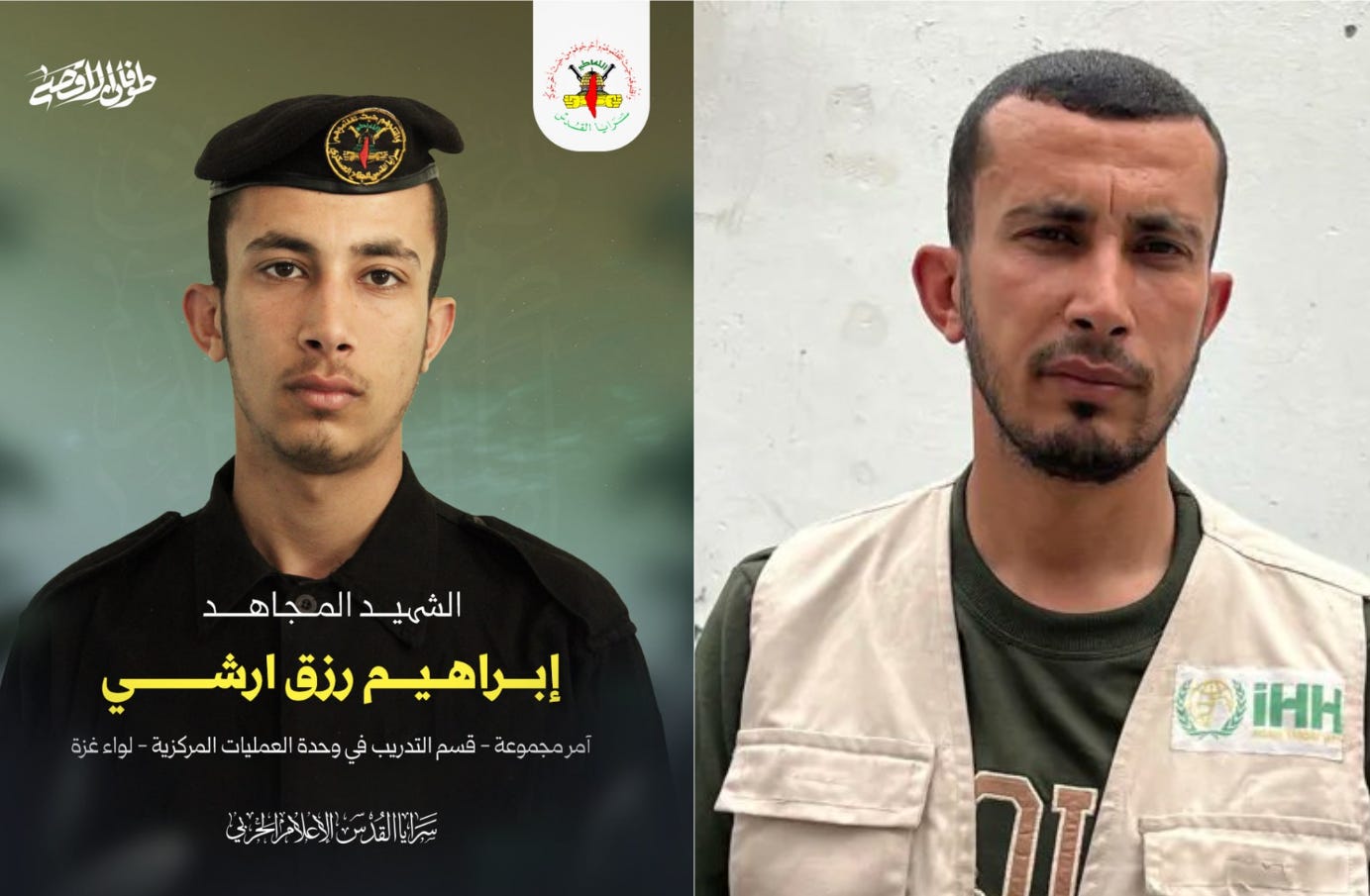
On Friday, Senior Policy Associate at the Israel Policy Forum Gabriel Epstein said that he had identified a fourth Gaza-based employee of Turkey’s IHH Humanitarian Relief Foundation who was a Palestinian Islamic Jihad operative, adding to a growing open-source record of aid workers, medical personnel, journalists, and civil-sector employees claimed by the U.S.-designated terror group following their deaths.


Epstein’s latest identification was Ibrahim Rizq Nimr Arshi, whom he described as director of IHH’s nutrition program in Gaza and a squad leader in PIJ’s Gaza Brigade. The new IHH-linked cases sharpen the question facing international aid agencies in Gaza: how many humanitarian roles overlapped with terror groups, and how much did employers, donors, or partner organizations know?
IHH’s ties to terrorism
IHH’s alleged ties to terror networks extend beyond Hamas. A Turkish police investigation in January 2014 uncovered that IHH had smuggled arms to al-Qaeda-affiliated jihadists in Syria, with prosecutors concluding through wiretaps and surveillance that the organization’s Kayseri and Kilis branches were sending funds, medical supplies, and household goods to jihadists with assistance from Turkey’s National Intelligence Organization.
Intelligence documents presented to the UN Security Council in February 2016 by Russian authorities identified IHH trucks—complete with license plates—transporting weapons and equipment to jihadist factions in Syria, including the Nusra Front.

In July 2010, thirteen members of Congress introduced House Resolution 1532, which urged an investigation into IHH’s role in providing “financial, logistical, and material support to terrorists.” The resolution cited a 2006 Danish Institute for International Studies report describing IHH as a front for funding terrorist organizations and sending jihadists to fight in Afghanistan, Bosnia, and Chechnya, and noted that in 2001, IHH was named in a U.S. federal court trial as having played an “important role” in al-Qaeda’s failed millennium plot to bomb Los Angeles International Airport.
Ibrahim Rizq Nimr Arshi
Epstein’s latest thread identified Ibrahim Rizq Nimr Arshi as director of IHH’s nutrition program in Gaza. According to Epstein, Arshi was also a squad leader in the training section of PIJ’s central operations unit in the Gaza Brigade and was killed in June 2025 with another PIJ terrorist.


Epstein documented that Arshi appeared as IHH’s nutrition program director in multiple Al Jazeera interviews from March to May 2025, while Lebanon’s An-Nahar described him as a social protection officer with IHH and the Hamas-affiliated Shehab agency also identified him in that civilian-aid context. Epstein further said family memorial posts showed Arshi wearing an IHH vest during food distributions.
Mohammed Jamal Faraj al-Mubayyad
Epstein previously reported that PIJ claimed Mohammed Jamal Faraj al-Mubayyad as a commander in the Gaza Brigade’s Central Mobilization Unit. In a follow-up, Epstein stated that al-Mubayyad was also a program director at IHH.


Earlier, Epstein wrote that al-Mubayyad’s social media included praise for PIJ figures including Khalil al-Bahtini, PIJ leader Ziyad al-Nakhala, and prisoner Khader Adnan. That material does not, by itself, prove operational membership. PIJ’s own later claim is the more consequential evidence.
Ahmed Matar Bustan
Ahmed Matar Bustan was one of the men Epstein listed in the same March 2026 thread on the IHH-linked cluster. Epstein wrote that Bustan, al-Mubayyad, and IHH employee Ishaq Assad al-Tayf were mourned after a May 28, 2025 strike by a PIJ channel dedicated to slain PIJ leader Khalil al-Bahtini.
The combination of the mourning channel, the shared incident, and Epstein’s subsequent categorization places him inside the documented pattern.


Ishaq Assad al-Tayf
Epstein’s March 2026 post identified Ishaq Assad al-Tayf as an IHH employee. He was reportedly killed in the same May 28, 2025 incident involving al-Mubayyad and Bustan and was subsequently mourned by the PIJ-linked channel. A separate PIJ obituary channel later published a poster identifying al-Tayf as a fighter in PIJ’s Tuffah Battalion, Gaza Brigade.


Why the pattern matters
The IHH cases raise a concrete vetting problem. If PIJ’s own posthumous materials and open-source records identify aid workers as commanders, squad leaders, or operatives, humanitarian agencies and their partners face a basic accountability question: whether their staffing systems can detect armed-group affiliation in a territory where terrorist organizations are embedded across civilian institutions.
The pattern assembled by Epstein is no longer anecdotal. It now includes multiple named men, specific ID numbers, civilian job descriptions, terrorist-unit labels, and visual records linking some of the same individuals to both aid work and armed organizations.
Shocking…lol….