


The Institute for the Study of War (ISW) released a report on Sunday noting the ongoing U.S.-Israeli military campaign is making measurable progress in neutralizing Iran’s critical missile and drone capabilities, systematically degrading Tehran’s ability to execute its asymmetric warfare strategy against Western interests in the Gulf region. A senior Israeli military official reported that between 260 and 290 of Iran’s estimated 410 to 440 missile launchers—approximately 63% to 70%—have been destroyed or rendered combat ineffective since operations began.
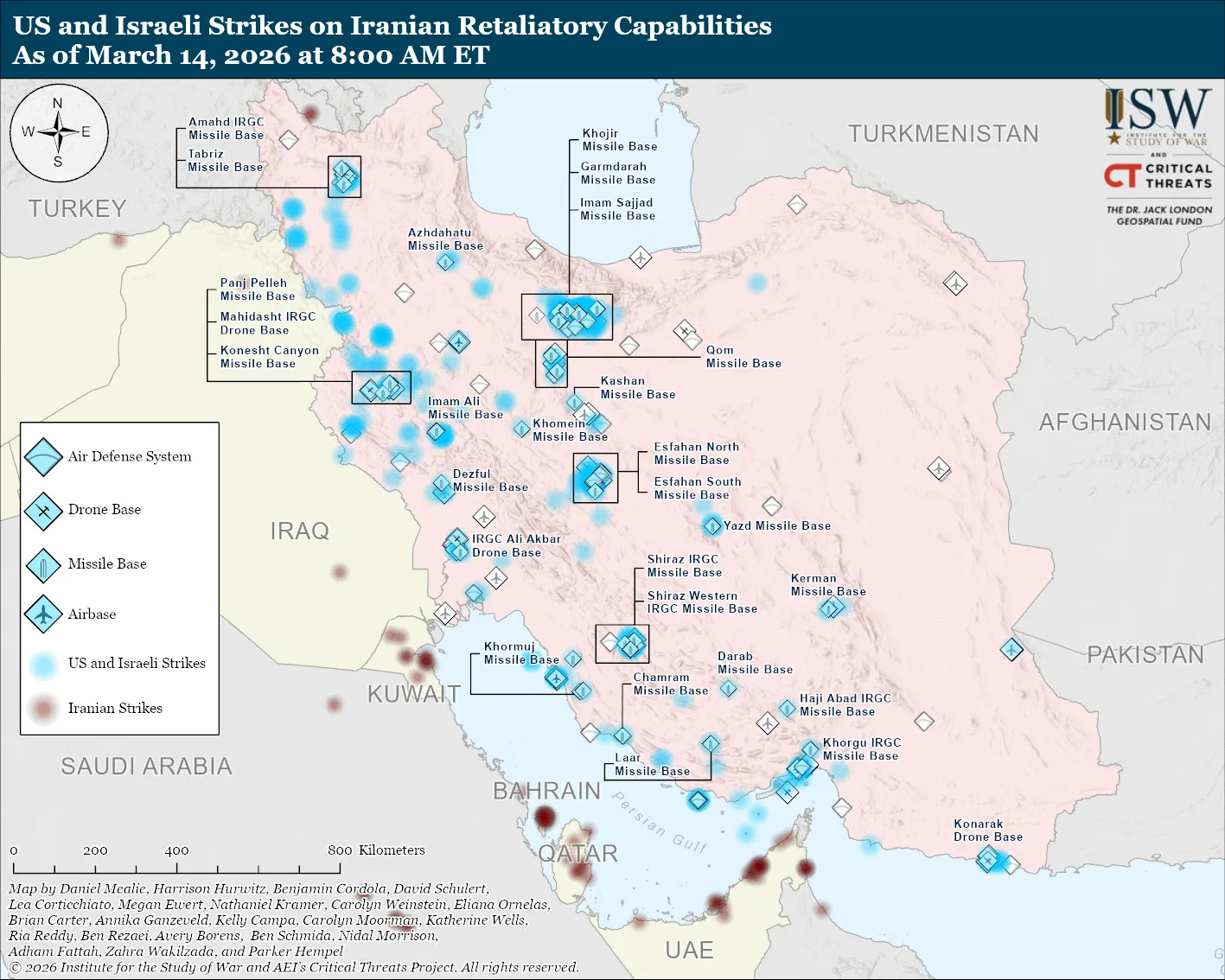
The campaign has focused on eliminating Iran’s drone and ballistic missile capabilities, which Tehran relies on to inflict casualties, disrupt regional oil infrastructure, and impose political pressure on the United States and its Gulf allies. Israeli intelligence reports indicate that Iranian missile force troops are demoralized, with personnel deserting and refusing orders as the combined force continues striking launch sites and command infrastructure.
Iran’s Five-Pronged Strategy Under Pressure
Iran developed a multi-pronged asymmetric strategy designed to outlast rather than militarily defeat the United States and Israel in an existential conflict. The strategy consists of five lines of effort: drone and ballistic missile attacks to inflict casualties and economic damage in the Gulf, drone, missile, and naval attacks including mines to disrupt Persian Gulf shipping, proxy attacks from Hezbollah and Iranian-backed groups, global terrorism, and cyber attacks on critical infrastructure.
The U.S.-Israeli combined force prioritized neutralizing drone and missile capabilities because these assets pose the most immediate threat to regional stability and oil markets. According to the ISW, these weapons systems can cause the most lasting damage to energy infrastructure and impose the most severe political pressure on Western governments through sustained attacks.
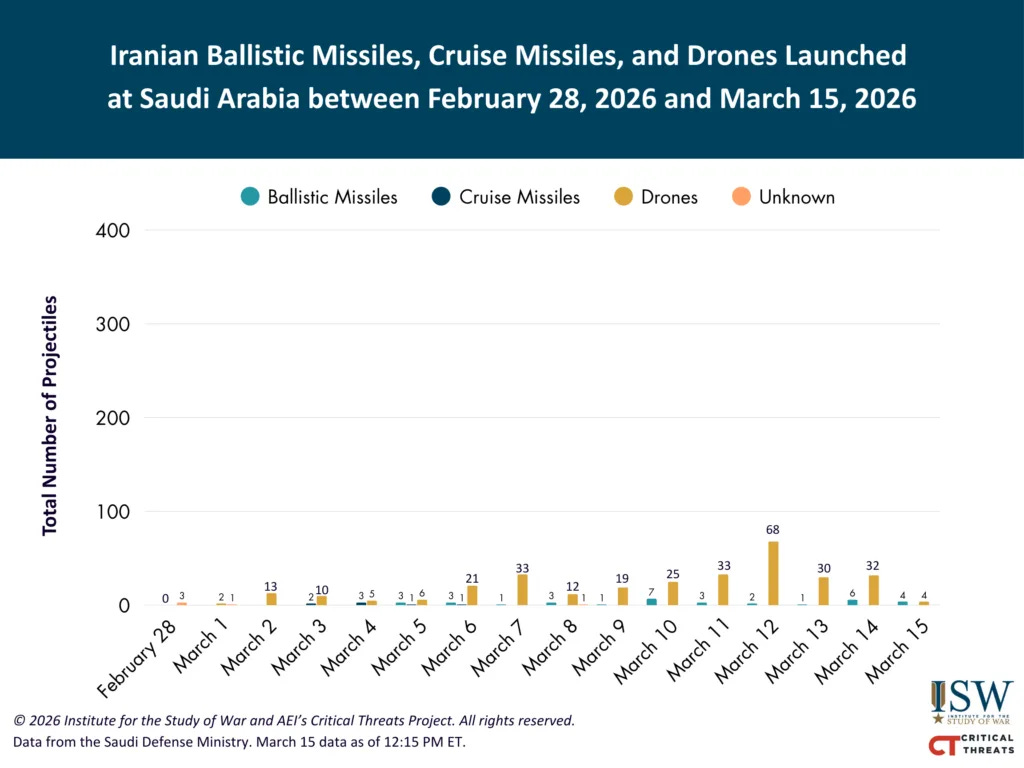
Iranian ballistic missile and drone launches have decreased gradually since the beginning of operations, though the regime continues firing reduced volumes of munitions. Some individual drones have penetrated air defenses and damaged oil infrastructure in recent weeks, including a March 11 attack on Omani oil facilities and a March 13 missile strike that damaged five tankers in Saudi Arabia.
No Evidence of Strategic Reserve
Speculation that Iran is hoarding advanced missile systems for later use after allied interceptor stockpiles are depleted finds little support in available evidence. Iran is currently deploying advanced missile systems including the Sejjil and Khorramshar against Israeli targets, contradicting claims of strategic withholding.
The ISW assessment notes that hoarding missiles would represent a gamble Iran cannot afford. Such a strategy assumes Tehran will retain sufficient launchers to continue firing advanced missiles once the United States expends its interceptors, an assumption undermined by the systematic destruction of Iranian launch infrastructure. The strategy also presumes Iran can accurately assess U.S. and Israeli interceptor stockpiles, which Tehran has no reliable method of doing.
The Islamic Revolutionary Guard Corps (IRGC) almost certainly lacks the command-and-control capability necessary to execute centrally-directed operations that prioritize certain munitions over others, according to the analysis. Iranian officials stated in November 2025 that they would launch thousands of missiles targeting Israel in any future war, indicating IRGC commanders likely emphasized mass attacks before operations began. Tehran has since noted it decentralized operations and adopted a “fire at will” approach in response to U.S. and Israeli strikes on military leadership.
Any strategic shift during the war to withhold missiles for later strikes would require central direction to ensure different organizational elements respond as headquarters desires. The combined force attacks on Iranian command and control and military leadership have likely disrupted Iran’s ability to manage such sophisticated planning.
Maritime Campaign Follows Phased Approach
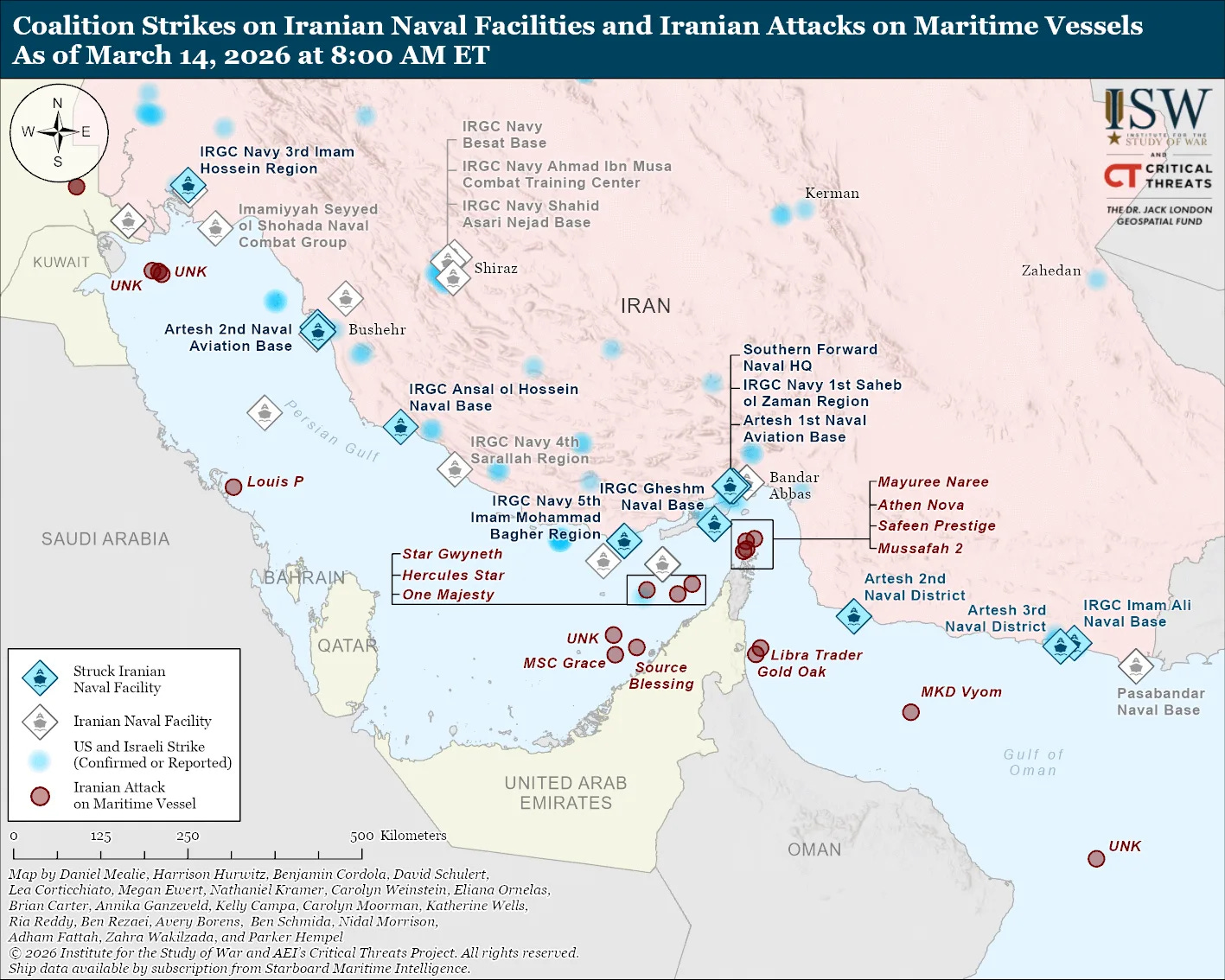
U.S. Central Command planned to suppress Iran’s maritime attacks through multiple phases mirroring the overall campaign structure, suppression of enemy air defenses along the coast to enable additional strikes and helicopter patrols, suppression of Iranian ballistic missile and drone attacks, destruction of Iran’s navy, and ultimately, defeat of Iran’s anti-ship missile and drone capabilities.
The last Iranian attack on merchant shipping occurred on March 11, though it remains unclear whether this represents successful suppression of Iranian capabilities or decreased shipping transiting the Strait of Hormuz. Iran may decide to mine the strait if its ability to target shipping becomes sufficiently degraded, but minesweeping operations would eventually clear the passage and restore traffic flow. Tehran must also calculate how mining the strait would affect its own oil export capabilities, as mines do not distinguish between ships Iran wants to pass through and those it wishes to attack.
Military Progress Amid Strategic Uncertainty
The ISW assessment concludes that available evidence supports the conclusion that the combined campaign is achieving its military objectives thus far, but operations remain incomplete. The collapse in Iranian drone and missile attack rates since late February presents compelling evidence that the military campaign is degrading Tehran’s ballistic missile and drone capabilities.
Continued drone and missile attacks, along with the remaining 150 launchers, indicate these assets remain a threat requiring full suppression. The maritime threat similarly requires sustained operations to neutralize. The analysis notes that while it remains too early to forecast whether the campaign will achieve overall political objectives or how long oil flow disruptions will last, declaring the operation a military failure is premature while the campaign remains underway and evidence clearly shows progress toward core objectives.