


A comprehensive fact sheet released by the U.S.-China Economic and Security Review Commission on March 16, 2026, exposes the depth of China's support for the Iranian regime's destabilizing activities across the Middle East, documenting how Beijing serves as Tehran's primary economic lifeline while enabling its military capabilities through technology transfers and sanctions evasion networks
China as Iran’s Economic Lifeline
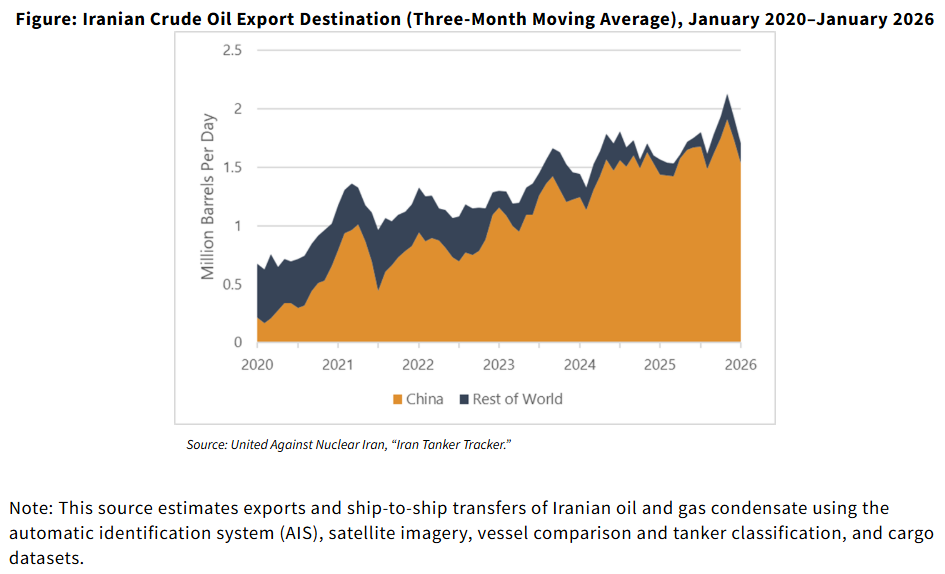
China has established itself as Iran’s largest trading partner and the dominant buyer of Iranian oil, with Chinese purchases accounting for approximately 90% of Iran’s exported oil. This relationship provides Iran with tens of billions of dollars in annual revenue that directly supports the Iranian government budget and military operations, according to the Commission report.
The economic partnership was formalized through a “comprehensive strategic partnership agreement” signed in 2021, covering economic, security, and technological cooperation over a 25-year period. The Commission identifies this relationship as part of an informal “Axis of Autocracy” that includes China, Iran, Russia, and North Korea, nations united by a shared desire to challenge U.S. global leadership and reshape the international system to favor authoritarian governance.
Systematic Sanctions Evasion
The report details how China enables Iran to circumvent international sanctions through sophisticated trade and financial networks, technology transfers, and dual-use trade arrangements. Chinese banks, front companies, and intermediary firms facilitate oil transactions and operate the shadow fleet that transports Iranian oil while providing access to controlled technologies supporting Iran’s missile and drone programs. This infrastructure includes money laundering operations that allow the entire network to function with relative impunity.
Military Technology Transfers
While China largely ceased direct weapons transfers in 2015 following UN Security Council Resolution 2231, security cooperation has shifted toward dual-use technology sales and transfers of defense-related technologies. Chinese components, including sensors, voltage converters, and semiconductors, have been discovered in Iranian drones used both by Tehran’s regional proxies and those exported to Russia for deployment in Ukraine.
Recent Escalation in Military Support
The report highlights several concerning recent developments. In the days leading up to U.S. and Israeli strikes in February 2026, anonymously sourced reports indicated China was engaged in direct arms sales to Iran, including offensive drones and a nearly finalized deal to sell anti-ship cruise missiles.
Most significantly, during the week of March 2, two state-owned Iranian vessels departed China’s Gaolan Port carrying what is believed to be sodium perchlorate, a key precursor used in solid rocket fuel for missiles. This followed a similar incident in January 2025 when two Iranian ships docked in China and were loaded with approximately 1,000 tons of sodium perchlorate. Additionally, China granted Iran full military access to its BeiDou satellite navigation system in 2021.
Calibrated Diplomatic Response
Despite the expanding partnership, the relationship remains asymmetric. Iran depends heavily on China for energy export revenue and diplomatic backing, while Beijing maintains a cautious approach to avoid jeopardizing relations with other Middle Eastern partners such as Saudi Arabia and the United Arab Emirates.
Following recent U.S. and Israeli strikes on Iran, Beijing has limited its official support to diplomatic statements characterizing the actions as violations of international law, condemning the killing of Ayatollah Ali Khamenei, and calling for immediate cessation of attacks. In a call with his Iranian counterpart, Chinese Foreign Minister Wang Yi both reiterated China’s support for Iran’s sovereignty and expressed confidence that Iran will “pay attention to the legitimate concerns of its neighbors.”
Multilateral Integration Strategy
China has helped ease Iran’s international isolation by facilitating its entrance into alternative multilateral institutions, including the Shanghai Cooperation Organization in 2023 and BRICS in 2024. Membership in these organizations brings Iran into closer alignment with China and Russia while helping Beijing’s goal of using them to promote illiberal norms and mitigate the impact of sanctions tools.
The Commission notes that China’s direct military engagements with Iran occur primarily through trilateral or multilateral activities rather than bilateral meetings. The PLA has participated in regular joint naval exercises with Iran and Russia since 2019, though China apparently did not join the 2026 iteration.
Strategic Implications
The Commission states this partnership emboldens each actor to take more provocative actions, believing that mutual support will help them withstand the consequences. China views the Islamic Republic of Iran as a partner in balancing U.S. influence in the Middle East while serving as a key supplier of discounted energy resources, a relationship that runs directly counter to U.S. foreign policy and national security interests.