


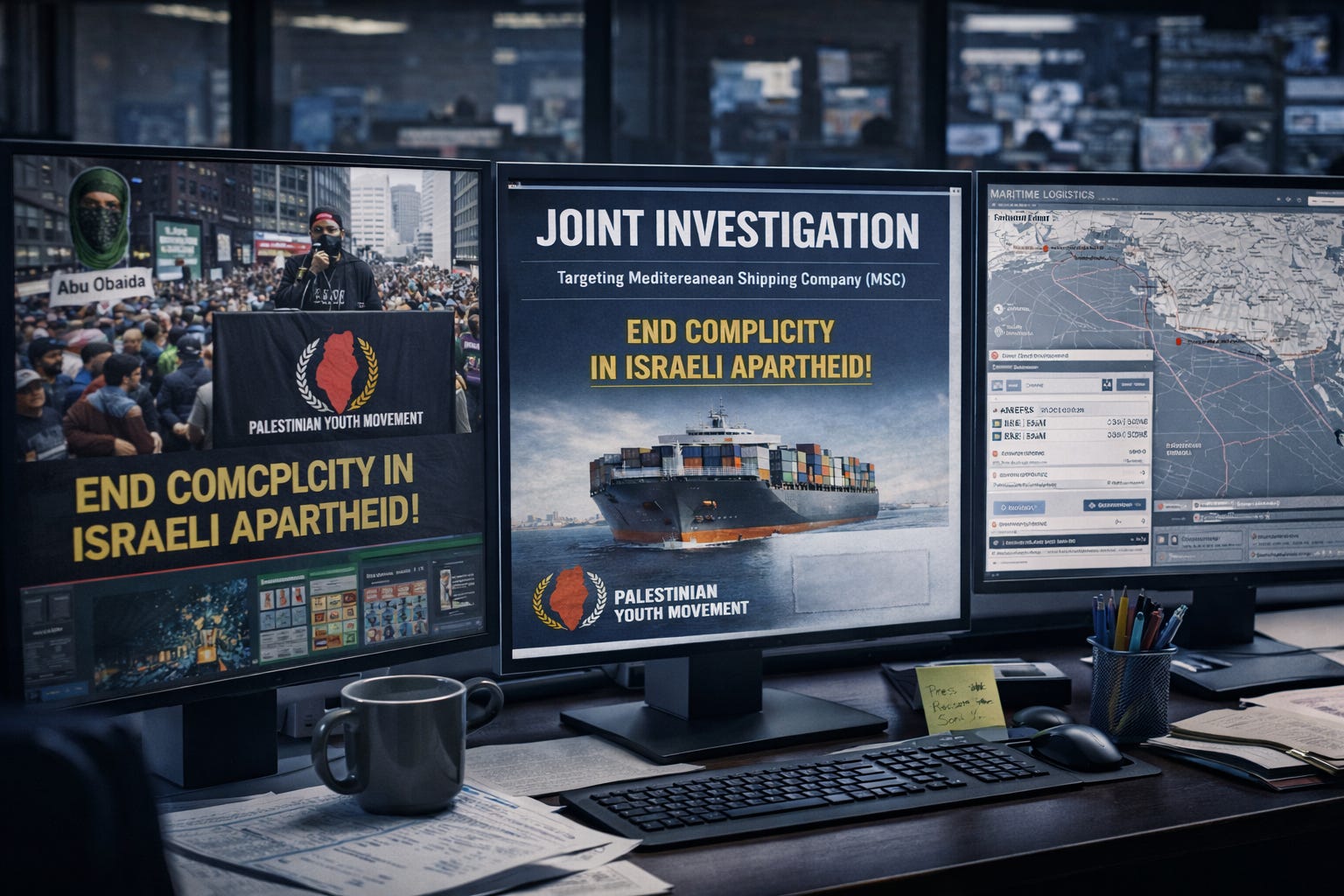
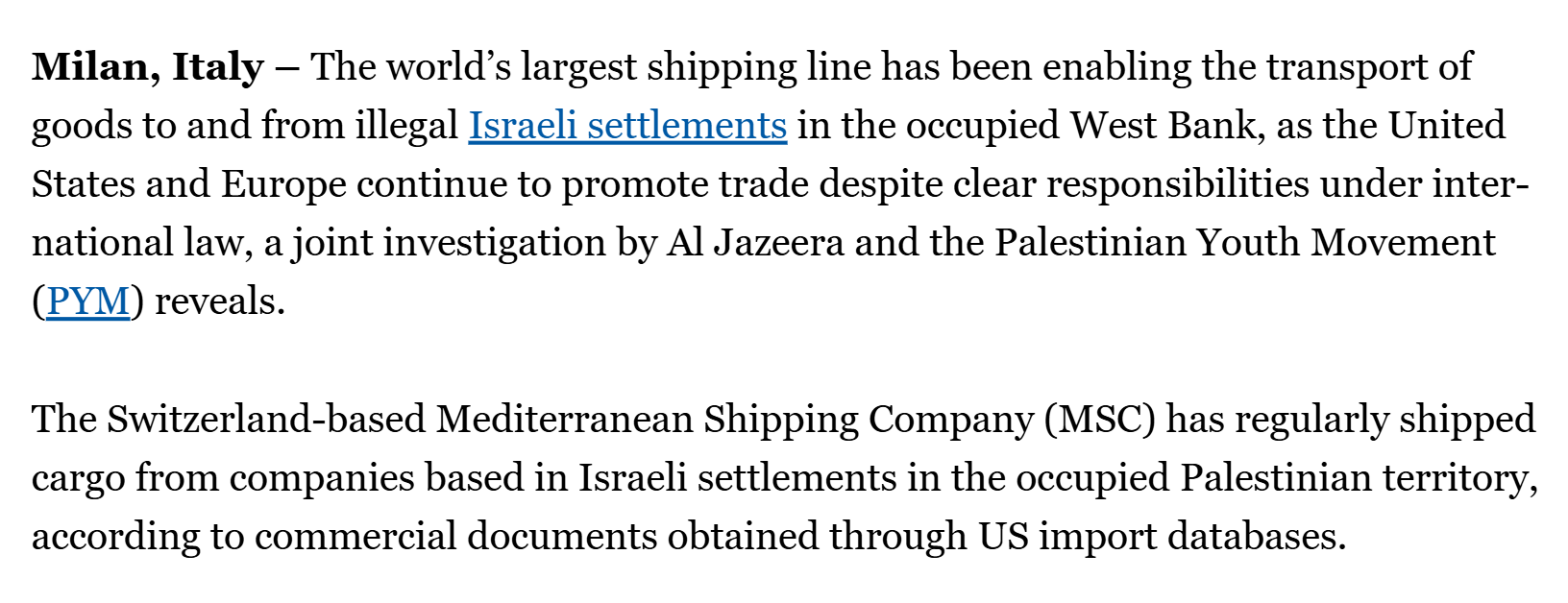
A new 26-page joint investigation published by Al Jazeera and Palestinian Youth Movement (PYM) targets the Mediterranean Shipping Company (MSC) and demands that the carrier “immediately cease all transport of goods” linked to Israeli settlements in the West Bank, arguing that failure to do so “may constitute a violation of international humanitarian law.”
MSC rejected the premise of the report, stating that it respects “global legal frameworks and regulations wherever it operates,” and that this applies to “all shipments to and from Israel.”
Yet the more consequential story is not the shipping data itself. It is the alignment behind the project and the way it is being packaged and amplified.
Although PYM has portrayed the work as its own, Al Jazeera characterizes it as a joint investigation and identifies itself as a producing partner. For a media outlet, that level of partnership is notable because it can blur the distinction between independent reporting and advocacy, and it may frame a targeted corporate pressure effort as journalism.
In standard reporting, a newsroom can use an advocacy group’s research while independently verifying documents, controlling the framing, and adding balancing context. Here, it’s marketed as co-produced—implying shared ownership of the target, the framing, and the intended result.
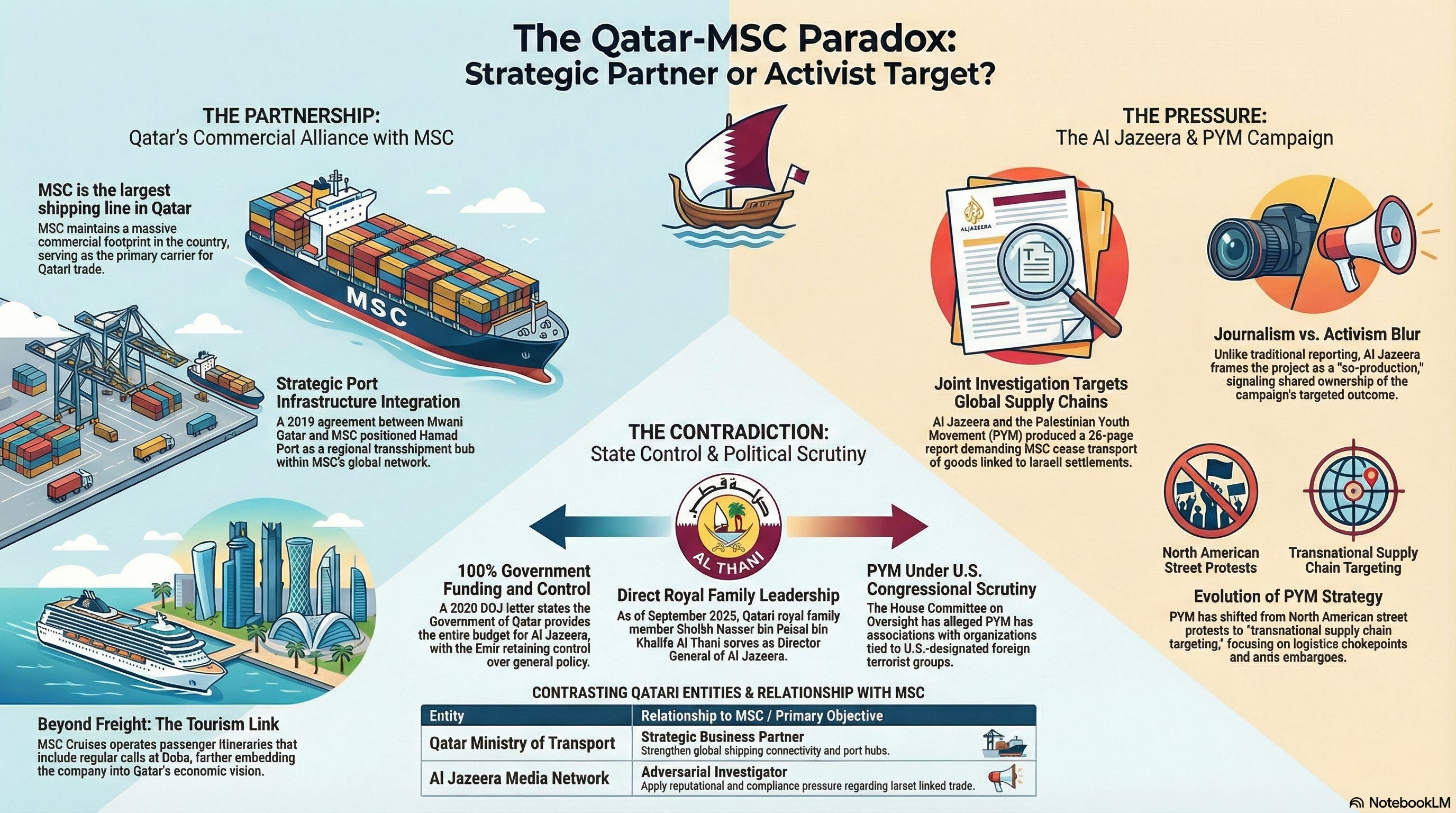
That makes MSC’s ties to Qatar especially relevant. Qatar’s state ecosystem has promoted MSC as a logistics partner, even as a state-run Qatari media network joins a campaign targeting the company.
Political Scrutiny Surrounding Palestinian Youth Movement (PYM)
The choice of PYM as a co-producer draws attention because the group itself has become the subject of scrutiny in Washington.
In June 2025, the House Committee on Oversight and Government Reform sent a letter to Attorney General Pam Bondi listing PYM among organizations associated with a protest coalition and alleging that “some of these groups have ties” to U.S. designated foreign terrorist organizations.
Separately, Tom Cotton urged the FBI to investigate statements by a PYM figure that he characterized as incitement against U.S. military assets.
Critics argue that PYM’s statements and programming reflect a pattern of rhetoric that celebrates political violence. For example, after the Hamas-led October 7 attacks, PYM defended a New York protest held in support of the massacre, saying organizers “defend their fundamental right to resist an illegal occupation, break out of their concentration camp, and defy the cruelty of the sixteen year Zionist blockade.”
Critics also points to PYM’s decision to launch an annual student scholarship named for the late PFLP leader Ghassan Kanafani, and to its hosting of PFLP member Wisam Rafeedie at PYM conferences.
For years, PYM focused solely on organizing demonstrations, rallies, and campus actions in North America. Over the past year and a half, however, PYM has increasingly shifted into transnational supply chain targeting, launching “Mask Off Maersk” in May 2024 as an international arms embargo campaign to “disrupt the flow of weapons” to Israel.
The quick shift from domestic protest politics to coordinated, multinational campaigns targeting chokepoints in global logistics has prompted observers to ask how these efforts are being funded and managed. Strategies like this typically require cross-border partnerships, specialized data work, and sustained operational support that goes well beyond traditional street-level organizing.
DOJ Findings on Al Jazeera and Qatar
The collaboration has also revived longstanding questions about Al Jazeera’s relationship with the Qatari state.
In a September 14, 2020 letter, the U.S. Department of Justice wrote that the Government of Qatar “provides the entire funding” for Al Jazeera Media Network, and that the board of the network is appointed by the Emir, with the Emir retaining control over budget and general policy. The DOJ letter adds that “Despite assertions of editorial independence,” Al Jazeera Media Network and affiliates, “are controlled and funded by the Government of Qatar.”
Additionally, as of September 2025, Qatari royal family member Sheikh Nasser bin Faisal bin Khalifa Al Thani serves as the Director General of Al Jazeera Media Network. According to the Jerusalem Post, “This is the first time a member of the royal family has assumed the top executive role at Al Jazeera.”
Qatar’s Betrayal of MSC?
The political optics sharpen further when placed alongside Qatar’s public promotion of MSC’s role in its port infrastructure. On its own website, MSC writes that it is “the largest shipping line in Qatar.”
In 2019, the Qatar Ministry of Transport announced a container services agreement between Mwani Qatar and MSC, positioning Hamad Port as a regional transshipment hub connected to MSC’s global network.
In 2025, the Qatar News Agency reported the launch of a new shipping service tied to the arrival of an MSC vessel, presenting the development as part of Qatar’s broader effort to strengthen its global shipping connectivity.
In addition to its container shipping operations, MSC Cruises also operates passenger cruise itineraries that include calls at Doha, further underscoring the company’s commercial footprint in Qatar beyond freight logistics.
Taken together, the investigation highlights an unusual juxtaposition: Qatar has publicly promoted MSC as a strategic shipping and logistics partner, even as Qatari state-run media co-produces an investigation that applies pressure on the same company over its commerce linked to Israel.