



According to reporting by the Washington Free Beacon, Qatar has engaged two Washington, D.C.-based crisis management firms to reshape public perception of its influence over American higher education following intense congressional scrutiny. The Qatar Foundation, the regime’s primary vehicle for advancing influence through U.S. universities, retained Washington Media Group for $40,000 monthly and the law firm Venable for $25,000 monthly to provide “strategic communications support” and manage what officials characterize as “public misconceptions” about their academic partnerships, according to federal foreign agent filings dated March 30 and March 31, 2026.
The hiring represents a coordinated damage-control operation following a House Committee on Education and Workforce report that exposed Qatar’s direct involvement in suppressing campus criticism of Hamas following the October 7, 2023 attack. The report, titled “How Campuses Became Hotbeds: The Rise of Radical Antisemitism on College Campuses,” revealed internal communications in which Qatar Foundation officials demanded that American universities operating in Doha remain “aligned and in touch” regarding official statements about the attack.


Coordinated Suppression of Institutional Responses
Documents reviewed by the House Committee demonstrated systematic coordination between Qatar Foundation leadership and university administrators to control campus messaging. On October 17, 2023—ten days after Hamas’s attack—Qatar Foundation President of Higher Education Francisco Marmolejo requested “information sharing and no surprises” during a call with university representatives.
Northwestern University’s Doha campus dean, Marwan Michael Kraidy, refused to sign Northwestern’s corporate statement criticizing Hamas, and the campus “intentionally chose not to circulate” the university’s October 13 statement condemning the attack as “abhorrent and horrific.”
Northwestern’s Doha campus operates under a contract that explicitly prohibits students and faculty from criticizing the Qatari regime, limiting institutional autonomy and free expression protections typically associated with American academic institutions.
Scope of Qatari Financial Influence
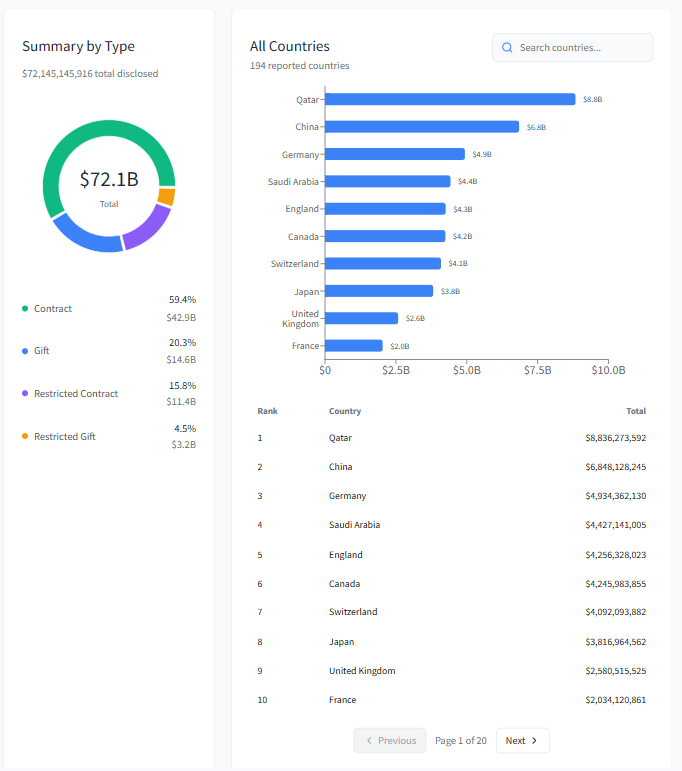
Qatar has become the dominant foreign funder of American higher education. According to Department of Education disclosures, Qatar provided $396 million to U.S. colleges and universities in 2024 and $1.2 billion in 2025—a tripling of annual investment that coincided with expanded satellite campus operations. Major universities with Education City campuses in Doha include Northwestern University, Georgetown University, Cornell University, and Carnegie Mellon University, with Qatar having channeled approximately $62.4 billion in aggregate funding to American higher education since 1986.
The Firms Behind the Message Pivot
Washington Media Group’s contract specifies its role is to “enhance public understanding” of Qatar Foundation partnerships and “promote transparency, address public misconceptions, and support informed dialogue regarding the structure, history, and impact of these partnerships.”


The firm’s CEO and registered agent, Crystal Patterson, has an extensive background in Democratic political communications, including roles with Hillary Clinton, former Sen. Edward Kennedy, and former Rep. Tim Ryan, as well as previous work at the left-wing Center for American Progress. Patterson is also a Northwestern University graduate—making her a product of the same institution whose Doha campus has restricted faculty speech about the Qatari government.
Venable’s contract with Qatar Foundation centers on government relations and ensuring “members of Congress and the administration have an accurate understanding of Qatar Foundation’s support for education.” Venable’s representative, Ronald Jacob, specializes in crisis management involving “government investigations, litigation, and media exposure,” according to his firm biography.
Neither firm responded to requests for comment regarding their engagement.
Media Operations and CNN Partnership
Qatar’s influence operations extend beyond education into American media infrastructure. CNN announced an expansion to Qatar in February 2025, establishing an office in Media City Qatar, with the regime providing “facilities and technical support” including “purpose-built studio with custom workspaces” at no apparent cost to the network. The Qatar Foundation in December 2023 retained Monika Plocienniczak, a veteran CNN producer with five years at the network, through the firm RF Binder, paying at least $460,000 since that engagement began.