


Jewish Onliner is an independent publication. If you find our work valuable, please consider becoming a paid subscriber. You can also subscribe to us on WhatsApp and Telegram. Follow us on Instagram, Discord, and X.
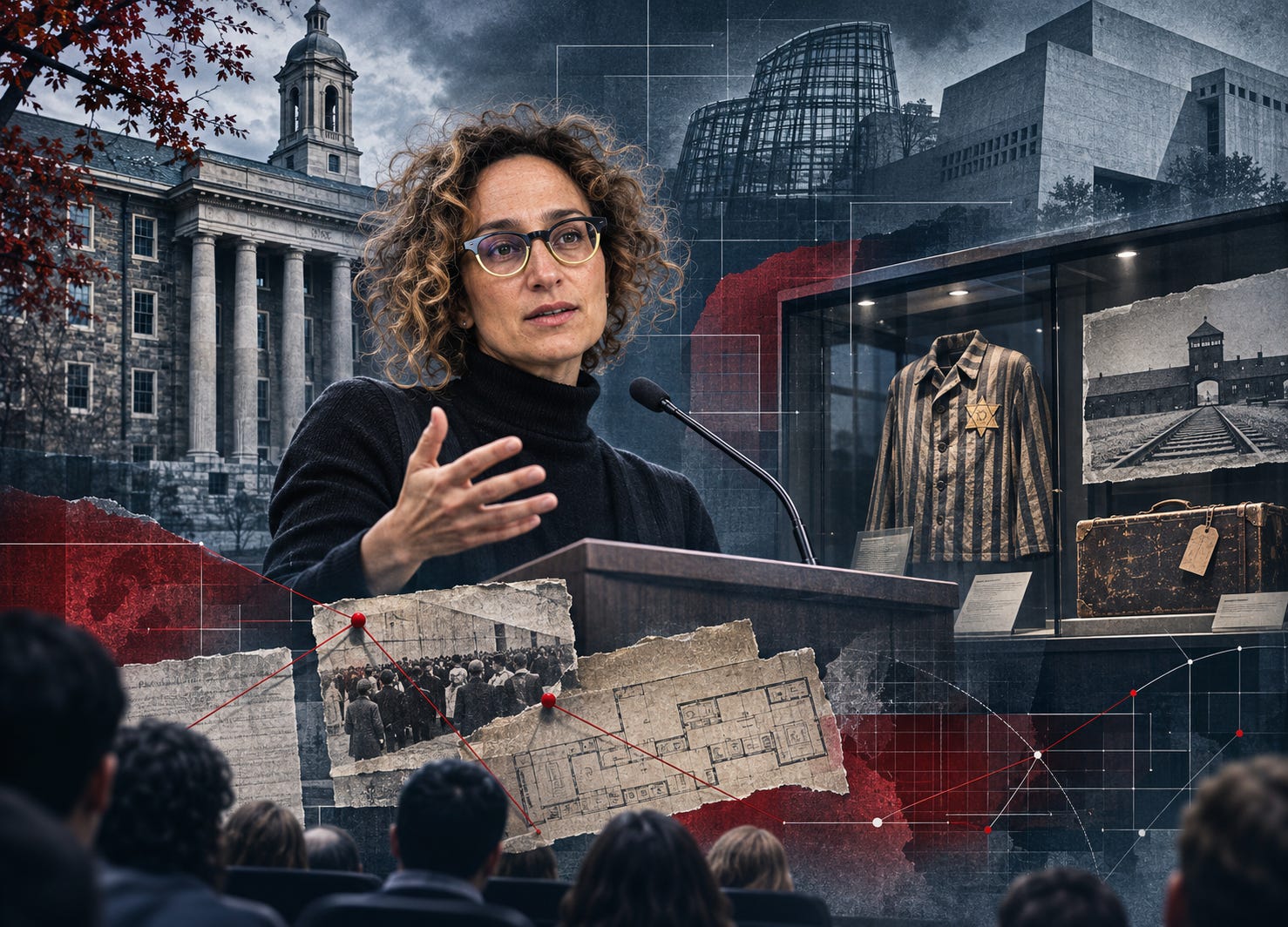
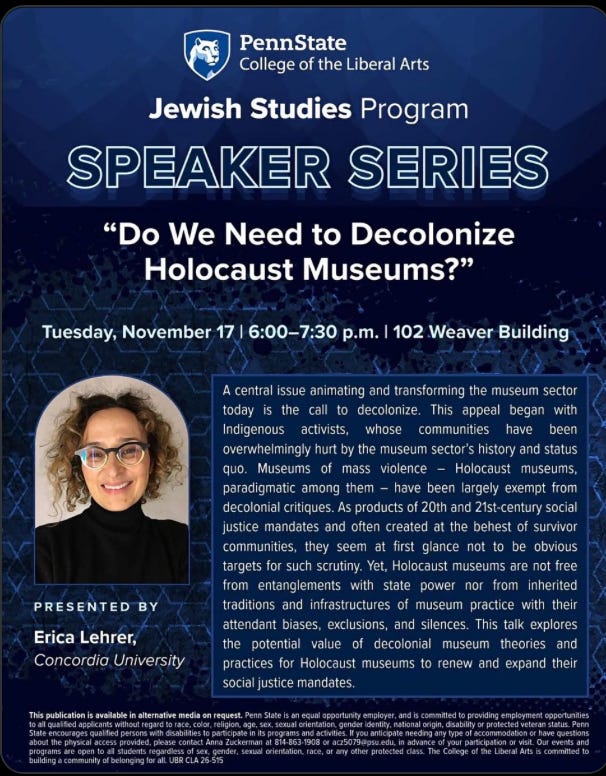
Pennsylvania State University’s Jewish Studies Program hosted a lecture Tuesday questioning whether Holocaust museums should be “decolonized,” featuring a Canadian professor whose research seeks to apply theories of colonial oppression and institutional violence to museums established to preserve the memory of the Nazi genocide of six million Jews.
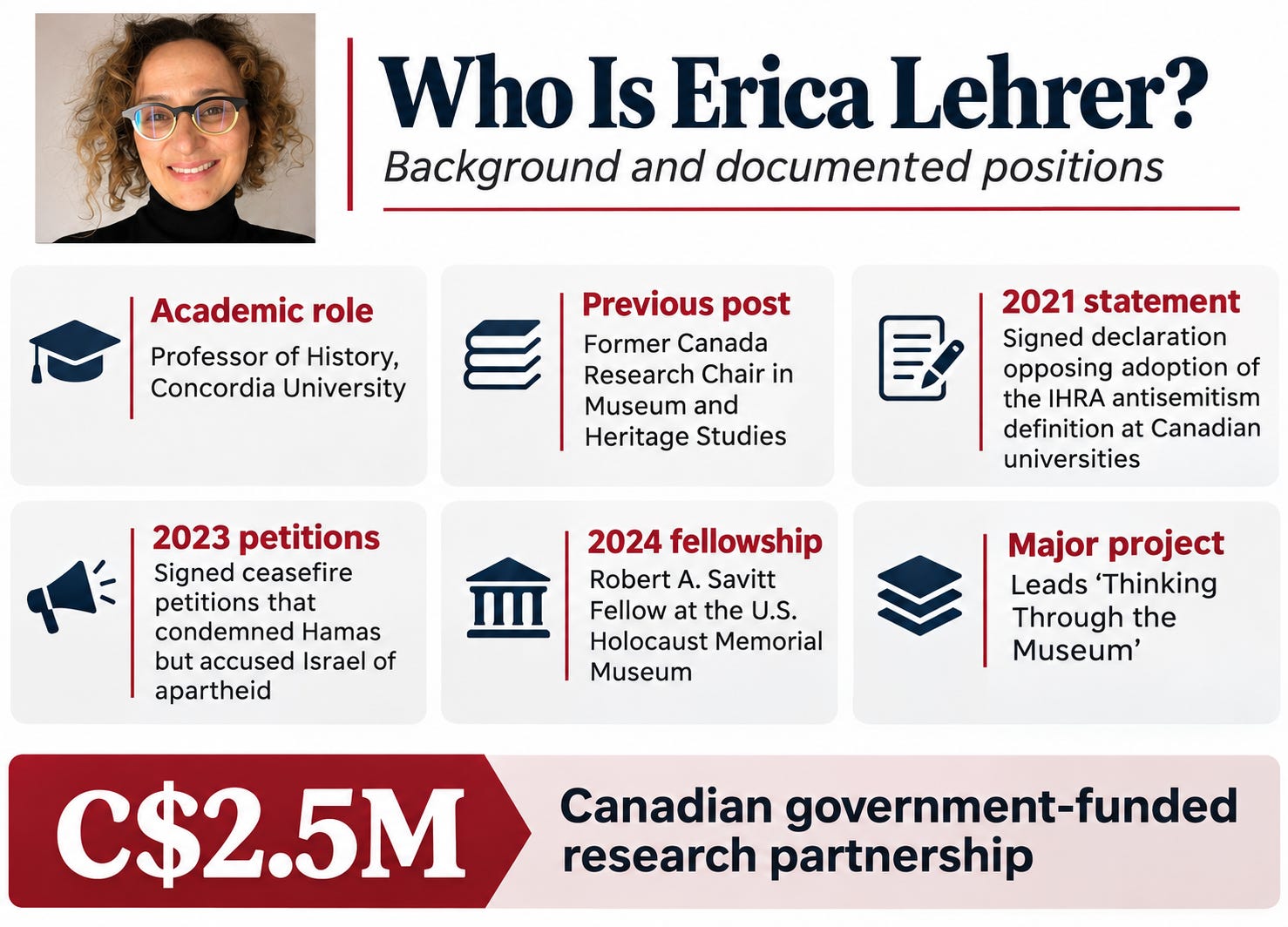
The November 17 event, titled “Do We Need to Decolonize Holocaust Museums?,” featured Erica Lehrer, a history professor at Concordia University in Montreal and former Canada Research Chair in Museum and Heritage Studies. The event description published by Penn State stated that Holocaust museums have been “largely exempt from decolonial critiques,” arguing that they remain entangled with state power and inherited museum practices carrying biases, exclusions, and silences.
The premise places institutions dedicated to documenting Nazi atrocities under scrutiny through academic frameworks traditionally used to examine colonialism, systemic oppression, and unequal power structures. Rather than focusing solely on how Holocaust history is preserved and presented, the approach questions whether the institutions responsible for its remembrance might themselves perpetuate forms of domination or exclusion.
An examination of Lehrer’s academic work reveals that the Penn State lecture was part of a broader effort to rethink how Holocaust museums operate, interpret history, and fulfill their public missions. Her research has explicitly identified major Holocaust institutions for decolonial examination. Separately, she directs a multimillion-dollar, Canadian government-funded research partnership seeking to transform museum practices.
Scholar Raised Possibility of ‘Museums as Mass Violence’
In a conference abstract published for the June 2024 Travels Beyond the Holocaust conference in Vienna, Lehrer proposed examining whether museums established to commemorate genocide and historical atrocities could themselves reproduce structures associated with Western colonialism and imperialism. The conference was organized by institutions including the Austrian Academy of Sciences and the Vienna Wiesenthal Institute for Holocaust Studies.
Her abstract, titled “Do We Need to Decolonize Atrocity Museums?,” extended decolonial criticism to institutions whose central purpose is documenting historical persecution and mass murder. Lehrer argued that museum structures, collections, classification systems, and approaches to displaying objects carry enduring colonial legacies, describing such influences as “embedded in their very bones.”
Most provocatively, Lehrer suggested considering not only museums commemorating mass violence but the formulation “museums as mass violence.” The argument raises the possibility that institutions established to preserve the memory of genocide could themselves perpetuate forms of institutional harm through their methods of collecting, classifying, and presenting historical material.
This represents a significant expansion of the framework through which Holocaust museums are examined. Under such an approach, the institutions are not assessed solely on the accuracy and completeness of their historical accounts, but also through theories concerning structural oppression, colonial inheritances, and the distribution of institutional power.
Her abstract specifically identified the United States Holocaust Memorial Museum in Washington, D.C., the Toronto Holocaust Museum, and the Canadian Museum for Human Rights in Winnipeg as institutions from which she intended to draw examples. The proposed areas of investigation included the representation of violence, repatriation of collections, and treatment of human remains, although the abstract did not identify specific misconduct at the three museums.
The argument subsequently became part of Lehrer’s published academic work. In 2025, Routledge published her afterword, “Do We Need to Decolonize Museums of Mass Violence?,” in the volume Museums and Mass Violence, on pages 249–258.
Lehrer Signed Statement Opposing Campus Adoption of IHRA Definition
Lehrer’s efforts to bring decolonial scrutiny to Holocaust institutions also intersect with her publicly documented positions on Israel and antisemitism. In May 2021, she signed a Jewish Faculty Network declaration opposing the adoption of the International Holocaust Remembrance Alliance (IHRA) Working Definition of Antisemitism at Canadian universities.
The declaration argued that the definition could be used to suppress criticism of Israel and activism supporting Palestinian causes. It also defended the Boycott, Divestment and Sanctions (BDS) movement as a legitimate form of nonviolent protest.
Lehrer subsequently signed two Academics for Peace petitions in October and December 2023 that demanded a ceasefire in Gaza and accused Israel of imposing apartheid on Palestinians. Notably, two Penn State professors, Lior Sternfeld and Tamir Sorek, were listed among the authors of the December statement that Lehrer signed.
These positions provide additional context for Lehrer’s academic activities, particularly as her museum research seeks to incorporate frameworks concerned with colonialism, oppression, and political power into institutions responsible for Holocaust remembrance.
Leads $2.5 Million Government-Funded Museum Network
Beyond her public lectures and academic publications, Lehrer directs a substantial international research initiative financed by Canadian taxpayers. In July 2021, Concordia University announced that she had received a seven-year grant worth approximately C$2.5 million from the Social Sciences and Humanities Research Council of Canada (SSHRC).
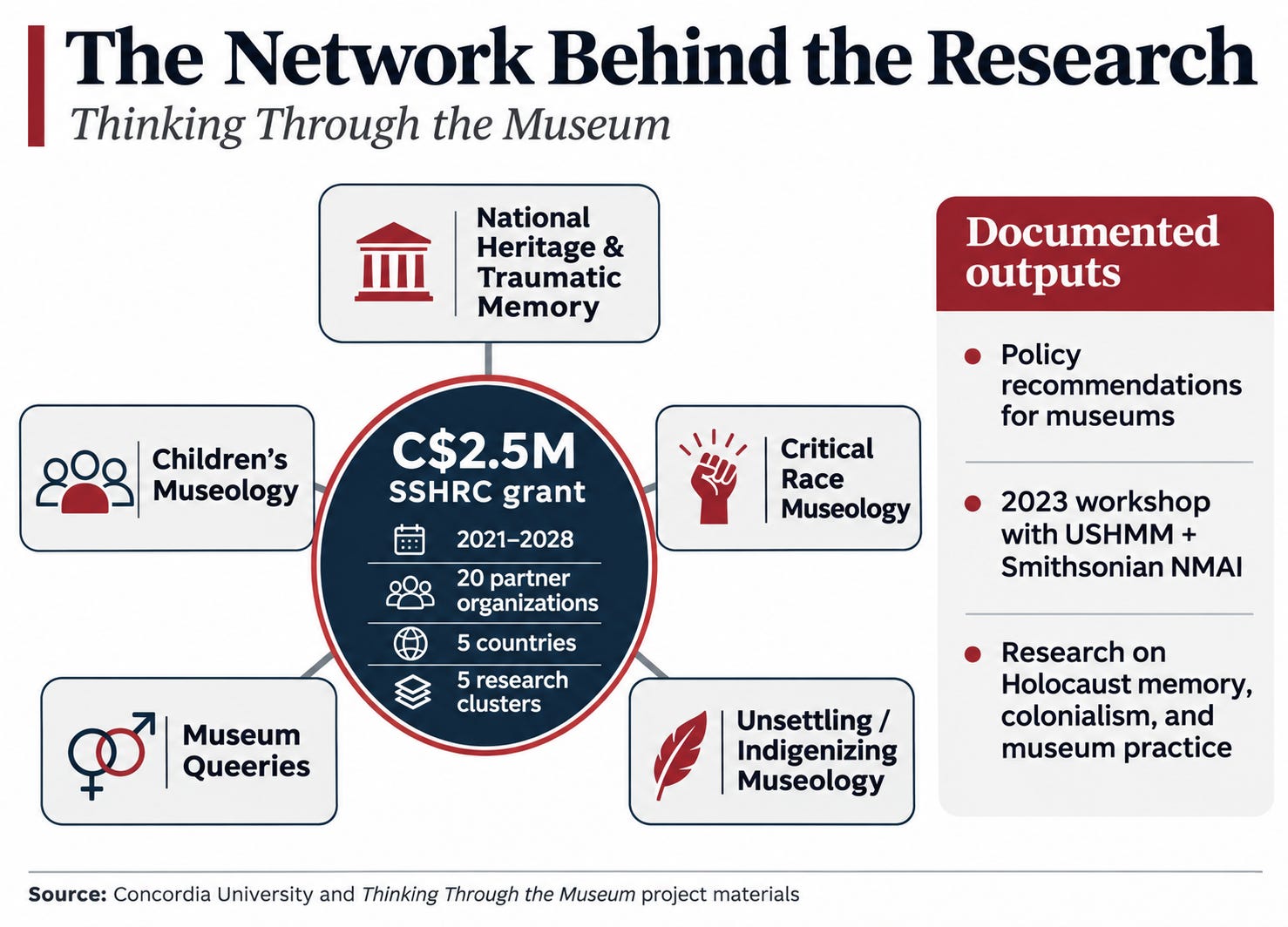
The project, Thinking Through the Museum: A Partnership Approach to Curating Difficult Knowledge in Public, brings together researchers, museum professionals, and community representatives from 20 partner organizations across five countries. Its stated objectives extend beyond academic criticism to changing museum practices, addressing institutional inequalities, and rethinking governance and representation.
In the university’s funding announcement, Lehrer framed museums as institutions capable of “accelerating progressive social change.” That stated ambition is significant in the context of her Holocaust-museum research, which questions whether existing approaches to remembrance adequately address the colonial and institutional power structures emphasized by decolonial theory.
The project’s research structure includes work on colonialism, racial representation, Indigenous museum practices, and traumatic historical memory. Among its initiatives, the National Heritage and Traumatic Memory research cluster examines intersections between Holocaust remembrance, colonialism, and communism, primarily in Poland.
Another project, Decolonial Museology Recentered, is co-led by Lehrer and University of Warsaw academic Joanna Wawrzyniak. Its objectives include developing practical tools and policy recommendations for discussion with museum and cultural-sector leaders.
A Broader Effort to Reframe Holocaust Remembrance
The Penn State lecture represents another documented appearance of a sustained effort to apply decolonial frameworks to Holocaust museums, extending from Lehrer’s academic publications to university presentations and a multimillion-dollar research partnership engaged in changing museum practices.
At the center of that effort is a consequential shift in perspective. Institutions established to commemorate the systematic extermination of European Jewry are being examined not only as guardians of historical memory, but as potential sites of institutional inequality and inherited colonial power.
Penn State’s decision to host a lecture explicitly questioning whether Holocaust museums need to be “decolonized” demonstrates how these ideas are being introduced into university Jewish Studies programming, while Lehrer’s wider research network seeks to translate related theories into institutional practices and museum policy.
There is no surprise this was allowed at Penn State. Their response to 10/7 concerns from parents was abysmal. They allowed Students for Justice in Palestine to be reinstated as a student club in December 2023. Penn State was also 4th or 5th on the list of US public universities who accepted millions from Qatar a few years ago. Their only saving grace (for their students who did not go to Penn State to support Hamas) was their geographic location in the middle of no where without easy access to public transportation, which kept campus demonstrations small and to a minimum.
The lunatics with their DEI and oppressor vs oppressive rubbish have taken over academia which Qatar pours billions into. This could have been a Monty Python sketch. It’s so absurd that it beggars belief.