

Jewish Onliner is an independent publication. If you find our work valuable, please consider becoming a paid subscriber.
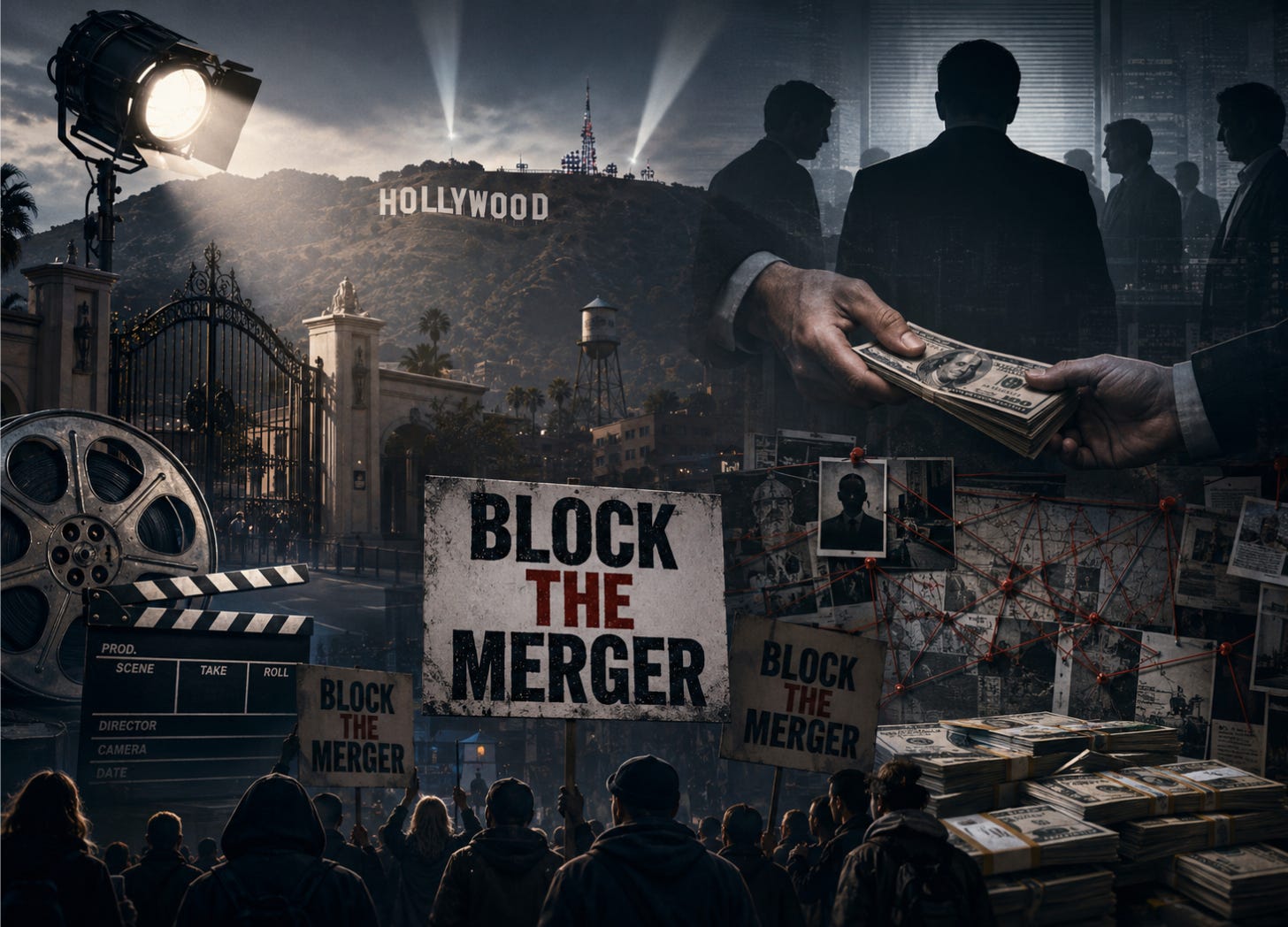
The “Block the Merger” campaign publicly framed its opposition to Paramount Skydance’s planned $110 billion acquisition of Warner Bros. Discovery as a fight over media consolidation, labor protections, creative independence and consumer choice. The Justice Department cleared the transaction on June 12, 2026, removing the deal’s biggest federal antitrust hurdle, though FCC review and possible state litigation remained unresolved.
But the campaign also drew participation from a wider progressive advocacy ecosystem. While the official effort focused on antitrust and Hollywood consolidation, some supporters and adjacent groups connected the merger fight to broader nonprofit and ideological networks, including organizations and funders that have also been active in anti-Israel advocacy or are now under congressional scrutiny.


The Ellison Factor
Larry Ellison, Oracle’s founder and the father of Paramount Skydance CEO David Ellison, is also a prominent pro-Israel donor. His Israel ties became central to CODEPINK’s anti-merger messaging, which used the campaign moment to attack the Ellison family directly.
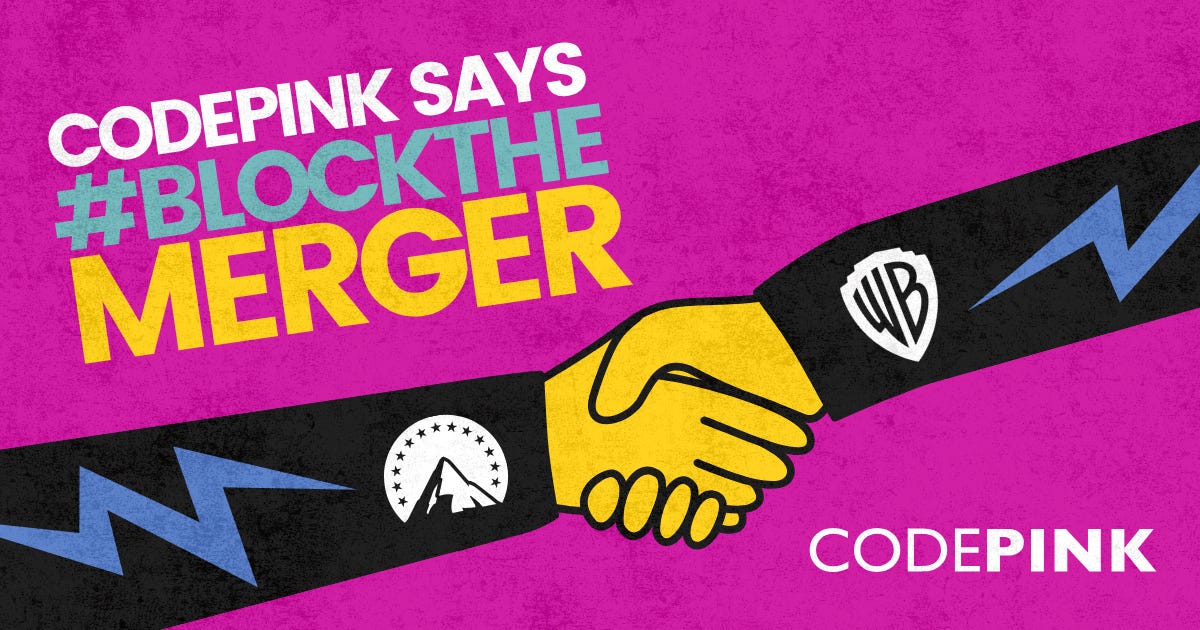
CODEPINK circulated a petition to California Attorney General Rob Bonta urging him to block the Paramount-Warner Bros. Discovery merger. The petition did not limit itself to antitrust concerns.
CODEPINK framed the deal as a transfer of media power to “Trump-aligned tech billionaires” and singled out Ellison’s support for Israel as a reason the transaction should be stopped. CODEPINK’s intervention illustrated the ideological current running alongside the public antitrust campaign.
Disney acquired Fox for $71.3 billion. Amazon bought MGM. Microsoft purchased Activision Blizzard for $68.7 billion. Unlike those earlier deals, the Paramount-WBD fight also became a vehicle for attacks on the Ellison family’s politics and Israel ties, most explicitly in CODEPINK’s petition.
The Public Campaign
The official “Block the Merger” campaign is led by the Future Film Coalition, which describes the effort as a campaign to protect independent film, local cinemas and public-interest storytelling. Its website lists more than 230 allies and more than 30 organizations opposing the Paramount-Warner Bros. Discovery deal.
The anti-merger campaign’s policy infrastructure included several major progressive organizations: Free Press, Open Markets Institute, American Economic Liberties Project and Democracy Defenders Fund.
These groups publicly framed the merger fight through the language of competition policy, media consolidation, press freedom and democratic accountability. They helped turn a corporate transaction into a broader public-pressure campaign aimed at regulators, state attorneys general and lawmakers.
Democracy Defenders Fund played a visible role. In April 2026, the group promoted the open letter from entertainment figures opposing the merger and quoted co-founder Norm Eisen warning that the deal would “erode the very bedrock of our democracy.” Two months later, House Oversight Chairman James Comer sent Eisen a letter demanding records from State Democracy Defenders Fund.


Soros, Arabella and the Anti-Israel Funding Trail
The anti-merger network sits inside a broader progressive nonprofit ecosystem funded by major institutional donors. Several of those donors have also financed organizations active in anti-Israel advocacy.
That donor ecosystem includes George Soros’s Open Society network, Pierre Omidyar-linked funding, the Ford Foundation, the Knight Foundation, the Hewlett Foundation and Arabella Advisors-linked vehicles such as the Sixteen Thirty Fund and New Venture Fund.
Open Society Foundations, founded by George Soros, said it gave $14.3 million in 2023 to groups working on Israel and Palestine, excluding an additional $3.3 million emergency fund. Its own statement said many of its partners were at the forefront of pushing for a ceasefire in Gaza.
Among the organizations OSF has supported is Al-Haq, a West Bank-based NGO that Israel designated as a terrorist organization in 2021 over alleged ties to the U.S.-designated terror group, the Popular Front for the Liberation of Palestine (PFLP). On September 4, 2025, the U.S. Treasury’s Office of Foreign Assets Control added Al-Haq to the Specially Designated Nationals list under an International Criminal Court-related sanctions authority.


OSF separately gave $225,000 to Jewish Voice for Peace, which organized pro-Palestinian campus encampments across the country.
The Arabella-managed New Venture Fund also funded the Alliance for Global Justice, which served as fiscal sponsor for Samidoun. Reporting on tax filings shows New Venture Fund gave AFGJ $501,500 in 2022 for ‘environmental programs.’ New Venture Fund later said it would discontinue grants to projects hosted by AFGJ and said it does not support terrorism.
In October 2024, the U.S. Treasury Department designated Samidoun as a “sham charity” and international fundraiser for the Popular Front for the Liberation of Palestine, a U.S.-designated Foreign Terrorist Organization.
According to Washington Examiner reporting, PayPal, Stripe, Salsa Labs and Deluxe stopped working with AFGJ in 2023, after scrutiny over AFGJ’s fiscal sponsorship of Samidoun.

What the Campaign Revealed
The Paramount-Warner Bros. Discovery deal raised real questions about consolidation in Hollywood. But the campaign against it also showed how public-interest antitrust advocacy can overlap with donor networks, ideological pressure groups and activist campaigns that bring their own political agendas into major media transactions.
Unfortunately, Larry Ellison, who defends the national interests of the United States and Israel, is an exception among Jewish leaders in the hi-tech industry.
Other Jewish leaders in this field, including Sam Altman, Sergey Brin, and Mark Zuckerberger, support the anti-American and anti-Semitic Democratic Party.
Along with them, 75% of American Jews support the Democratic Party.