


Jewish Onliner is an independent publication. If you find our work valuable, please consider becoming a paid subscriber. You can also subscribe to us on WhatsApp and Telegram. Follow us on Instagram, Discord, and X.

A Palestinian research organization with a documented history of foreign-backed strategic research has unveiled a multi-year initiative aimed at weakening Christian support for Israel by studying, monitoring and influencing the religious networks that sustain it.
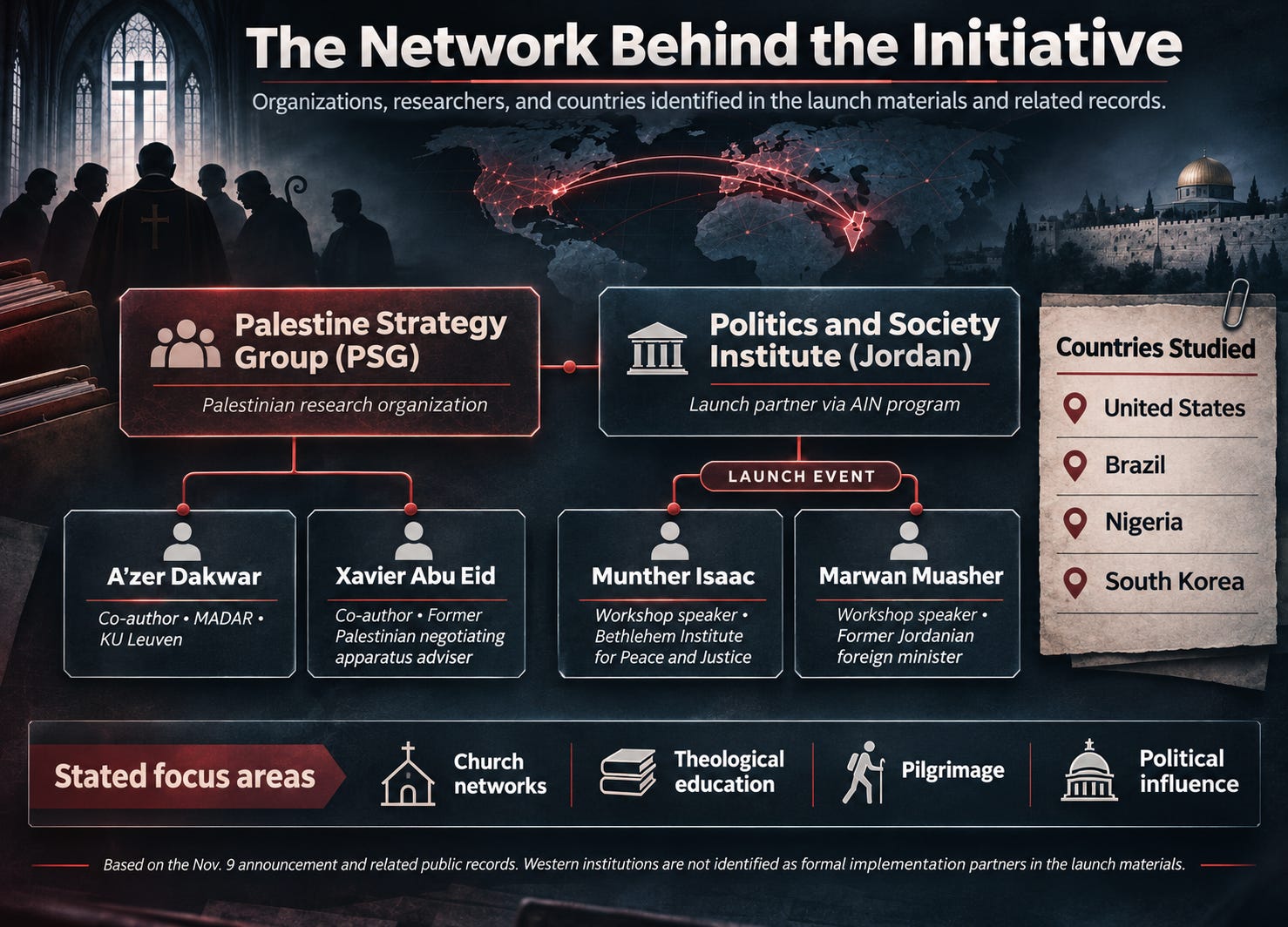
The Palestine Strategy Group launched the initiative on November 9 in Amman, Jordan, during a workshop held in partnership with the Politics and Society Institute, a Jordanian think tank whose annual report shows it previously received USAID-backed institutional support. The new study, titled Toward a Palestinian Strategy to Confront Christian Zionism, follows two years of research into the religious, political and financial structures behind Christian Zionist advocacy, with the United States identified as the leading case study.
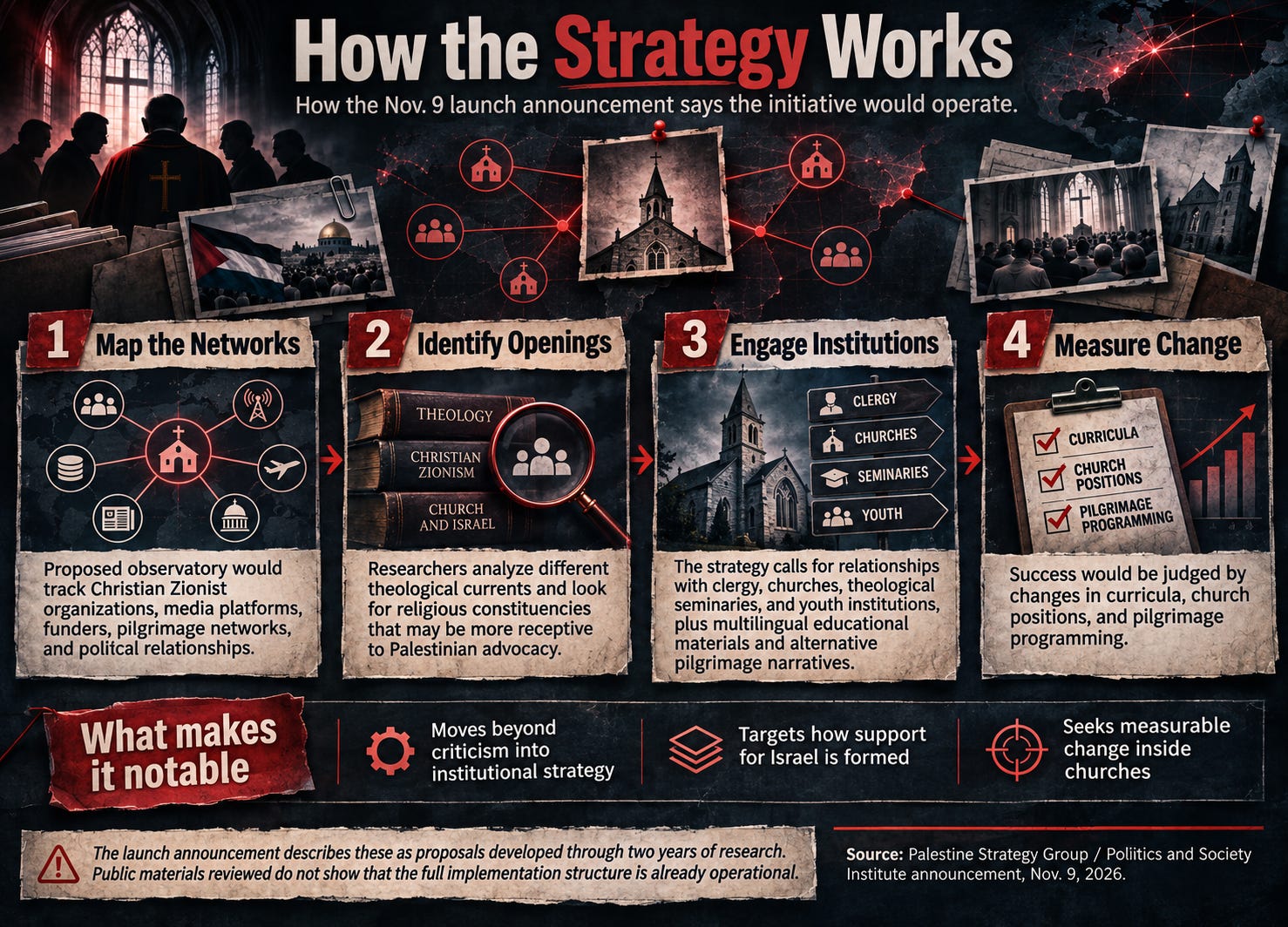
According to the launch announcement, the strategy goes far beyond criticizing Christian Zionism. It proposes an organized effort to map pro-Israel Christian networks, track their donors and media ecosystems, cultivate relationships with churches and clergy, influence theological education, reshape pilgrimage narratives and measure whether church institutions begin changing their positions on Israel and Palestinian issues.
Strategy Calls for Monitoring Christian Zionist Networks and Reshaping Church Teachings
The project is not merely descriptive. It is designed to identify how Christian support for Israel is built, and then develop ways to strategically weaken and redirect it.
The organizers describe Christian Zionism as a movement with major real-world political consequences, arguing that theological ideas about Israel can translate into lobbying, electoral mobilization, foreign policy pressure and support for Israeli claims over Jerusalem and the biblical heartland. The study identifies three major currents within Christian Zionism, including apocalyptic interpretations tied to end-times prophecy, teachings linking support for Israel to divine blessing, and covenantal approaches emphasizing the continuing biblical relationship between God and the Jewish people.
The strategy’s practical recommendations are especially notable. Among them is a proposed observatory that would monitor Christian Zionist organizations, media platforms, funders, pilgrimage networks and their relationships with political actors. The announcement also calls for building a theological and intellectual platform led by Palestinian and Arab Christians, producing multilingual educational materials, and fostering sustained ties with churches, seminaries and youth institutions.
Another component proposes alternative pilgrimage routes centered on Palestinian Christian communities and narratives, rather than the more familiar Christian tourism circuits centered primarily on biblical and Israeli state narratives. The strategy’s success, according to the organizers, would be measured by changes in church teachings, theological curricula, pilgrimage programming and the institutional positions adopted by churches.
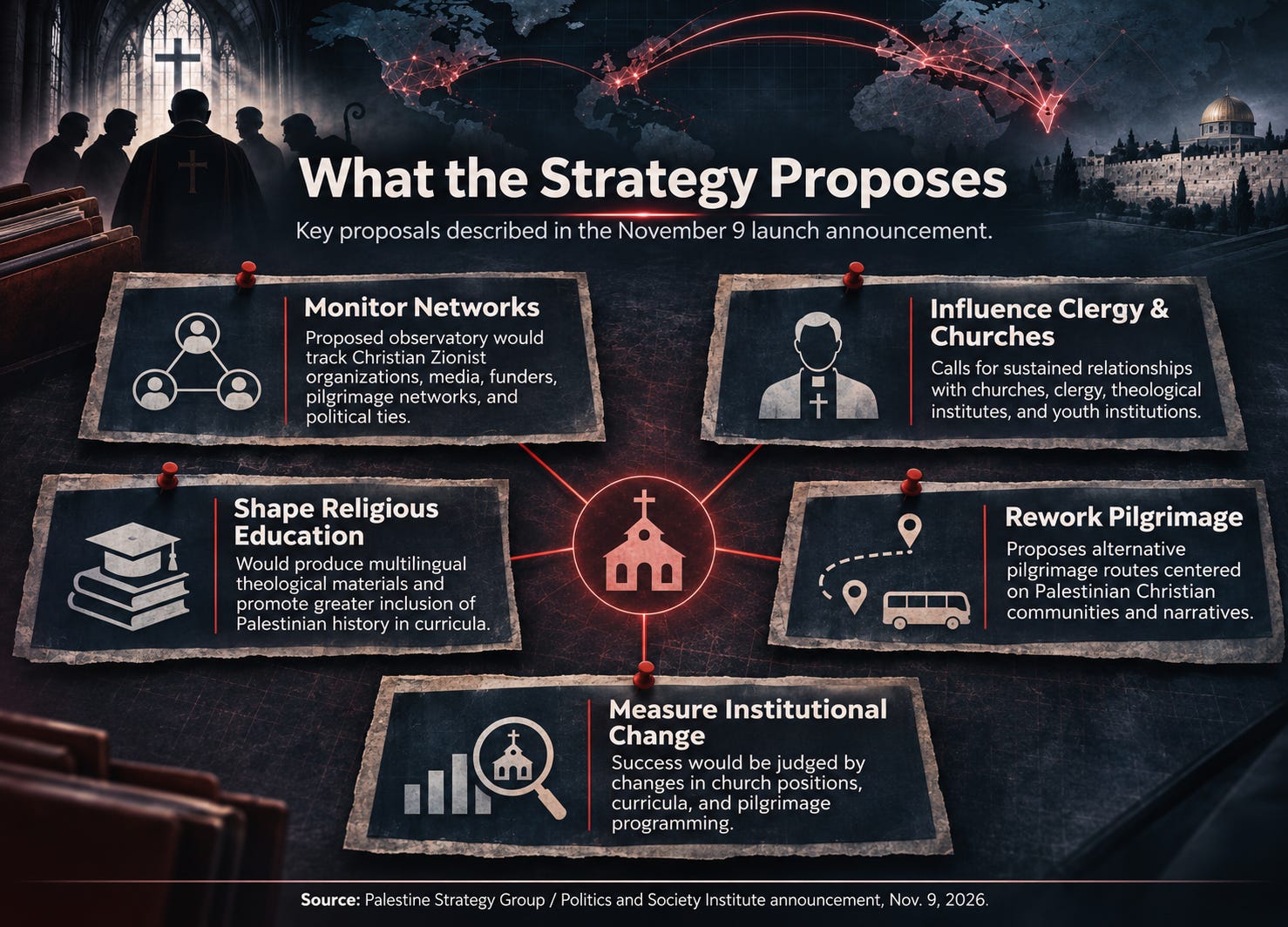
Those benchmarks are significant. They show that the initiative is not simply about publishing papers or convening conferences. It seeks concrete change inside Western Christian institutions.
Earlier Norwegian-Funded Strategy Targeted American Churches and Jewish Advocacy Networks
The new strategy also builds on earlier PSG work that explicitly examined how Palestinian advocacy could gain traction inside American religious life.
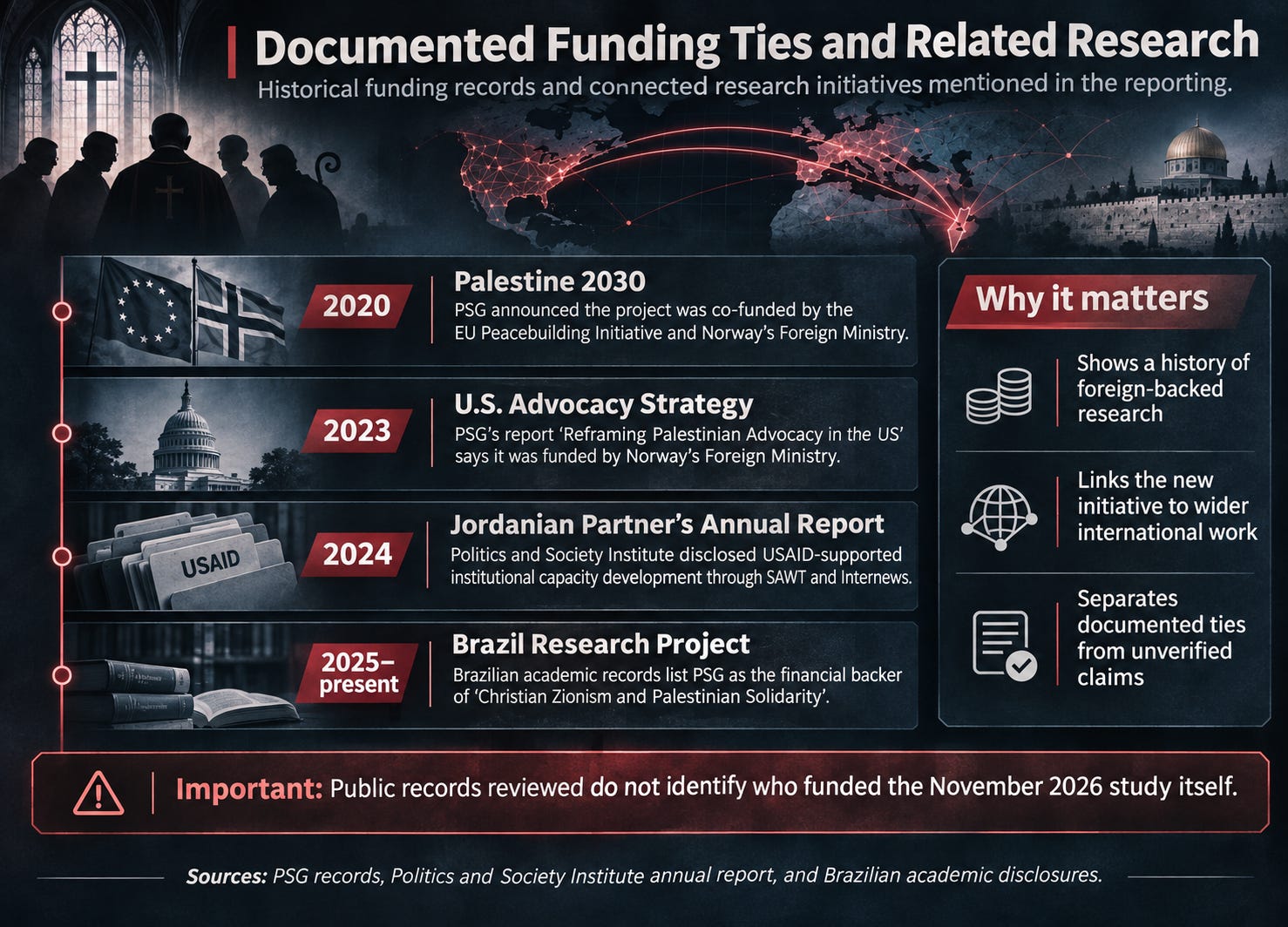
In October 2023, the group published Reframing Palestinian Advocacy in the US, a 39-page report that identifies the Norwegian Ministry of Foreign Affairs as its funder. That report contains an entire section on American church politics and argues that Palestinian advocates should develop more effective strategies for engaging church constituencies and countering pro-Israel activism among Christians.
The report identifies mainline Protestant denominations such as the Evangelical Lutheran Church in America and the Presbyterian Church (USA) as institutions already involved in Palestinian advocacy through divestment initiatives, resolutions and visits to Palestinian communities. But it argues that existing methods had limited impact and that new approaches were needed.
It also highlights younger evangelicals as a particularly important opening. Citing survey data, PSG argued that younger evangelicals were less uniformly pro-Israel than earlier generations and could be more receptive to Palestinian political messaging. The document treats this as a strategic opportunity to reshape part of the American Christian landscape over time.
The same 2023 report also examines American Jewish advocacy organizations and explicitly recommends exploiting divisions between mainstream pro-Israel groups and more liberal Jewish organizations. It identifies established institutions such as AIPAC, the Anti-Defamation League and the American Jewish Committee, while also discussing J Street, Americans for Peace Now, T’ruah, Jewish Voice for Peace and IfNotNow as part of a wider landscape of internal tension and competition. PSG wrote that Palestinian advocates should seek to exploit “growing pockets of contention” within that ecosystem.
That earlier report is important because it shows the newly launched church strategy did not emerge in a vacuum. PSG had already been thinking in concrete strategic terms about how to reshape religious and political constituencies in the United States.
PSG’s History of Norwegian and EU Funding
PSG’s foreign funding history stretches back further still.
In a June 2020 press release, the group said its Palestine 2030 initiative was co-funded by the European Union’s Peacebuilding Initiative and Norway’s Foreign Ministry. That project involved Britain’s Oxford Research Group, the Palestinian Forum for Israeli Studies (MADAR), Gaza-based PalThink for Strategic Studies and the I’lam Media Center.
PSG described the effort as a project to strengthen Palestinian strategic capacity, build policy-relevant networks and produce research for decision-makers. The group also has historical connections to senior Palestinian diplomatic circles. A 2016 interview identified Husam Zomlot, now the Palestinian ambassador to the United Kingdom, as PSG’s founder and coordinator.
Jordanian Launch Partner Previously Received USAID Support
The Jordanian partner in the new launch also has notable foreign support links.
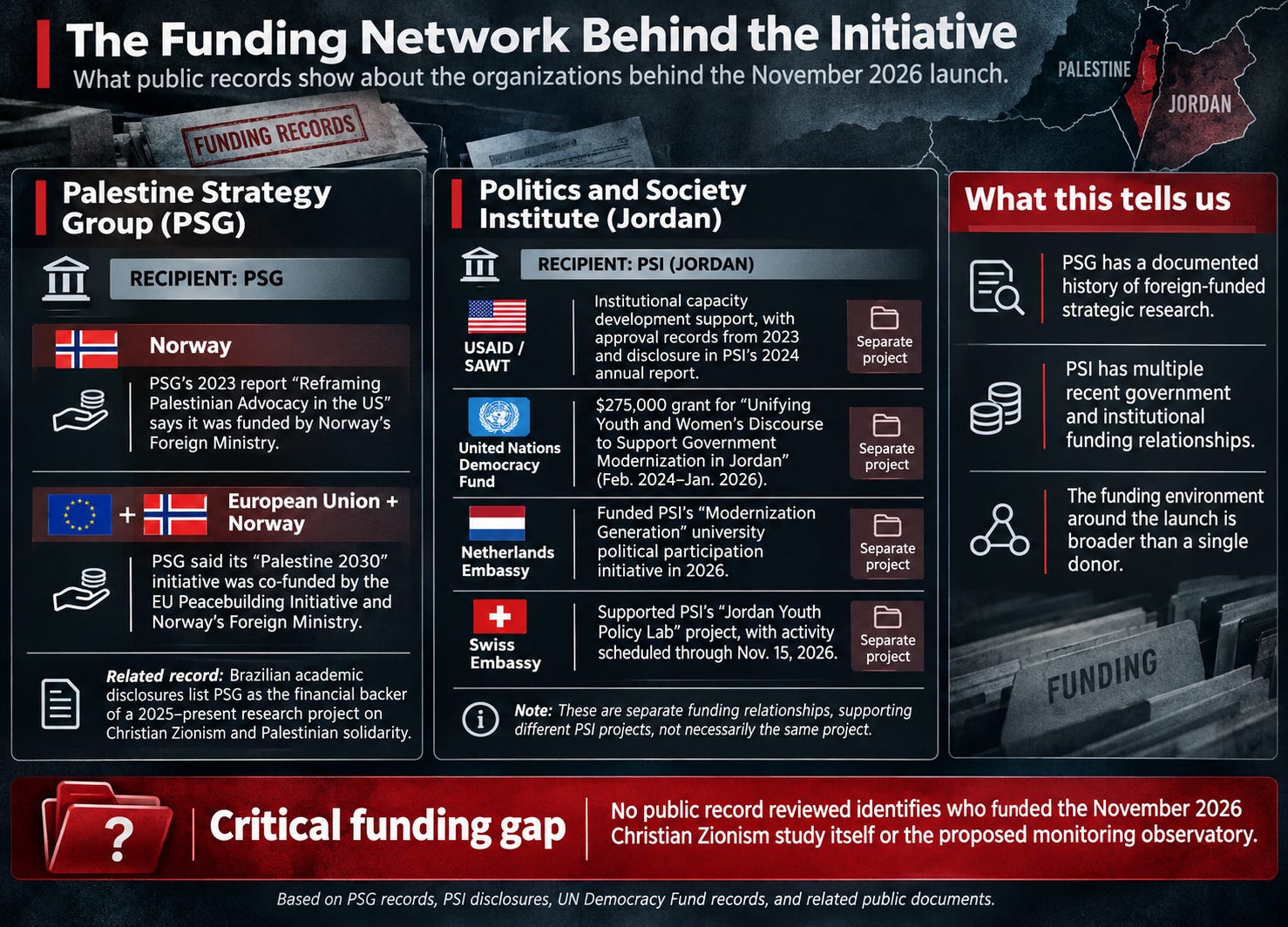
The Politics and Society Institute’s 2024 annual report states that the institute received institutional capacity development support through SAWT, backed by USAID and Internews. According to the report, that assistance focused on internal operations including project management, human resources, financial administration and governance. The same report also identifies a U.S. Embassy-funded sustainability initiative and cooperation with the Royal Norwegian Embassy in Jordan.
More recent records identify additional European government funding relationships involving the Jordanian institute. In 2026, the Netherlands Embassy financed a university political participation initiative, while the Swiss Embassy supported a separate youth policy research program with activities scheduled through November. The United Nations Democracy Fund separately awarded the institute $275,000 for a political participation initiative running from February 2024 through January 2026.
The November 9 launch was held under the institute’s Adnan Abu-Odeh Program for the Study of the Zionist Movement and Israel, known as AIN. The institute describes AIN as a research program training young Jordanian researchers to examine Israeli institutions and political developments through primary-source materials, including Hebrew-language sources.
PSG Financed Related Research on Christian Zionism in Brazil
Separate academic records in Brazil suggest PSG is also backing related work abroad.Brazilian researcher Joanildo Albuquerque Burity’s academic profile lists an ongoing project beginning in 2025 titled Christian Zionism and Palestinian Solidarity: Agents, Networks and Discursive Disputes, and identifies PSG as the source of financial assistance.
The project examines religious leadership, digital media networks, Holy Land tourism and theological education in Brazil and Latin America, areas that substantially overlap with the themes outlined in the November 9 launch. Brazil is also one of the four countries specifically named in the new study, alongside the United States, Nigeria and South Korea.
Study Authors Have Established Connections to Western Churches
The Amman workshop was presented by researchers A’zer Dakwar and Xavier Abu Eid.
Dakwar is affiliated with MADAR and KU Leuven, while Abu Eid previously worked with the Palestinian negotiating apparatus.
Abu Eid also has documented contact with senior Church of England officials. The Diocese of Chelmsford recorded his January 2025 meeting with Bishop Guli Francis-Dehqani in Bethlehem, and he later accompanied a British church delegation through Nablus in January 2026.
The event also featured former Jordanian Foreign Minister Marwan Muasher and Palestinian Lutheran pastor Munther Isaac, a prominent advocate of Palestinian liberation theology who has already spoken in Western theological settings, including an appearance at Episcopal Divinity School in New York earlier this year.
Those existing church and academic relationships add another layer to the story. The strategy explicitly proposes building longer-term ties with clergy, churches and theological institutions, and some of the figures around the initiative already have access to those worlds.
The Big Picture and Funding Questions
One important question remains unresolved. While public records clearly document PSG’s previous Norwegian and EU funding, and the Jordanian partner’s USAID-backed institutional support, the available documents do not identify who funded the new two-year Christian Zionism study itself. The November 9 launch announcement lays out the strategy’s goals and proposed mechanisms, but the full study does not appear to be publicly posted, and no public grant document reviewed by Jewish Onliner identifies the backer of this specific research effort.
Even so, the initiative’s stated objectives are clear. A Palestinian organization with a record of foreign-backed strategic research has spent two years studying how Christian support for Israel operates across key countries and has now unveiled a plan to monitor, engage and reshape the religious networks behind it. The proposed initiative is aimed not only at public debate, but at the institutions where theological and political loyalties are formed.