


More than two years after the October 7th massacre and ensuing Hamas-Israel War, online attention hasn’t faded—it has transformed. A new computational study analyzing over 2.3 million social media posts reveals that conflict discourse doesn’t decay; it reactivates in intense bursts, sustaining emotional engagement long after traditional news cycles move on.
The finding challenges assumptions about “compassion fatigue” and suggests something more fundamental: different platforms don’t just host the same conversation—they create distinct information environments where the same war is experienced, narrated, and emotionally processed in fundamentally different ways.
The Study
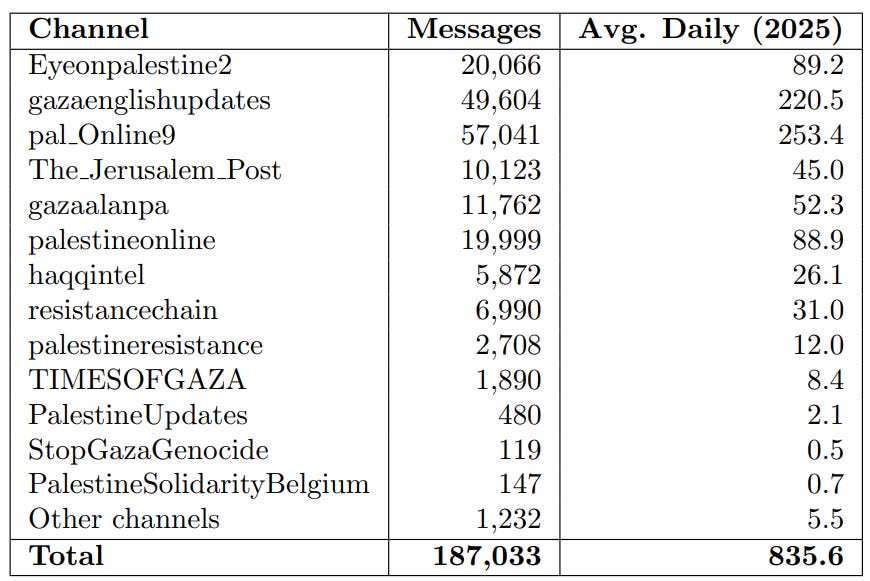
Researchers Despoina Antonakaki (Foundation for Research and Technology – Hellas, Greece) and Sotiris Ioannidis (Technical University of Crete) analyzed 187,033 Telegram messages, 2.1 million Reddit comments, and 2,001 tweets spanning 2023-2025. The study was submitted to arXiv, an open-access preprint repository, and has not yet undergone formal peer review.
Using advanced natural language processing techniques, including BERTopic topic modeling and sentiment analysis, they tracked what people discussed, how conversations evolved, and which emotions dominated discourse. BERTopic automatically groups large text collections into meaningful themes by considering the context and meaning of words rather than just their frequency.
Attention Doesn’t Fade—It Clusters
The study’s starkest finding: roughly 67% of all messages appeared during just 15% of the study period. Rather than steady attention or gradual decline, discourse concentrates in explosive bursts around major events.
This creates what researchers call a “persistence paradox.” Four major spikes—exceeding 200% of baseline activity—corresponded to the October 7 attacks, the Al-Shifa Hospital incident (November 2023), the Rafah invasion (May 2024), and the Al-Nasr Hospital bombing (September 2025). The September 2025 event generated activity comparable to the initial attacks nearly two years earlier.
“Contrary to typical ‘attention decay’ models that predict declining online engagement over time, our data shows sustained and even increasing discourse intensity,” the authors write.
Three Platforms, Three Roles
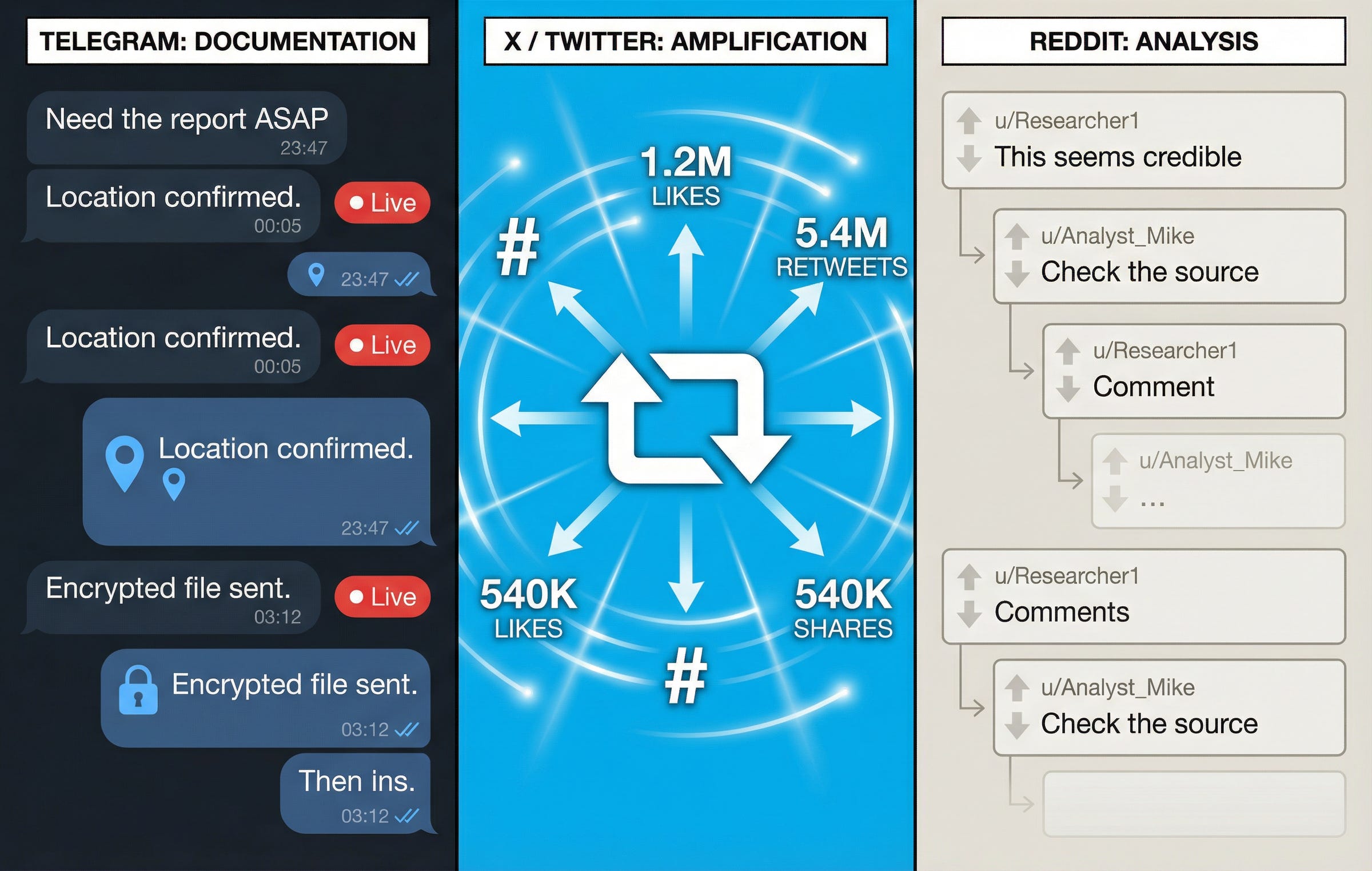
The study’s central insight concerns platform specialization. Telegram, X (formerly Twitter), and Reddit don’t mirror the same conversation—they perform distinct functions in what researchers call a “digital conflict ecosystem.”
Telegram functions as the Documentation Hub—an “immediacy-driven eyewitness medium” where minimal moderation and encryption enable raw, graphic, real-time documentation that other platforms prohibit.
X operates as the Amplification Network—using viral mechanics and algorithms to rapidly disseminate “emotionally charged frames” to global audiences, prioritizing speed and emotional mobilization.
Reddit serves as the Analysis Engine—where threading and voting systems create “extended analytical discussions that process and contextualize information from other platforms,” hosting more reflective debate. “Telegram is generative, Twitter amplificatory, and Reddit contextualizing,” the researchers conclude.
If accurate, this suggests people aren’t merely disagreeing about facts—they’re engaging with fundamentally different versions of the conflict shaped by platform-specific affordances: the technical features and algorithms that determine what users see and how they interact.
Micro-Narratives Traditional Methods Miss
Traditional topic modeling identifies broad categories like “military action” or “humanitarian crisis.” This study demonstrates that newer methods reveal far more granular structure.
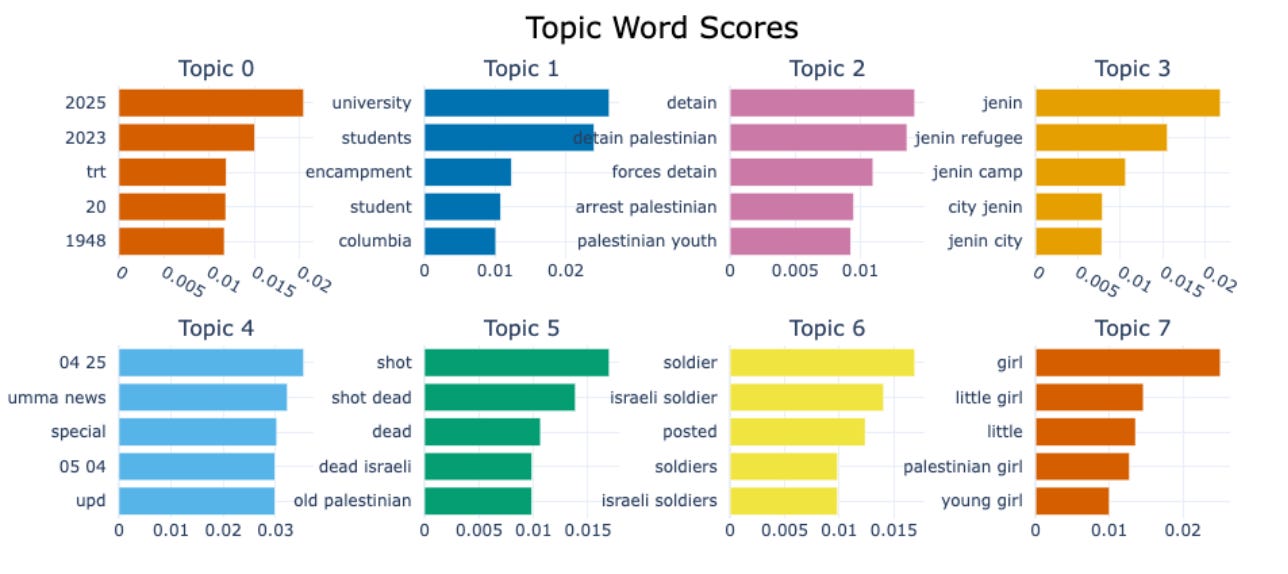
BERTopic identified over 1,000 distinct storylines—specific raids, university protests, airstrikes, aid deliveries—that traditional approaches would lump together. The researchers emphasize it provides “significantly richer and more coherent topic clusters,” capturing “micro-events, geographically specific operations, and humanitarian narratives that LDA cannot detect.”
The “Jenin neighborhood” exemplifies this: discussion of Jenin, a West Bank city and refugee camp, forms a hub connecting nine related sub-topics including tear gas deployment, settler militias, tanks and occupation, aid distribution, and refugee narratives. These form semantically tight, interconnected “storyworlds”—recurring mini-plots people return to and build upon.
While traditional methods “excel at summarizing high-level thematic trends,” the authors note, BERTopic “exposes the fine topology” of how specific events and locations shape discourse.
Emotion Concentrates Around Topics
Sentiment remained overwhelmingly negative throughout: 78.4% negative, 15.2% neutral, 6.4% positive—sustained across 24 months, contradicting typical compassion fatigue patterns.
But emotions weren’t uniform. The researchers linked specific emotions like fear, anger, grief, and solidarity to particular topics. Fear and anger concentrated around military operations; grief and solidarity emerged around humanitarian crises and casualties. News channels showed balanced sentiment; advocacy channels displayed extreme negative skew, reflecting different purposes and audiences.
Children as Solidarity Triggers
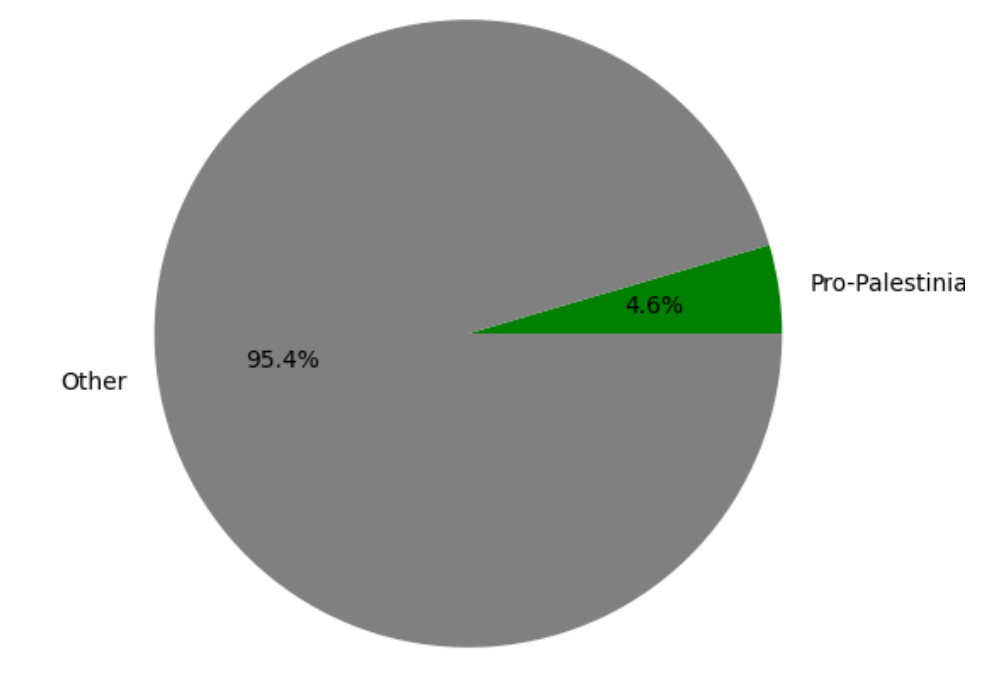
Explicit solidarity expressions (”Free Palestine,” “Ceasefire Now”) represented a minority of posts, with 7.3% on Telegram, 12.8% on Reddit, and 5% on Twitter.
But references to children substantially increased solidarity likelihood, though effects varied by platform. Telegram messages mentioning children were 3.5 times more likely to contain solidarity appeals; Reddit posts were twice as likely; Twitter showed more modest increases.
One refined analysis suggested child references sometimes “diversify emotional responses” rather than uniformly intensifying support language. “Humanitarian framing is a key trigger for positive engagement,” the authors conclude, while acknowledging context-dependency.
Limitations and Implications
The researchers don’t claim online discussion directly causes violence or policy outcomes—they demonstrate correlation, not causation.
Yet the framework remains compelling. Modern wars generate “digital conflict ecosystems” where documentation, amplification, and interpretation occur across interconnected platforms, and where emotional intensity can be repeatedly reactivated through the interaction of events and platform design.
A fundamental question remains about what happens when war transforms into a persistent emotional environment, one that engagement-driven platforms can endlessly reignite, reframe, and redistribute.
For researchers, policymakers, and platform designers, the “persistence paradox” may signal a broader shift in how global publics experience distant crises in an age of algorithmic media.
Read additional similar data analyses about the war: