


Jewish Onliner is an independent publication. If you find our work valuable, please consider becoming a paid subscriber. You can also subscribe to us on WhatsApp and Telegram. Follow us on Instagram, Discord, and X.

New York City used an AmeriCorps-backed program to place full-time members inside the New York chapter of the Council on American-Islamic Relations, according to a new investigation by journalist Natalie Winters.

Winters reported that at least two members of NYC Civic Corps, a national-service program administered by NYC Service through the Mayor’s Office, were placed at CAIR-NY in different years. Civic Corps members serve full-time at participating nonprofit organizations and city agencies.
irected educators and school boards to a September 11 curriculum listing Osama bin Laden’s “Letter to America” among its K-12 background resources. CAIR National later removed its endorsement and link to the curriculum, saying an earlier version had not undergone “proper vetting.”
Building CAIR-NY’s Operations
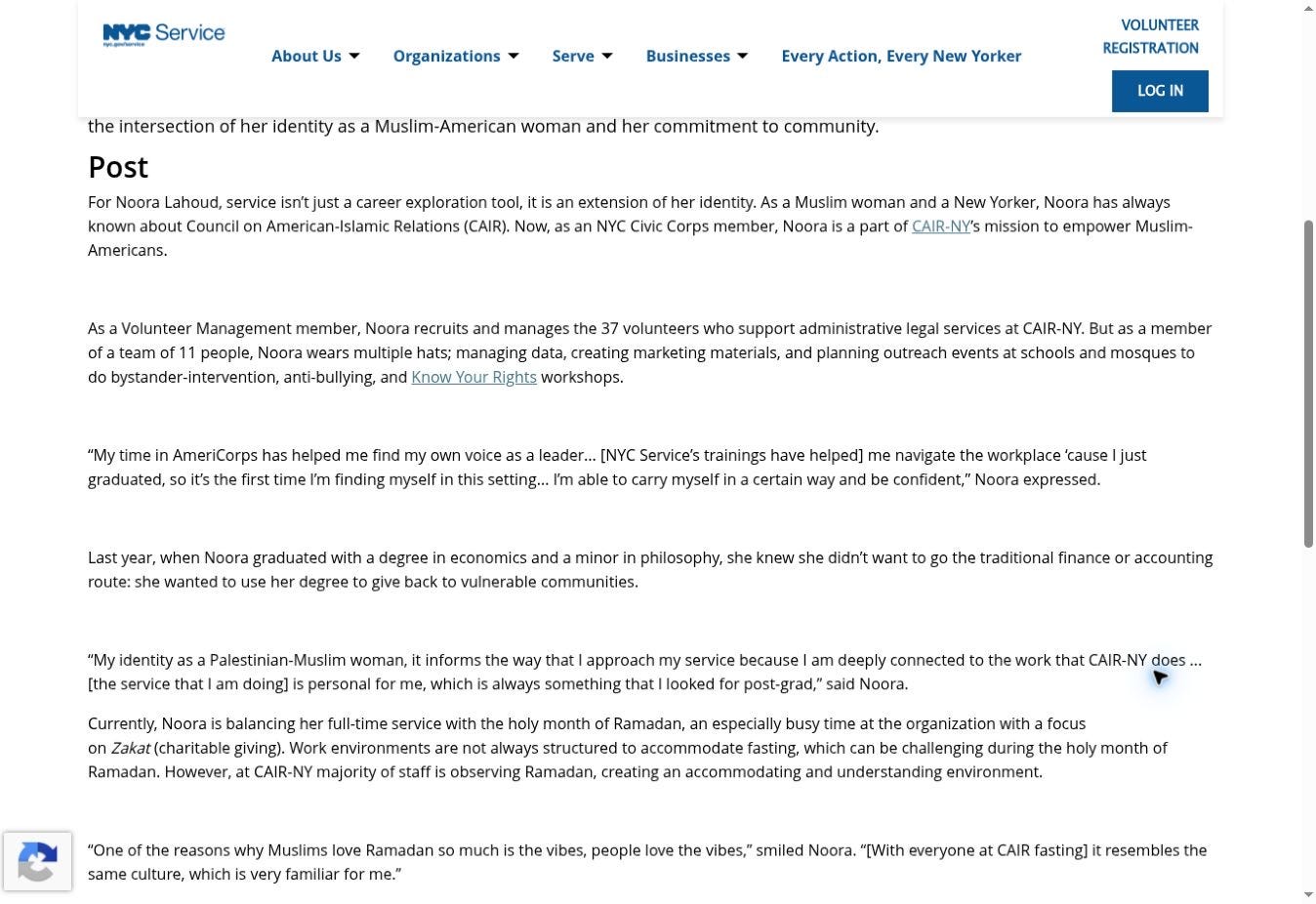
According to the Civic Corps profile cited by Winters, one CAIR-NY placement went well beyond occasional volunteering. The member managed 37 legal-services volunteers, maintained organizational data, produced marketing materials and helped plan outreach to schools and mosques.
NYC Service currently lists CAIR-NY among its Civic Corps nonprofit partners and highlights Noora Lahoud as a Civic Corps member serving at the organization.
In 2022, CAIR-NY introduced Samuel Croce as “our NYC Civic Corps member,” according to Winters. Its annual report separately listed Croce on the organization’s staff roster and recorded $4,000 in “Civic Corps Fees.”
The records show a publicly backed national-service program placing full-time service members at CAIR-NY to work on volunteer coordination, data management, communications and outreach.
Broader City Support
The Civic Corps placements are not the only documented form of New York City support for CAIR-NY.
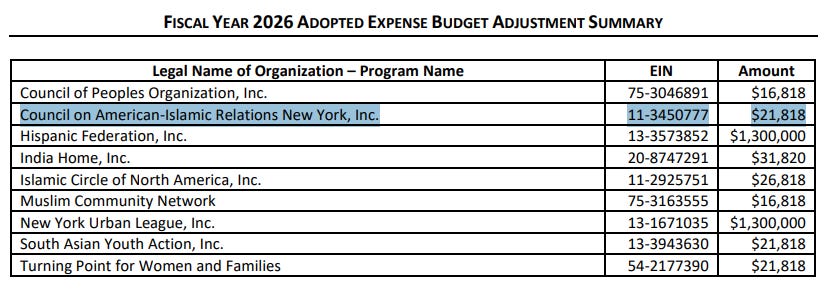
City Council budget records show CAIR-NY was designated for recurring allocations through the Communities of Color Nonprofit Stabilization Fund. The chapter was designated to receive $21,818 in each of fiscal years 2023, 2024, 2025 and 2026.
The city describes the initiative as supporting capacity-building and strengthening nonprofit organizations serving communities of color.
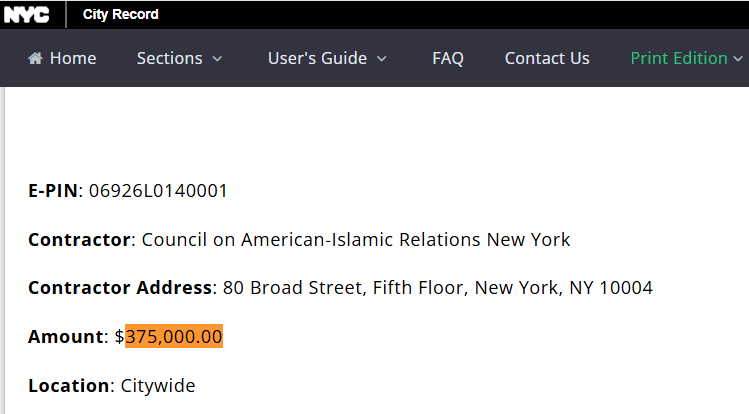
A February 2026 City Record notice also shows the Department of Social Services and Human Resources Administration seeking public comment on a proposed $375,000 contract award to CAIR-NY for citywide immigration legal services.
The proposed contract covers July 1, 2025 through June 30, 2028 and lists the procurement method as City Council discretionary funds or a line-item appropriation.
Separately, CAIR-NY has developed school-focused advocacy and workshop programming in New York. In a 2024 report, the chapter said it intended to continue working with policymakers and school districts through educational programming, policy advocacy and legal action.
A Contrast With the FBI
The city relationship stands in stark contrast to restrictions the FBI placed on non-investigative outreach with CAIR.
A Justice Department inspector general review found that the FBI adopted a policy in 2008 intended to significantly restrict non-investigative interactions with CAIR. The policy was developed partly in response to evidence presented during the Holy Land Foundation terrorism-financing trial, in which CAIR was named as an unindicted co-conspirator.
Importantly, the FBI’s restrictions extended to interactions involving CAIR’s local chapters as well as its national organization.
The Jewish Onliner report detailing New York City’s use of the AmeriCorps-backed Civic Corps program to place full-time members within the Council on American-Islamic Relations’ New York chapter (CAIR-NY), alongside recurring municipal allocations and a proposed $375,000 legal-services contract, raises profound and legitimate concerns regarding institutional oversight and public accountability.
The primary issues centering on this report include: Direct Conflict with Federal Security Policies: The most glaring concern is the stark contradiction between New York City’s active support and the official stance of the federal government. Following the 2008 Holy Land Foundation terrorism-financing trial—where CAIR was designated as an unindicted co-conspirator—the FBI established an explicit policy strictly restricting non-investigative interactions with the organization. This federal restriction explicitly extends to local chapters. A local municipality actively building operational capacity for an organization restricted by federal law enforcement signals a troubling breakdown in inter-agency alignment.
Taxpayer-Funded Operational Support: The records indicate that Civic Corps members were not merely participating in superficial community outreach; they were embedded full-time to build CAIR-NY's core infrastructure. Funding individuals to manage legal-services volunteers, handle organizational data systems, and coordinate expansion operations effectively means public tax dollars are directly underwriting the administrative growth of a highly controversial political advocacy group.
Vetting and Curricular Concerns: The report highlights instances where educational materials associated with the organization directed school boards to a September 11 curriculum featuring Osama bin Laden’s “Letter to America” as a K-12 resource. While CAIR National later retracted its endorsement citing a lack of "proper vetting," the fact that a group heavily embedded in public school advocacy was tied to such materials justifies intense scrutiny over what kind of ideological frameworks public funds are inadvertently legitimizing.When a city administration establishes a taxpayer-funded staffing pipeline and allocates substantial discretionary contracts to an entity that federal law enforcement deliberately keeps at arm's length, it demands immediate transparency and a formal review of municipal vetting protocols.