


Jewish Onliner is an independent publication. If you find our work valuable, please consider becoming a paid subscriber. You can also subscribe to us on WhatsApp and Telegram. Follow us on Instagram, Discord, and X.

On September 2, Israeli legal scholar Avraham Russell Shalev released a forthcoming paper arguing that the international legal consensus shaping many judgments about Israel has developed within an academic environment that Shalev argues systematically marginalizes Jewish and Zionist perspectives.
In his forthcoming paper From Blogs to Boycotts: Anti-Zionist Biases in Legal Academia, Shalev examines how international-law journals, conferences, professional networks and academic platforms help create the “expert consensus” later invoked by international institutions.
His central argument is not simply that individual scholars hold anti-Israel views. Rather, he argues that the infrastructure producing international-law expertise has developed institutional mechanisms that marginalize Jewish and Zionist perspectives, allowing a narrow ideological framework on Israel to become embedded as a dominant interpretation within parts of international legal discourse.
The paper examines controversies involving Opinio Juris, the Columbia Law Review, the Leiden Journal of International Law and what Shalev describes as informal “grey boycotts” against Israeli scholars.


The Battle Before the Courtroom
International legal campaigns involving Israel often rely on claims of expert consensus. Arguments about occupation, proportionality, self-defense, genocide and state responsibility frequently cite academic commentary and legal scholarship as evidence that a particular interpretation represents mainstream international law.
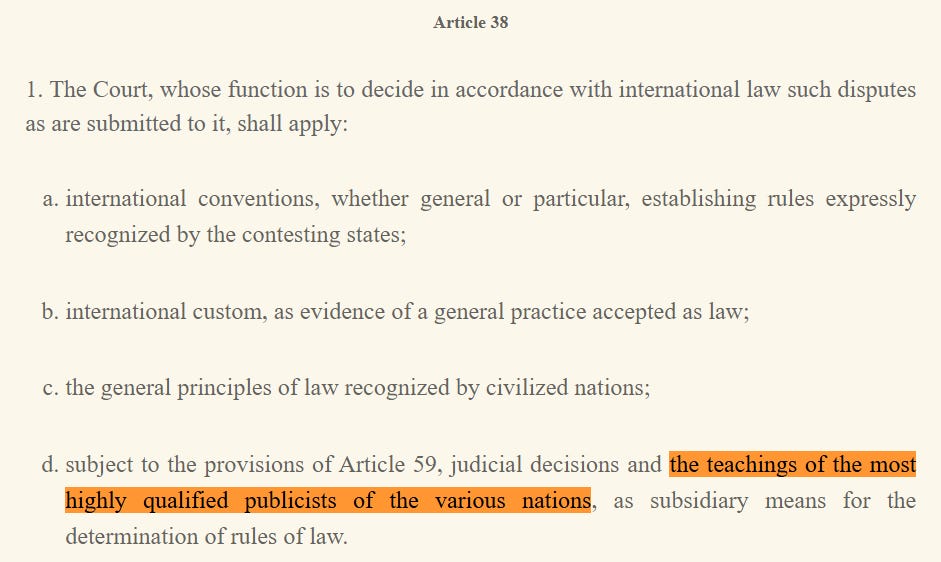
That influence is recognized within the international legal system itself. Article 38 of the Statute of the International Court of Justice identifies “the teachings of the most highly qualified publicists of the various nations” as a subsidiary means for determining legal rules.
Shalev argues that this creates an overlooked power center: the academic institutions that determine which scholars, arguments and interpretations receive legitimacy.
When certain perspectives are excluded from journals, conferences and professional networks, he argues, the resulting consensus can become self-reinforcing and influence the legal positions adopted by international bodies.
From October 7 to the Legal Narrative
A central focus of the paper is the reaction of parts of the international-law community following Hamas’ October 7 massacre.
Shalev examines international-law blogs such as Opinio Juris, arguing that some platforms have provided space for scholars whose responses to October 7 framed Hamas’ attack through anti-colonial theory while leaving Zionist perspectives underrepresented.
One example discussed by Shalev is an October 2023 Opinio Juris post by legal scholar Mohsen al-Attar responding to an interview with Professor Noura Erakat. The discussion situated October 7 within a broader anti-colonial framework and referenced Frantz Fanon’s argument that “decolonisation is always a violent phenomenon.”
The post also included an addendum published after October 7 that continued discussing the conflict through the lens of anti-colonial struggle. Critics argued that the framing risked treating Hamas’ attack primarily as an anti-colonial event rather than confronting Hamas’ deliberate targeting of civilians and the scale of the atrocities committed during the attack.
University of Haifa legal scholar Yahli Shereshevsky later criticized elements of the response within international-law circles, arguing that some reactions reflected a failure to fully acknowledge the nature of the October 7 attacks.
For Shalev, the episode represents a broader pattern: legal discourse surrounding Israel often begins from frameworks of colonialism, oppression and state violence while placing less emphasis on Israeli security concerns, Hamas terrorism and the legal obligations of non-state armed groups.
The Institutions Defining Acceptable Debate
Shalev also examines the controversy surrounding the publication of Rabea Eghbariah’s article Toward Nakba as a Legal Concept in the Columbia Law Review.
The article became controversial after the journal acknowledged that it had been commissioned and did not undergo the journal’s standard review process.
Shalev argues that the episode reflected a broader asymmetry: arguments challenging Israel’s legitimacy often gain access to prestigious academic platforms, while scholars defending Israel or contesting dominant narratives face greater professional barriers.
The paper also discusses cases involving Israeli scholars whose submissions were rejected or altered during publication processes, including Anne Herzberg and Tal Mimran.
Shalev also examines the controversy surrounding the Leiden Journal of International Law. He argues that the journal’s decision to add a disclaimer to an article by Israeli authors after criticism on social media reflected broader concerns about the treatment of Israeli scholars publishing on Israel-related issues.
The “Grey Boycott” of Israeli Scholars
Beyond formal publication decisions, Shalev focuses on what he calls “grey boycotts”: informal professional practices that isolate scholars without requiring an official boycott policy.
The paper highlights the 2018 controversy involving legal scholar Eugene Kontorovich at a conference hosted by the Asser Institute in The Hague.
Critics of Kontorovich’s scholarship on Israel and disputed territories, including Dr. Valentina Azarova and Professor Ralph Wilde, called on organizers to reconsider his invitation. When organizers refused to withdraw the invitation, Shalev argues that critics pursued informal forms of professional distancing from him.
The paper also discusses the case of Israeli scholar Daphné Richemond-Barak, an expert on underground warfare, whom Shalev cites as an example of the barriers Israeli scholars can face in international academic and policy settings.
Shalev further argues that Jewish and Israeli scholars have faced both explicit and informal exclusion from conferences, professional networks and academic spaces.
A 2024 survey by the Israel Young Academy and AFIK surveyed 1,015 Israeli senior faculty members and found that 32% reported significant damage to international collaborations and 26% reported difficulties presenting at international conferences.
The Question of Who Produces “Expert Consensus”
The battle over Israel at international institutions does not begin when judges issue rulings or diplomats draft resolutions. It begins earlier, in the academic journals, conferences and professional networks that determine which legal theories gain authority and which scholars shape the boundaries of accepted debate.
Shalev’s central argument is that the struggle over Israel in international law is fought upstream, before court filings and diplomatic resolutions, through the institutions that determine which scholars, concepts and arguments acquire academic legitimacy.
His paper argues that before legal arguments reach courts, governments or international institutions, they are first filtered through the academic ecosystem that determines which scholars, concepts and interpretations receive authority.