


Jewish Onliner is an independent publication. If you find our work valuable, please consider becoming a paid subscriber. You can also subscribe to us on WhatsApp and Telegram. Follow us on Instagram, Discord, and X.

NAZA, the documentary film that won Venice’s Special Jury Prize in September, grew from a reporting network whose editors and writers have publicly advocated ending Zionism and rejecting Israel’s nature as a Jewish state, according to a new Jewish Onliner investigation.
The documentary portrays Israeli military operations in Gaza as a system of “calculated mass killing.” Produced by The Guardian and JW Films, it draws on reporting published by +972 Magazine, Local Call and The Guardian between 2023 and 2025. These institutional connections place the film within an openly activist media network, parts of which pursue political goals extending far beyond the documentary’s stated focus on Israel’s military conduct in Gaza.
A Local Call Editor Explicitly Demanded an End to Zionism
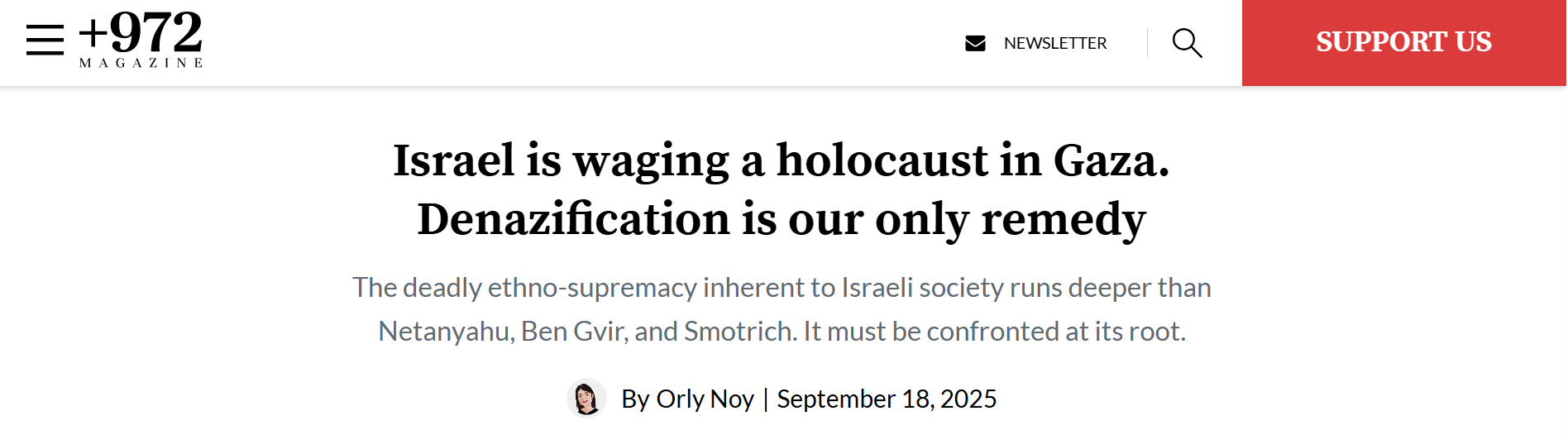
One of the clearest statements came from Orly Noy, an editor at Local Call, the Hebrew-language publication whose reporting helped underpin NAZA. In a September 2025 essay published by +972, Noy wrote:
“Zionism, in all its forms, cannot be cleansed of the stain of this crime. It must be brought to an end.”
She demanded a process of “denazification” across Israeli society and rejected the country’s combined Jewish and democratic identity. Her position explicitly targeted Zionism itself, not simply the government in power.
The Guardian Published Calls for the “End of Zionism”
In an August 5, 2011 column, David Hearst, then a Guardian foreign editorial writer, envisioned “The end of Zionism, no less.”
An April 24, 2024 essay by Guardian US columnist Naomi Klein called Zionism a “false idol” and declared: “So tonight we say: it ends here.”

In July 2024, the newspaper published Ahmed Moor’s essay calling for the “end of Zionism.”
The newspaper’s involvement in NAZA went beyond commentary: it produced the film, drawing on reporting by The Guardian, +972 and Local Call.
Just Vision Connects the Network to Local Call and an Alleged PFLP-Linked Staffer
The network also runs through Just Vision, which co-founded Local Call with 972 Advancement of Citizen Journalism and continues to co-publish it. Just Vision says Local Call was created partly because Israeli media did not adequately cover what it calls “occupation and apartheid.”
Just Vision’s Gaza outreach associate, Fadi Abushammala (spelled Abu Shammala in some sources), has also been identified in French media sources as part of the Popular Front for the Liberation of Palestine (PFLP). In 2014, French outlet Mediapart explicitly referred to Abushammala as a PFLP member. Because Just Vision co-publishes Local Call, whose reporting helped underpin NAZA, the allegation concerns an organization inside the network behind the film.
Just Vision, for its part, identifies Fadi Abushammala as its Gaza outreach associate and says he serves as executive director of Gaza’s General Union of Cultural Centers (GUCC). An April 20, 2009 post on the Red Eagle forum identified Abushammala as the Progressive Student Action Front’s representative at Al-Aqsa University. The PFLP’s own website later described that organization as its “student framework.”

Six months later, Palestinian outlet SAMA identified Abushammala as executive director of the Palestinian Progressive Youth Union. Palestinian news agency Safa later called the organization the PFLP’s “youth framework.” Abushammala’s LinkedIn profile lists him as executive director of the union from July 2009 through June 2010 and later as a GUCC project manager.
Jewish Onliner contacted Just Vision for comment on its Gaza outreach associate Fadi Abushammala’s alleged membership in the Popular Front for the Liberation of Palestine (PFLP) but had not received a response by the time of publication.
Radical Activism Disguised as “Documentary Filmmaking”
Parts of the network are also open about treating their journalism as activism. In an interview published by the Jewish Liberation Fund, +972 Magazine’s resource development manager, Dana Mills, stated that “our actual journalistic work is our activism.”
The magazine’s 2022 editorial statement similarly identified its founders as activist-journalists and committed to examining “Zionism as a settler-colonial project.” It also placed Palestinian refugees’ right of return among the political questions central to its coverage. The magazine presents those commitments as part of its journalistic approach, not as activities separate from it.
Co-Director Wanted the Film to Generate Sanctions
Yuval Abraham, a journalist at +972 Magazine and Local Call, and Rachel Szor — the directors of NAZA — connected the film directly to international political pressure in their September 10 AFP interview, ahead of its Venice premiere. After describing their hope that Western governments would withdraw support and impose sanctions, Abraham said that pressure was needed: “Those of us inside Israel and Palestine trying to fight for change, need it.”
Abraham’s genocide accusation was already public before the documentary’s release. In an October 2025 essay, he described Israeli operations as “genocide” while discussing intelligence, artificial intelligence, targeting and civilian-casualty calculations. He also stated that his investigations had helped substantiate genocide allegations in international proceedings.
The Film’s Allegations Face Specific Factual Challenges
Beyond the network’s politics, the IDF’s detailed rebuttal debunks NAZA’s account of Israeli targeting practices.
In its October 1 response, the IDF denied the film’s claim that it approved a Gaza strike expected to kill approximately 500 civilians, saying it has never done so. It also rejected the portrayal of casualty thresholds as automatic permission to strike and said artificial intelligence neither independently designates targets nor authorizes attacks. The military stated that witnesses describing limited intelligence functions were presented as authorities on a much broader decision-making process.


A Times of Israel analysis identified apparent differences between Hebrew testimony and English subtitles and noted missing details needed to assess major allegations independently. Hundreds of Unit 8200 reservists also signed a petition asking commanders to investigate whether personnel from their unit actually participated in the film.
These factual disputes unfold against a documented political backdrop: a reporting network that openly mixes journalism with activism, influential figures who deny Israel’s right to exist, and directors who want Western sanctions imposed. The film’s political aim comes from its own makers, not from its critics. They have said publicly what kind of international pressure they wanted it to create.