


Jewish Onliner is an independent publication. If you find our work valuable, please consider becoming a paid subscriber.
Editor’s note: This is the latest article in a series examining alleged Muslim Brotherhood front groups in the United States—the 29 organizations listed in the infamous 1991 Muslim Brotherhood Explanatory Memorandum outlining a “Civilization-Jihadist Process” to destroy Western civilization from within. With renewed U.S. government focus on Brotherhood networks and recent congressional scrutiny, this series investigates the documented connections between these groups and their historical advancement of Brotherhood strategic objectives in America.
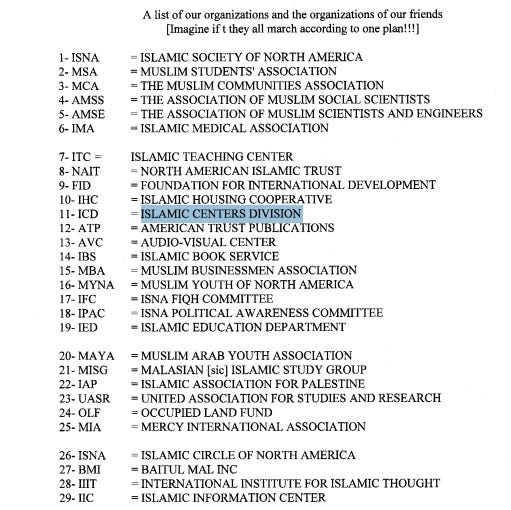
When the FBI seized the Muslim Brotherhood's 1991 strategic memorandum from an Annandale, Virginia basement in 2004, it recovered a roster of 29 American organizations the Brotherhood described as "our organizations and the organizations of our friends" — entities tasked with "a kind of grand Jihad in eliminating and destroying the Western civilization from within." Listed as item #11 was the Islamic Centers Division (ICD).
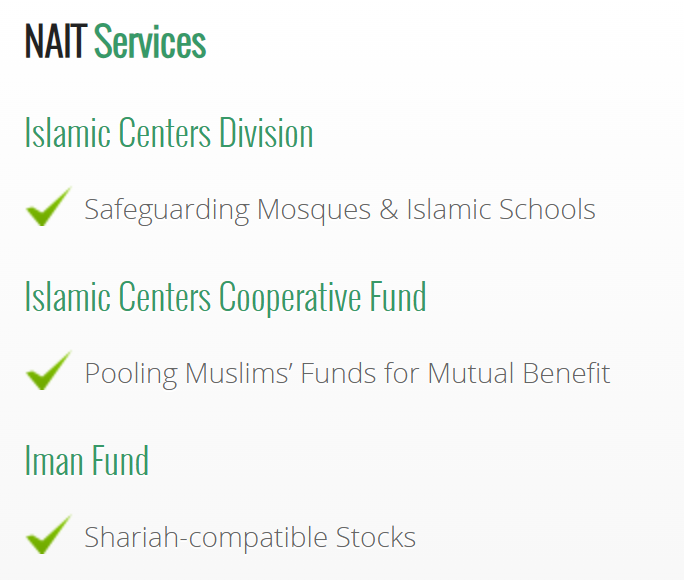
Today, ICD is not defunct, dissolved, or rebranded. It remains listed on the North American Islamic Trust’s website as one of its services A 2025 Ohio appellate case involving NAIT has brought renewed attention to how at least one mosque property agreement placed major governance decisions inside a waqf framework, with trustee consent required for property sales and disputes routed through religious arbitration. In practice, NAIT’s own description of the model treats the donor’s intent as permanent, meaning later mosque boards may have limited power to alter the property’s religious or governance terms.
What ICD Actually Does
NAIT publicly markets ICD as a service that simply “Safeguards Mosques & Islamic Schools.” A CUNY Graduate Center/Center for the Study of Philanthropy paper described ICD as the NAIT sector primarily responsible for making NAIT serve as a waqf for Islamic centers and said ICD provides legal and fundraising assistance to Islamic organizations.
NAIT-linked Islamic Horizons materials also emphasize mosque bylaws, board governance, election rules, legal services, dispute resolution, and the use of waqf structures to prevent local institutions from being diverted from their founding religious purpose.
The Perpetual Lock
NAIT says mosque boards may be “tempted” to change a property’s use, use it as collateral, prohibit accepted worship practices, or permit “un-Islamic” activity. But for properties in the NAIT Waqf Family, NAIT states that “none of such actions would be feasible.”
NAIT describes the model as perpetual and tied to the “unalterable sanctity” of the donor’s will. A 2025 Ohio appellate case involving NAIT showed one such trust agreement requiring the property to follow “Islamic Rules of Conduct and Code,” with certain religious disputes sent to a trustee-appointed FIQH Committee.
The Ohio Case That Revealed the Mechanism
In August 2025, Ohio’s Tenth District Court of Appeals affirmed a lower court’s refusal to compel arbitration in a property dispute between Masjid Oumar Al-Foutiyou and NAIT. The case exposed the language of one NAIT trust agreement, including arbitration before NAIT’s FIQH Committee and “cessation event” provisions.
The mosque alleged that NAIT improperly obtained a 50% property interest through a May 2015 quitclaim deed filed without authorization. The appellate ruling addressed whether the dispute had to go to arbitration, not whether the fraud allegations were true.
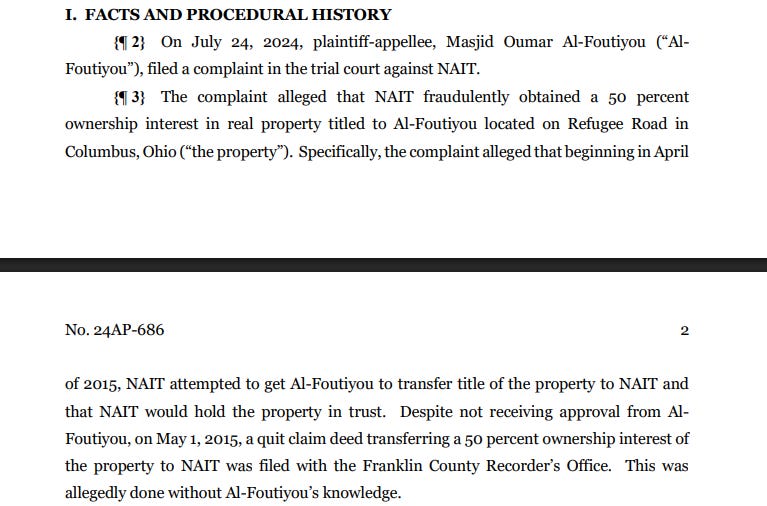
When the mosque later sought to sell, NAIT refused consent and moved to compel arbitration before a trustee-appointed “FIQH Committee,” whose decisions the agreement described as “final and binding.” The court denied NAIT’s motion, but the appellate record revealed the agreement’s religious-arbitration clause, “cessation event” provisions, and trustee-consent process for property sales.
Federal Court Evidence
In the Holy Land Foundation case, federal prosecutors listed NAIT among entities they said were or had been members of the U.S. Muslim Brotherhood’s Palestine Committee and/or its organizations.
The court order states that, during the early years of the Occupied Land Fund, later renamed the Holy Land Foundation for Relief and Development, OLF raised money and supported Hamas through an account held with ISNA and NAIT.
The order further states that some checks deposited into that account were made payable to “the Palestinian Mujahadeen,” which it describes as the original name of Hamas’s military wing.
NAIT’s current board lists Dr. Gaddoor Saidi as chairman. The HLF unindicted-co-conspirator attachment includes the name “Gaddor Ibrahim Saidi” in its list of individuals/entities described as members of the U.S. Muslim Brotherhood and again in a category of individuals/entities allegedly used by Mousa Abu Marzook as a financial conduit for Hamas.
Arabic-Language Reports Link ICD to Brotherhood Networks
Egypt’s Islamist Movements Portal — a major Arab-world tracker of Brotherhood activity — lists “شعبة المراكز الإسلامية” (Islamic Centers Division) among 39 Brotherhood-affiliated entities operating in the United States, alongside CAIR, ISNA, MSA, ICNA, and IIIT.
A separate Arabic analysis identifies NAIT as “particularly important to the Muslim Brotherhood network in Canada” for “establishing mosques, student houses, and Islamic centers” — a cross-border footprint English-language reporting often overlooks.
Scale and Significance
NAIT-linked Islamic Horizons reported in 2023 that the trust had grown into a “comprehensive solution provider” with more than 400 waqf institutions in the United States and Canada. According to 2015 reporting in the New York Post, NAIT has held title to more than 300 mosques and helped finance more than 500 Islamic centers in America.
The report also identified several controversial NAIT-linked mosques whose worshippers or attendees later included individuals involved in terrorism cases, including the Islamic Society of Boston, the Islamic Community Center of Phoenix, and Dar al-Hijrah Islamic Center.
Of the 29 entities the Muslim Brotherhood listed in 1991 as its allied network, few have remained as institutionally intact, as legally entrenched, or as quietly active as Item #11. As the Trump administration targets certain Muslim Brotherhood chapters and subdivisions for FTO and SDGT designations, renewed scrutiny is falling on U.S.-based organizations identified in historical Brotherhood-linked documents.