


A 19-year-old suspect charged with torching Mississippi’s historic Beth Israel Congregation admitted to federal authorities that he targeted the building because of its “Jewish ties” and described it as the “synagogue of Satan,” according to a federal affidavit filed January 12. The language Stephen Spencer Pittman allegedly used mirrors a widespread antisemitic trope that has exploded across social media platform X over the past year, with Jewish Onliner’s analysis revealing hundreds of thousands of posts amplifying this hate-filled rhetoric.
Mississippi Governor Tate Reeves announced that additional charges could be filed as the investigation continues, with state prosecutors indicting Pittman on charges of first-degree arson of a place of worship with hate crime enhancements.


Social Media Amplification: 363,600 Posts in One Year
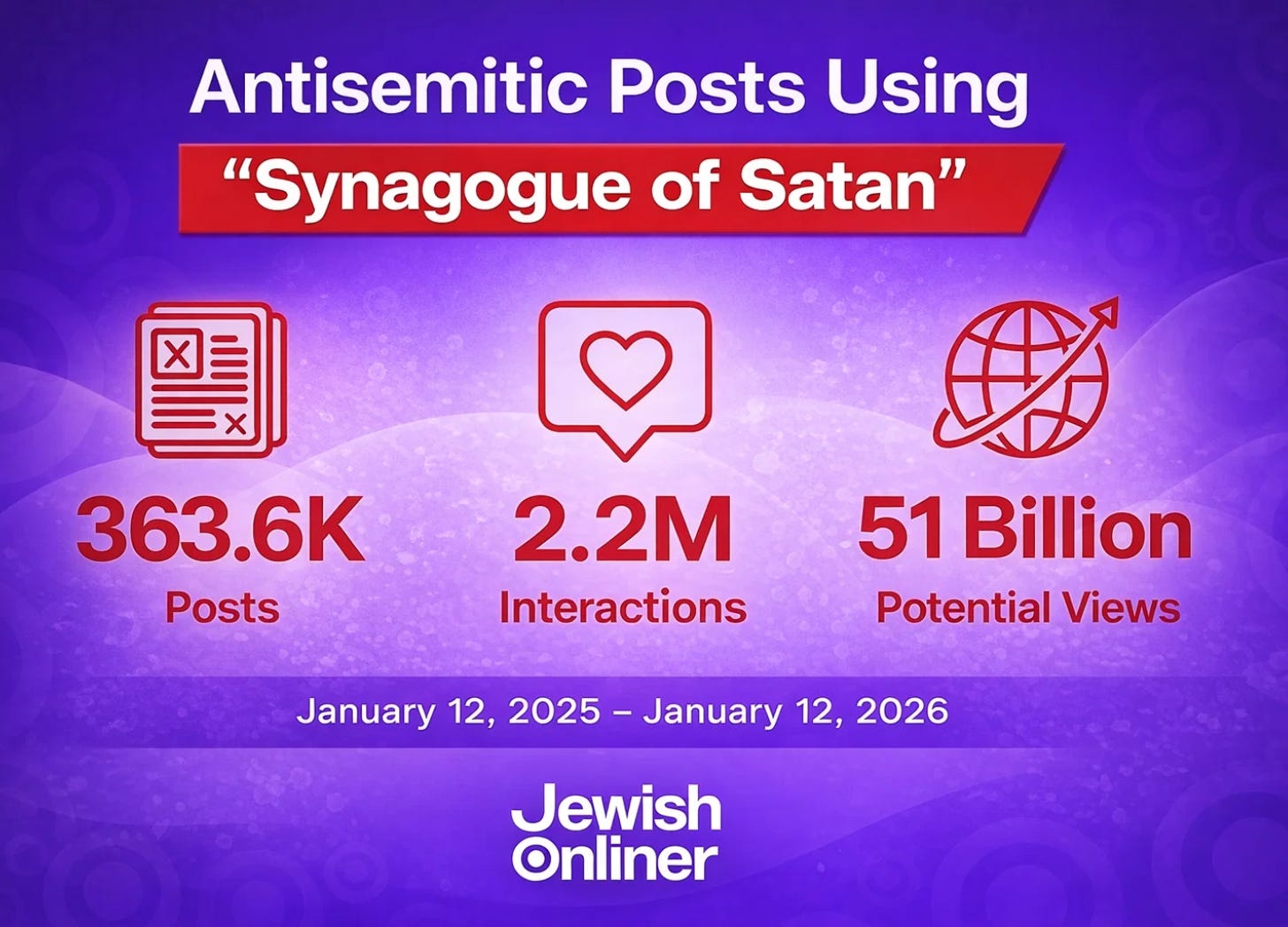
Using social media listening tools, Jewish Onliner tracked the proliferation of “synagogue of Satan” on X from January 12, 2025 to January 12, 2026. The analysis identified 363,600 posts containing the phrase, generating 2.2 million interactions and reaching a potential audience of 51 billion views.
The massive scale of this antisemitic rhetoric reveals how extremist language has become normalized on the platform, creating an environment where hate speech flourishes with minimal consequence.
The Super Spreaders
Jewish Onliner’s analysis identified several high-profile accounts as major amplifiers of “synagogue of Satan” rhetoric and related antisemitic conspiracy theories. Candace Owens, the conservative commentator and podcaster, emerged as one of the top spreaders. Owens has faced mounting scrutiny for increasingly overt antisemitism throughout 2025. A Jewish Policy Institute study documented a sharp increase in her anti-Israel and antisemitic rhetoric. The watchdog organization StopAntisemitism recently named Owens their “Antisemite of the Year” for 2024, citing her promotion of conspiracy theories about Jewish power and control.


Jake Shields, a former mixed martial arts fighter turned far-right podcaster, also ranked among the top amplifiers. The Anti-Defamation League documented how Shields uses his podcast platform to spread “antisemitic conspiracy theories, male supremacist bigotry and white nationalist talking points.” His X account regularly promotes claims about Jewish control of media, finance, and government institutions.


Machiavelli (@TheRISEofROD) represents another key node in the antisemitic content network. This account specializes in promoting elaborate conspiracy theories linking Jewish individuals and organizations to various alleged schemes of global manipulation and control.


“Synagogue of Satan”: From Scripture to Antisemitic Weapon
The phrase “synagogue of Satan” originates from the New Testament’s Book of Revelation, where it appears twice in references to specific first-century communities. However, this biblical term has been weaponized throughout history as an antisemitic slur casting Jews as satanic or evil, according to a Network Contagion Research Institute report.
Among modern antisemites, the phrase has become a calling card. Louis Farrakhan, leader of the Nation of Islam, has repeatedly deployed the term to demonize Jews. The Southern Poverty Law Center documents Farrakhan’s extensive use of “synagogue of Satan” rhetoric alongside references to “Satanic Jews” and claims that Judaism is a “dirty religion.” The Simon Wiesenthal Center’s comprehensive report on Farrakhan notes he has “consistently described Jewish houses of worship as ‘Synagogues of Satan,’ claiming that ‘the Satanic Jews . . . control everything.’”
How Online Rhetoric Shapes Offline Reality
The Mississippi synagogue arson illustrates the troubling environment created when antisemitic language proliferates unchecked on social media platforms. While the exact sources of Pittman’s radicalization remain under investigation, his alleged use of “synagogue of Satan” language reflects the same rhetoric that has been amplified hundreds of thousands of times on X over the past year by high-profile influencers and anonymous accounts alike.
The widespread circulation of such terminology contributes to an atmosphere in which violent antisemitism becomes conceivable. The phrase Pittman allegedly invoked during his confession did not emerge in a vacuum—it exists within a digital ecosystem where millions of users encounter this dehumanizing language regularly.