


Jewish Onliner is an independent publication. If you find our work valuable, please consider becoming a paid subscriber. You can also subscribe to us on WhatsApp and Telegram. Follow us on Instagram, Discord, and X.
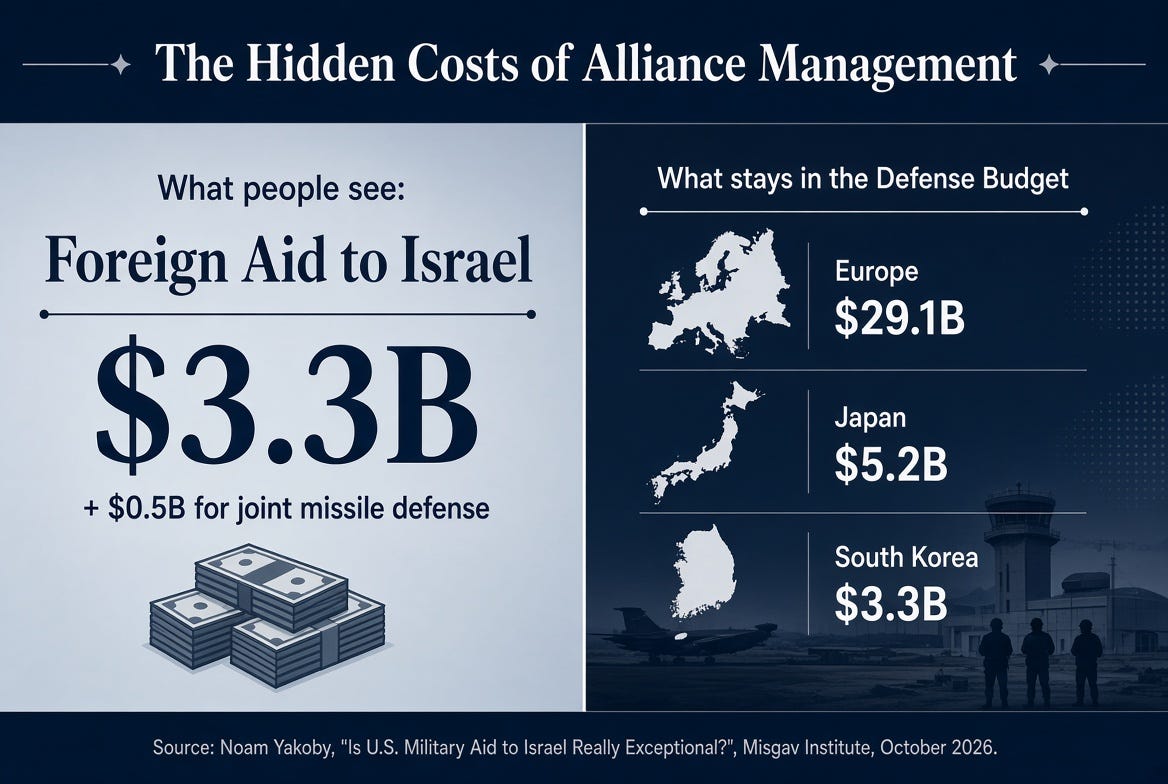
A new report published by Israel’s Misgav Institute for National Security and Zionist Strategy challenges the portrayal of U.S. military aid to Israel as an exceptionally costly American security commitment, documenting substantially higher expenditures on military deployments and infrastructure supporting other U.S. allies. The October 27 analysis, authored by Noam Yakoby, compares Israel’s regular $3.3 billion in annual U.S. military financing, plus $500 million for joint missile defense, with historical estimates of $29.1 billion in annual American military presence costs in Europe, $5.2 billion in Japan and $3.3 billion in South Korea.
Unlike those treaty allies, Israel does not host a comparable permanent American combat force. Yakoby argues that U.S. assistance instead supports Israel’s independent military capabilities while providing Washington with intelligence, defense technology, regional deterrence and other strategic benefits. The report acknowledges that overseas military deployments also serve independent American objectives and that their costs are not directly interchangeable with foreign military assistance.


Billions Spent on American Forces in Europe and Asia
According to the International Institute for Strategic Studies (IISS), the United States spent approximately $29.1 billion maintaining its military presence in Europe in 2018, including personnel, bases and deterrence initiatives. An additional $6.74 billion in NATO-related expenditures brought the estimate of direct American spending on European defense to approximately $35.8 billion that year.
In East Asia, a 2021 Government Accountability Office report documented $20.9 billion in Pentagon obligations for Japan and $13.4 billion for South Korea between 2016 and 2019, averaging approximately $5.2 billion and $3.3 billion annually, respectively. During that period, Japan contributed $12.6 billion and South Korea $5.8 billion in financial and in-kind support, offsetting portions of the costs associated with American deployments.
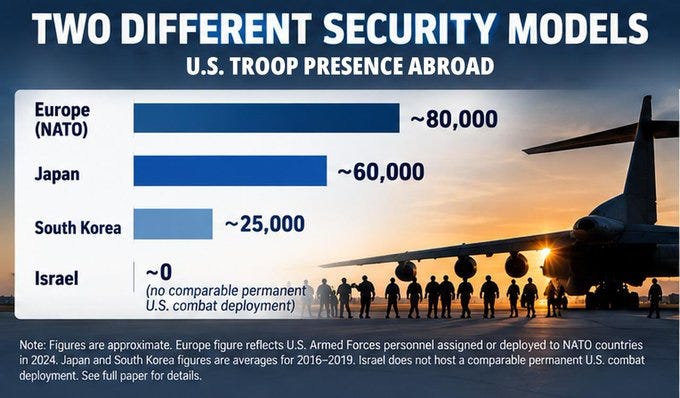
The Misgav report identifies approximately 80,000 U.S. troops assigned or deployed to NATO countries in Europe in 2024, alongside roughly 60,000 personnel in Japan and 25,000 in South Korea. Israel, by contrast, maintains its own military without a comparable permanent American combat deployment. Israel also spent approximately 8.8% of its GDP on defense in 2024, compared with NATO-wide defense expenditures of 2.65% of combined GDP. Before the October 7, 2023, Hamas-led terrorist attack, Israel’s defense spending stood at 4.4% of GDP in 2022.
Overseas Military Bases Carry Additional Costs
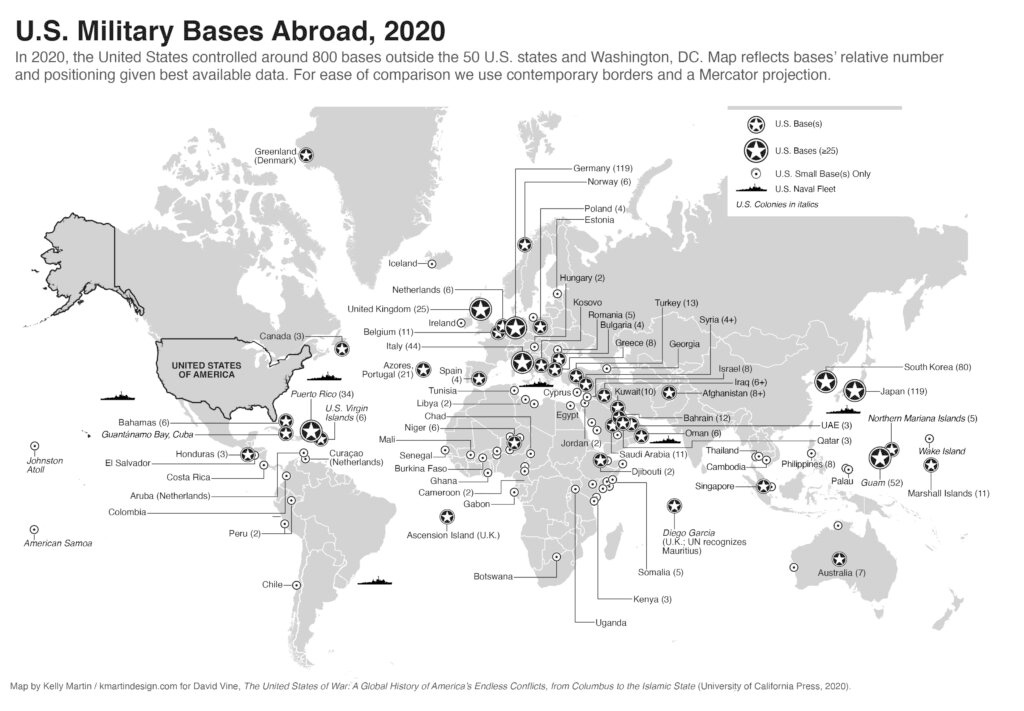
A 2024 Congressional report identified at least 128 U.S. military bases overseas across 51 countries. For fiscal year 2023, it identified approximately $5.4 billion in military construction budget authority for commands outside the continental United States, including projects in Hawaii and Guam, alongside approximately $27.8 billion in overseas operations and related expenses. Using these figures, Yakoby calculates a rough gross estimate of $33.2 billion, or $32.5 billion after subtracting certain reported host-country contributions, although the underlying spending categories are not fully comparable.
A separate Quincy Institute analysis estimated overseas basing costs at approximately $55 billion annually, rising to roughly $80 billion when personnel expenditures were included. While calculated using different methodologies, the estimates demonstrate the substantial costs of American military commitments recorded outside traditional foreign assistance budgets.
Military Aid to Israel Also Supports U.S. Defense Industries
Under the current U.S.-Israel Memorandum of Understanding, Washington provides $3.3 billion annually through Foreign Military Financing and an additional $500 million for joint missile defense cooperation, supporting programs including Iron Dome, David’s Sling and Arrow.
Yakoby emphasizes that much of this assistance finances American-produced military equipment. Historically, roughly three-quarters of Israel’s Foreign Military Financing was required to be spent on U.S. goods and services, with the remaining offshore procurement exception being phased out by 2028. The spending supports American defense contractors, manufacturing facilities and production lines, although the report acknowledges that these industrial benefits do not eliminate the fiscal cost of the assistance.
The analysis also accounts for extraordinary wartime assistance. Following the October 7 attack, Congress approved an additional $8.7 billion in military financing and missile defense funding in April 2024, bringing fiscal year 2024 appropriations for these programs to approximately $12.5 billion.
Intelligence, Technology and Battlefield Experience
Beyond financial considerations, Yakoby identifies significant strategic returns for the United States through intelligence sharing, technological development and Israeli combat experience. In May 2026, the Senate Select Committee on Intelligence reported legislation describing Israel as a critical American security partner whose defense and intelligence capabilities contribute to U.S. operational effectiveness and technological superiority.
The report documents American adoption of Israeli-developed military technologies, including the Trophy and Iron Fist active protection systems for armored vehicles, F-35 components and advanced communications equipment. It also identifies lessons from Israeli military operations that have informed American military research and training.
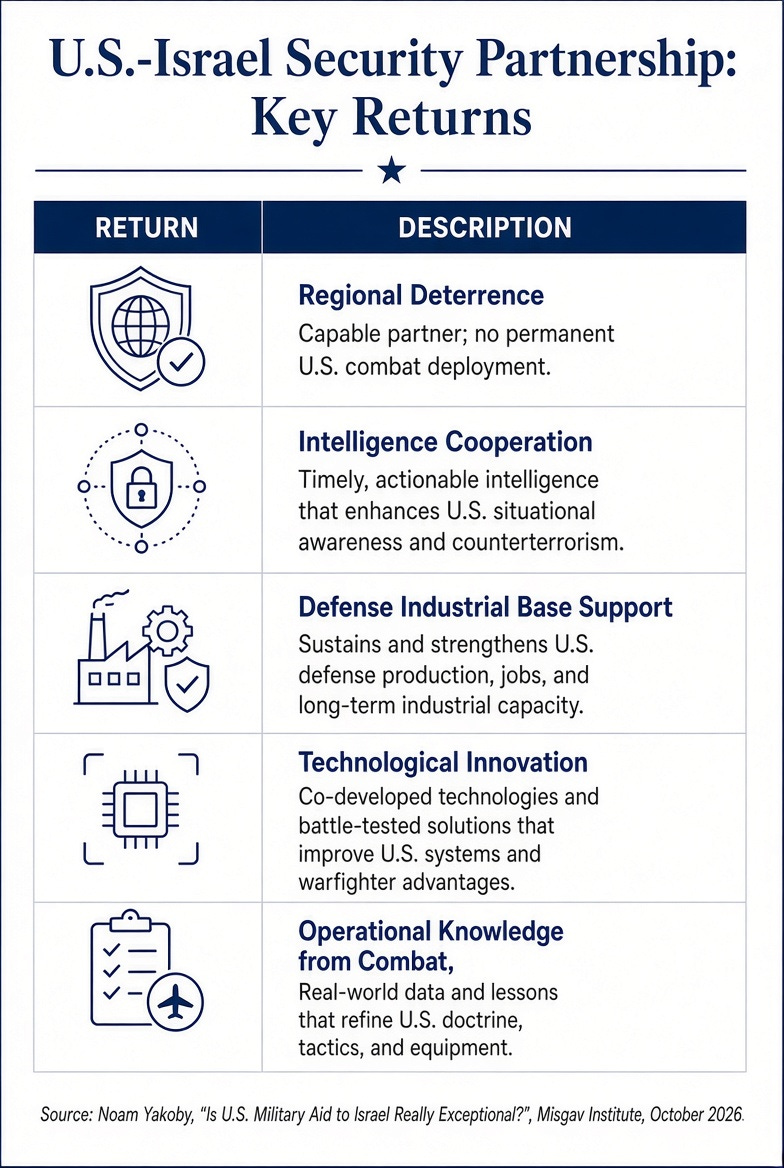
An April 2026 U.S. Army study examined Israeli battlefield medicine and casualty evacuation practices, while a September 2025 Army analysis drew lessons from Israeli operations against Hamas’ tunnel infrastructure in Gaza. Yakoby argues that this operational experience, alongside Israel’s capabilities against Iranian military threats, strengthens American military preparedness and regional deterrence.
Assessing the Strategic Value of U.S. Aid to Israel
With the current U.S.-Israel military assistance agreement set to expire in September 2028, Yakoby argues that future negotiations should account for the full costs and strategic benefits of American security partnerships rather than evaluating aid to Israel in isolation. The report emphasizes that Israel’s independent military capabilities, intelligence cooperation, defense innovation and contributions to regional deterrence provide Washington with returns that extend beyond the financial value of military assistance.
While the analysis does not advocate maintaining current aid levels indefinitely and acknowledges growing support for gradually phasing out assistance, it argues that any changes should be evaluated against the costs and benefits of alternative American security arrangements. Yakoby concludes that U.S. military aid to Israel is considerably less exceptional when examined alongside Washington’s broader global defense commitments.