


Jewish Onliner is an independent publication. If you find our work valuable, please consider becoming a paid subscriber. You can also subscribe to us on WhatsApp and Telegram. Follow us on Instagram, Discord, and X.
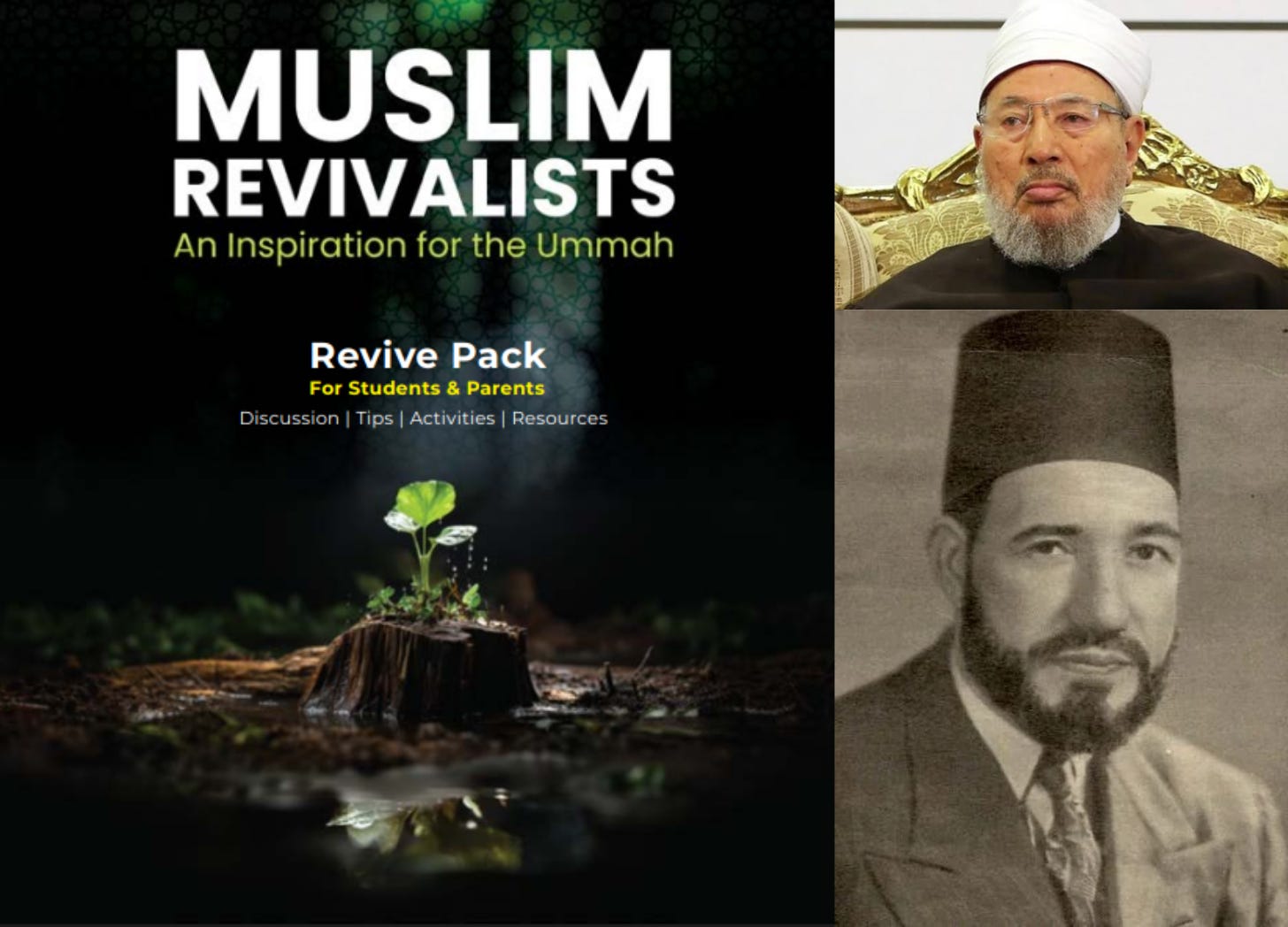
A Jewish Onliner investigation has uncovered educational materials published by the Muslim American Society (MAS), a tax-exempt 501(c)(3) nonprofit organization, that promote Muslim Brotherhood founder Hassan al-Banna and Yusuf al-Qaradawi, widely regarded as the Brotherhood’s spiritual leader, as models of Islamic revival. Qaradawi, who died in 2022, publicly endorsed suicide bombings targeting Israeli civilians and maintained close relationships with senior Hamas leaders.
The materials include a Muslim Revivalists booklet featuring educational activities for children as young as seven, including exercises encouraging students to envision an Islamic revival in America, and a separate Sincerity teaching packet that incorporates Qaradawi’s writings into structured educational programs for youth and young adults.
Jewish Onliner’s examination also identified more recent MAS publications invoking al-Banna’s teachings, a project to translate and distribute Qaradawi’s books, and material adapted from a scholar affiliated with the International Union of Muslim Scholars (IUMS). The findings come as the United States has expanded counterterrorism sanctions and designations against Muslim Brotherhood branches accused of supporting Hamas.
Muslim Brotherhood Founder Featured in Student Revivalism Booklet
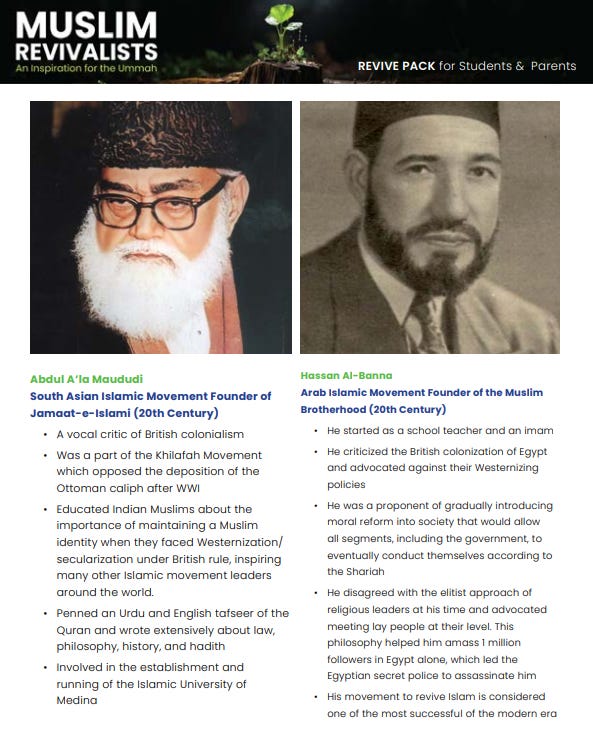
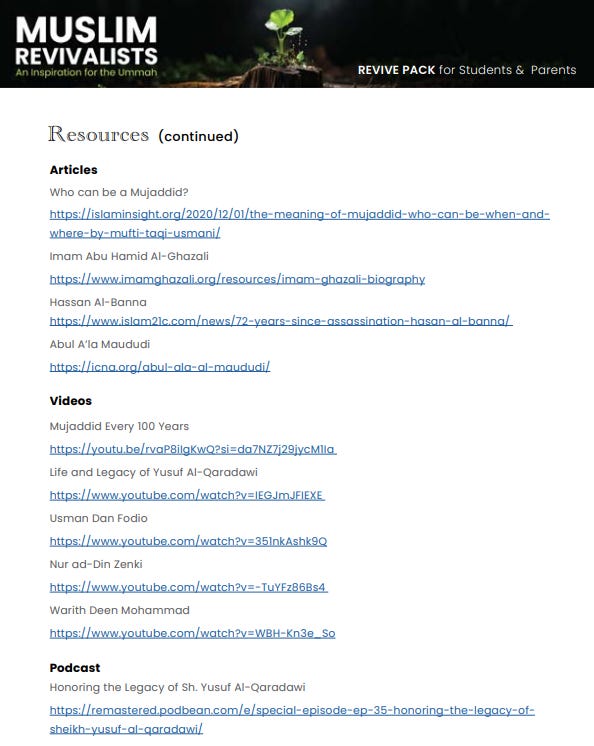
The Muslim Revivalists booklet, hosted in MAS’s November 2023 online resource directory, introduces students and parents to tajdid, the concept of Islamic religious renewal. Its historical profiles include Hassan al-Banna, founder of the Muslim Brotherhood in Egypt in 1928, and Abul A’la Maududi, founder of the Islamist movement Jamaat-e-Islami.
The booklet presents Hassan al-Banna as a model of Islamic revival, portraying his efforts to reshape Egyptian society and government around Islamic law as an achievement. MAS credits him with advocating “gradually introducing moral reform into society” until all segments, including government institutions, would eventually operate according to Sharia law.
MAS further claims that al-Banna’s organizing methods attracted “1 million followers in Egypt alone” and describes his movement as “one of the most successful of the modern era.” The booklet presents the Brotherhood’s founder as a historical example of successful Islamic revival and social transformation, without critically examining the movement’s ideology or political objectives.
Qaradawi Presented as a Moderate Revivalist Despite Support for Suicide Bombings
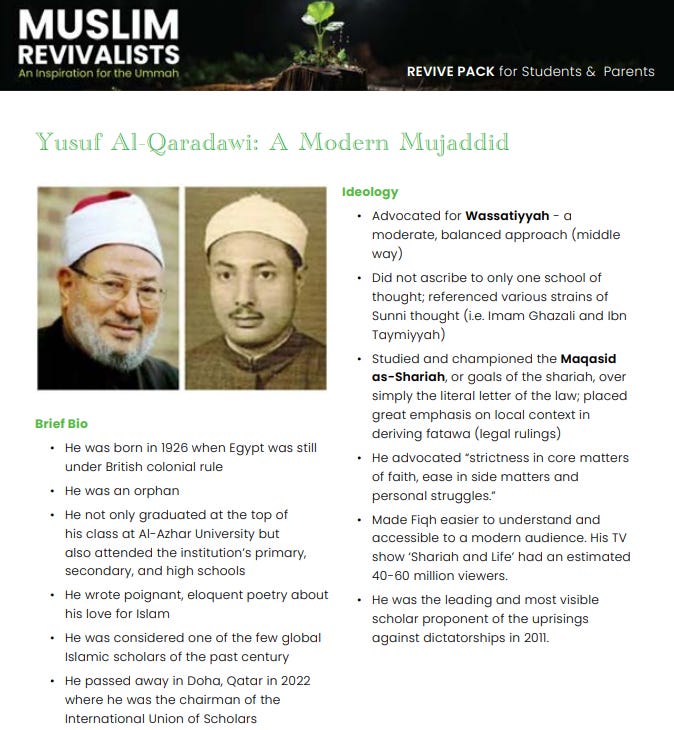
A subsequent section, titled Yusuf Al-Qaradawi: A Modern Mujaddid, presents the late cleric as an influential religious reformer whose teachings made Islamic jurisprudence accessible to Muslims internationally. Under a heading labeled “Ideology,” the booklet says Qaradawi advocated wasatiyyah, describing it as “a moderate, balanced approach.” It also praises his flexibility across Sunni schools of jurisprudence and emphasis on the broader objectives of Sharia.
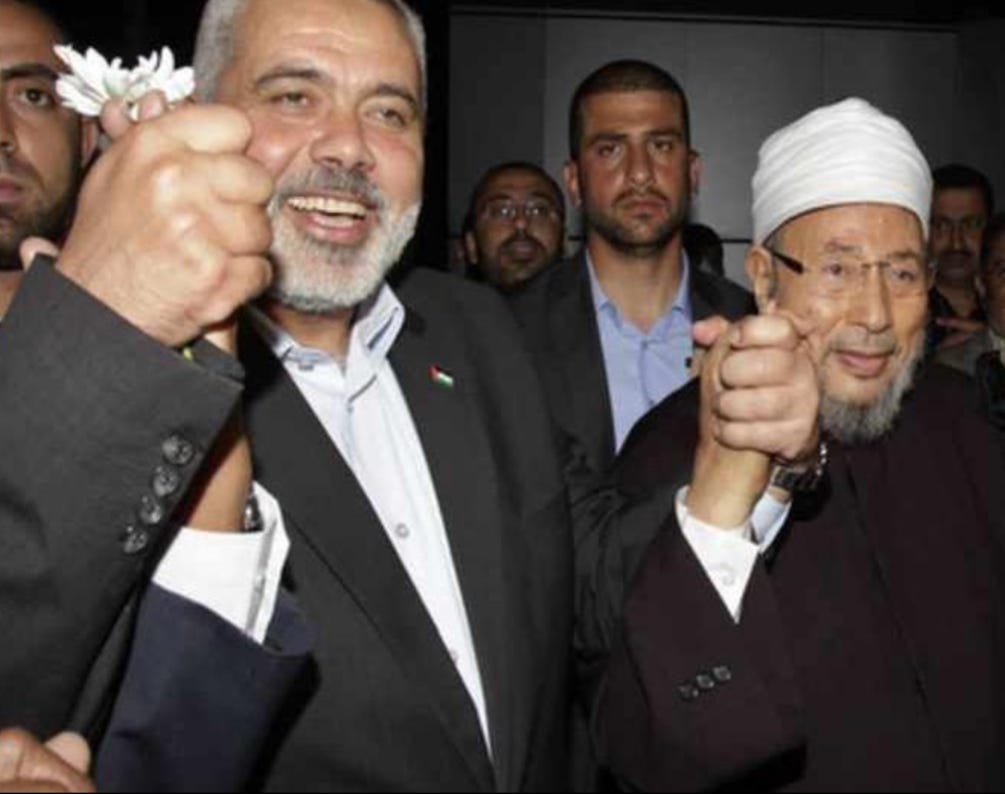
The characterization contrasts with Qaradawi’s documented support for terrorist violence against Israelis. During a July 2004 appearance in London, he publicly defended Palestinian suicide bombings, describing them as legitimate martyrdom operations. His religious rulings helped legitimize Hamas’s suicide bombing campaigns, while his close relationship with the terrorist organization included a 2013 visit to Gaza, where he was photographed being welcomed by Hamas leader Ismail Haniyeh.
The MAS booklet instead emphasizes Qaradawi’s influence, popularity and religious outreach. It specifically credits his Muslim Brotherhood involvement and da’wah work with allowing him to “relate and connect to the masses,” contrasting his accessibility with scholars who concentrated on academic debate and teaching.
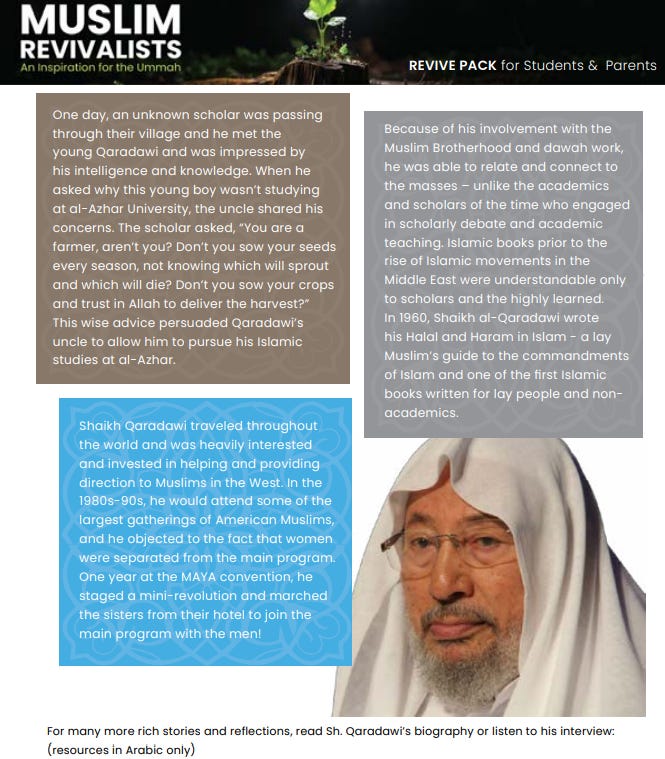
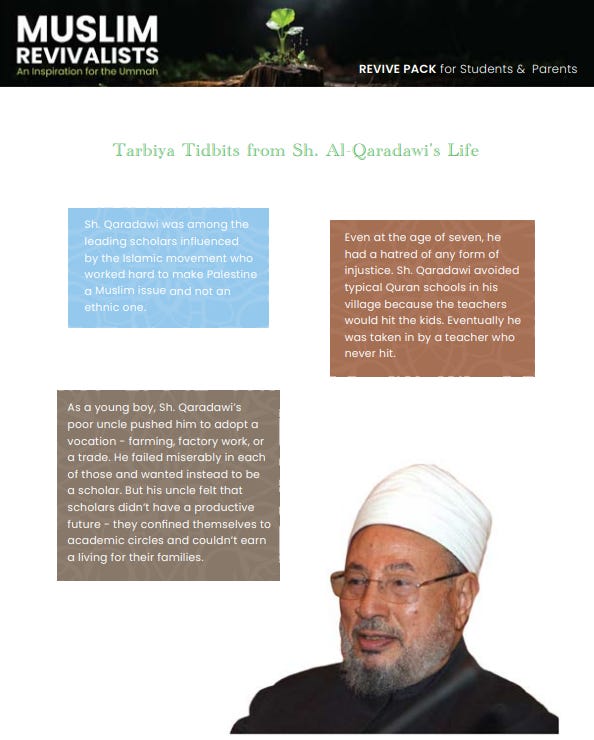
Another passage praises Qaradawi’s efforts to “make Palestine a Muslim issue and not an ethnic one,” presenting his work as instrumental in extending the Palestinian cause beyond an ethnic or national framework.
In its introduction, MAS advertises an accompanying ReMAStered podcast episode reflecting on Qaradawi’s life, characterizing him as an example of a “Modern Day Influencer.”
Exercises for Children as Young as Seven
Beyond its historical profiles, the booklet provides four structured activities intended to translate its lessons into student participation. One exercise, designated for children aged ten and older, instructs participants to divide into groups and assemble digital slideshows depicting their hopes for an Islamic revival in America.
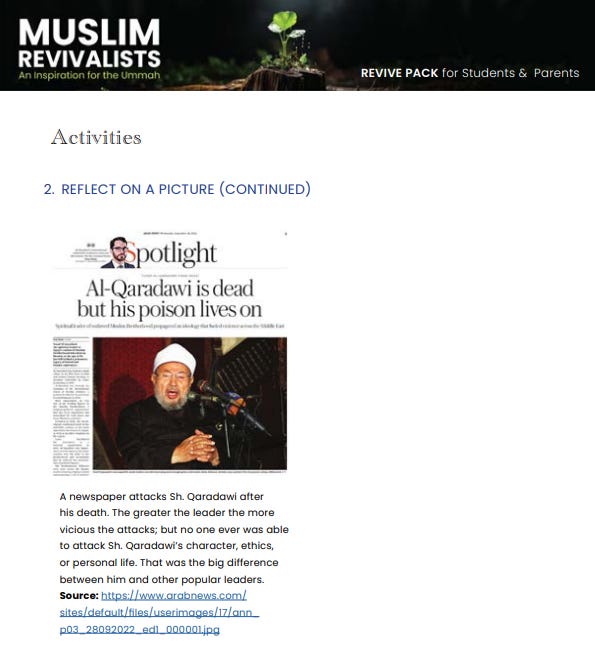
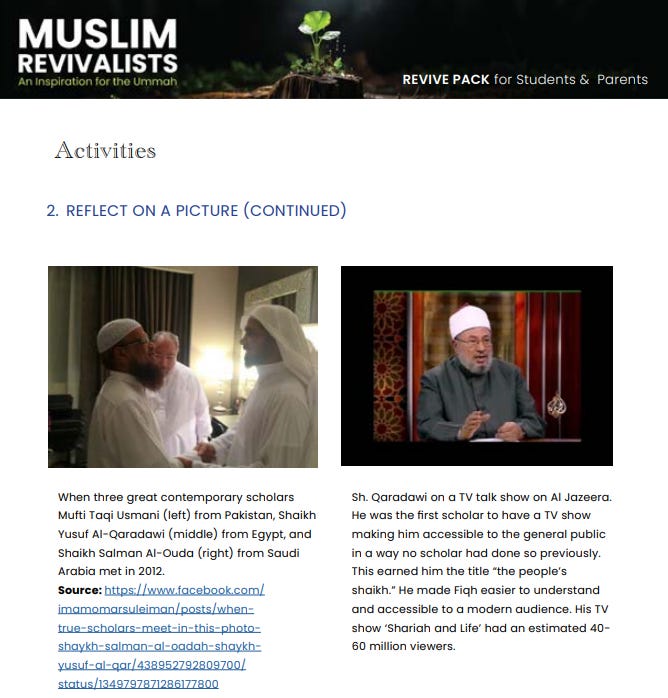
Another activity, intended for participants aged twelve and older, asks students to examine photographs of influential religious figures and discuss their significance. Examples include Qaradawi conducting Maududi’s funeral prayers in Karachi, Pakistan, in 1979, appearing on Al Jazeera and meeting with other Islamic scholars. The booklet provides background information for facilitators to share as participants reflect on the photographs.
For children aged seven and above, a separate activity instructs participants to write prayers seeking the revival of Islam, greater strength for Muslims and guidance on how they personally might contribute to the cause of Islam. Another exercise for children aged seven and older encourages participants to develop daily habits, citing Qaradawi’s practice of writing books during spare moments as an example of personal discipline and productivity.
The activities are presented as adaptable educational exercises for students and parents, connecting the booklet’s revivalist themes with religious practice, personal development and community participation.
MAS Youth Incorporates Qaradawi’s Writings Into Teaching Programs
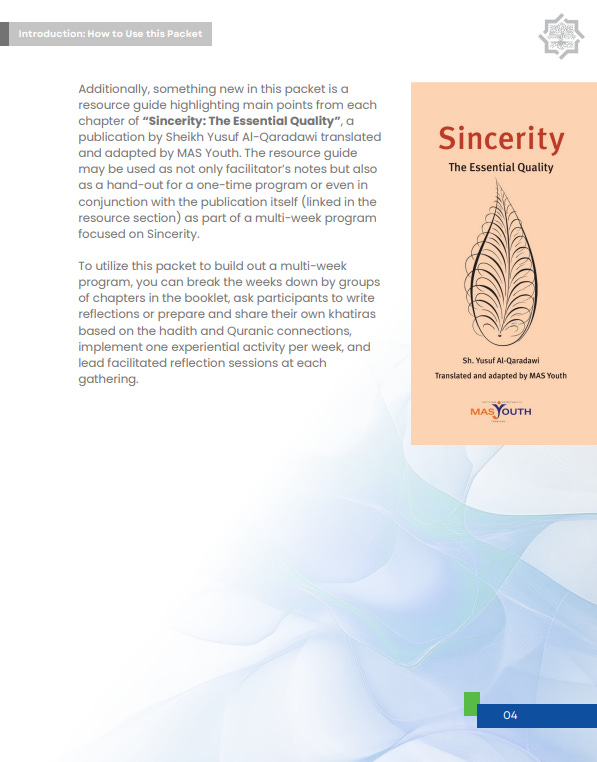
A second MAS Revive Pack, hosted in the organization’s September 2024 resource directory, focuses on sincerity and explicitly identifies its primary audience as youth and young adults. Its introduction states that the packet includes facilitator notes drawn from Sincerity: The Essential Quality, a work by Qaradawi translated and adapted by MAS Youth. The accompanying translators’ notes date that adaptation to December 2006.
The packet explains that facilitators can use the material for a single educational session or a multi-week program, recommending that Qaradawi’s chapters be divided across weekly meetings and combined with personal reflections, short presentations and experiential exercises.
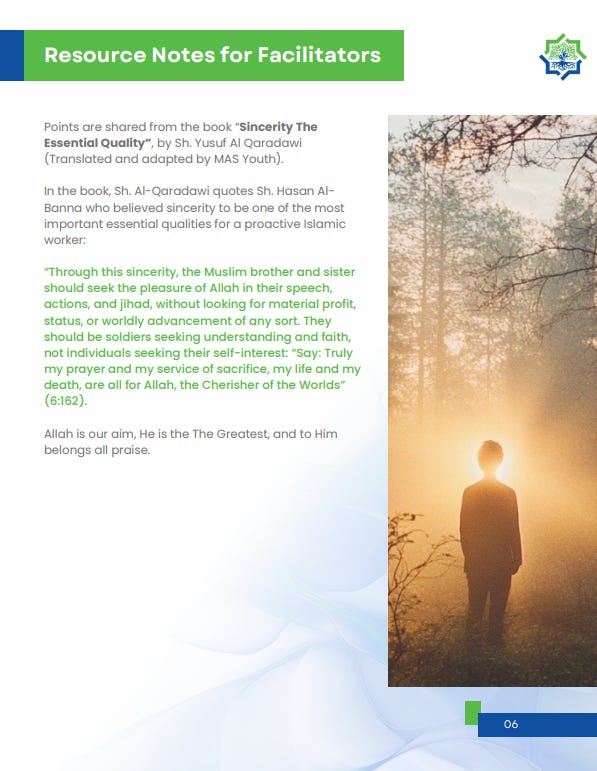
Its opening facilitator notes reproduce Qaradawi’s discussion of Hassan al-Banna’s teachings on sincerity, emphasizing the Brotherhood founder’s call for Muslims to dedicate their speech, actions and jihad to God rather than personal advancement. The accompanying online edition introduces al-Banna’s ten principles for Islamic movement work, including sincerity, action, jihad, sacrifice, compliance and loyalty.
Continued Promotion Through MAS Publishing and Translation Projects
The two booklets are accompanied by additional MAS publications referencing the same figures and intellectual tradition. In a November 21, 2024 article titled Elements of Successful Movement Work According to Divine Sources, MAS discusses personal sacrifice, organizational discipline, leadership, consultation and collective Islamic organizing. The article cites al-Banna’s Message of the Teachings, including his description of fighting for God’s sake as the highest level of struggle, while also discussing oral, written and other forms of effort.
MAS has also advertised an initiative to expand the availability of Qaradawi’s writings. An archived February 2025 Project100 listing describes a proposal to translate all of Qaradawi’s books and distribute them digitally alongside audiobook recordings.
More recently, on July 15, 2026, MAS published The Overlooked Virtue of Safeguarding the Ummah, identifying the underlying author as Khaled Hanafi, a member of the International Union of Muslim Scholars.
In testimony submitted to an August 5, 2026 Senate Judiciary hearing, National Jewish Advocacy Center Senior Litigation Counsel Arielle Klepach described IUMS as the Brotherhood’s “transnational scholarly authority.” In a separate fatwa dated March 28, 2025, and published April 1, the union’s religious-legal committee declared armed jihad against Israel obligatory for capable Muslims, calling for military intervention and the provision of weapons, expertise and intelligence to armed fighters.
U.S. Expands Muslim Brotherhood Terrorist Designations
The materials have remained publicly accessible during a period of expanding American counterterrorism action against Muslim Brotherhood networks. On November 24, 2025, President Donald Trump signed an executive order directing a review of specified Muslim Brotherhood chapters for potential terrorist designations.
On January 13, 2026, the Treasury Department designated the Egyptian and Jordanian branches as Specially Designated Global Terrorists for providing material support to Hamas. The State Department simultaneously designated the Lebanese Muslim Brotherhood, known as al-Jamaa al-Islamiyah, as both a Foreign Terrorist Organization and a Specially Designated Global Terrorist.
Further Treasury sanctions followed on July 23, 2026, targeting senior Egyptian Brotherhood official Mahmoud al-Abyari and additional individuals and entities accused of supporting Hamas financial networks.
MAS’s published figures for 2025 report more than 40 chapters across 23 states, over 50 centers nationwide and more than 8,000 youth and young professionals served weekly. Its publicly available Revive Pack library continues to offer adaptable resources for youth and community education, including materials that local facilitators can use to organize discussions, activities and religious-development programs.