


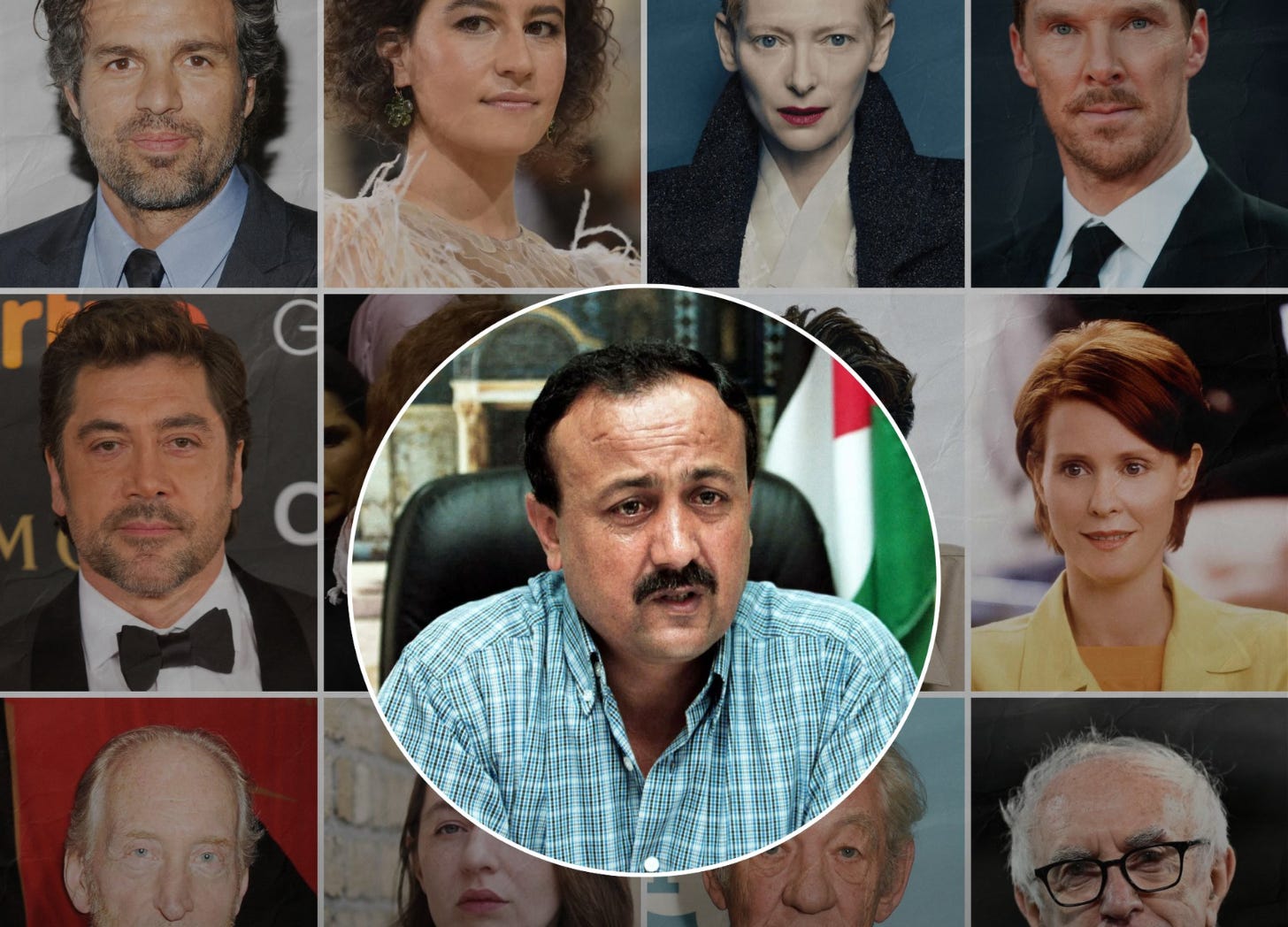
A global campaign backed by over 200 celebrities, artists, and public figures is calling for the release of Marwan Barghouti, a convicted terrorist serving five consecutive life sentences plus 40 years in Israeli prison for his role in orchestrating attacks that killed five civilians during the Second Intifada.
The “Free Marwan” petition, announced Wednesday, has attracted prominent names including British actors Stephen Fry and Miriam Margolyes, American singer-songwriter Paul Simon, actors Mark Ruffalo, Sir Ian McKellen, Benedict Cumberbatch, and Tilda Swinton, as well as musicians Annie Lennox, Sting, and Brian Eno, and author Margaret Atwood.
The campaign claims Barghouti has been “unjustly imprisoned” and “illegally held” for over 23 years, characterizing him as “Palestine’s most popular leader” and “a powerful symbol of unity.” The organizers have explicitly invoked South African leader Nelson Mandela’s name to launder Barghouti’s legacy, with musician Brian Eno declaring: “Just as global solidarity helped free Nelson Mandela, we all have the power to accelerate the day that Marwan Barghouti walks free.”
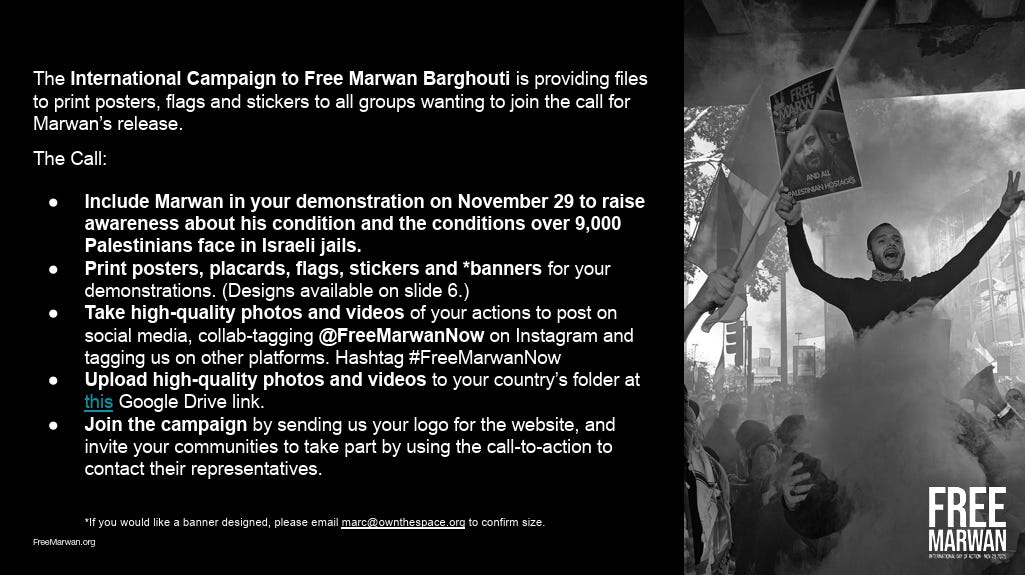
The campaign website features downloadable materials for demonstrations, filming guidelines for social media content, and instructions for contacting political representatives.
A History of Terror, Not Peace
The celebrity campaign’s sanitized portrayal of Barghouti stands in stark contrast to his documented record of terrorism and violence. Barghouti was a founder and senior official of the designated terrorist group Al-Aqsa Martyrs Brigades, which carried out dozens of suicide bombings and shooting attacks that killed Israeli civilians during the Second Intifada between 2000 and 2005. He also served as head of Tanzim, an armed Fatah faction responsible for numerous attacks on Israeli civilians.
Israeli security services regarded him as the “chief of staff of the Intifada” for his leadership of militant forces during the Palestinian terror campaign that claimed over 1,000 Israeli lives. In May 2004, following a lengthy trial, the Tel Aviv District Court convicted Barghouti on five counts of murder for his role in directing specific terror attacks.
The Victims of Barghouti’s Terror
The terror attacks for which Barghouti was convicted, which killed five people, include:
Father Georgios Tsibouktzakis was killed in a drive-by shooting on June 12, 2001, near Ma’aleh Adumim. The 35-year-old Greek Orthodox monk and abbot of St. George’s Monastery in Wadi Qelt was shot in the neck while returning from Jerusalem. The attack occurred during a ceasefire declared by Yasser Arafat following the Dolphinarium discotheque massacre. Barghouti denied directing the attack and falsely accused “Israeli settlers” of the killing.
The Seafood Market attack on March 5, 2002, saw a Barghouti-directed terrorist open fire on a crowded Tel Aviv restaurant with an M16 rifle and throw grenades at fleeing diners. Three civilians were killed—Salim Barakat, 33, of Yarka; Yosef Haybi, 52, of Herzliya; and Eli Dahan, 53, of Lod—along with a Druze police officer who attempted to stop the attacker. Thirty-five were wounded.
Yoela Hen was killed in Jerusalem on January 15, 2002, in another attack for which Barghouti was convicted of directing.
The Campaign’s False Claims of an “Illegitimate” Trial
The “Free Marwan” campaign claims Barghouti was “unjustly imprisoned” in “a violation of justice,” citing an Inter-Parliamentary Union report that allegedly found it was “impossible to say that Mr. Barghouti received a fair trial.”
Critics have responded that this fundamentally misrepresents both the trial and the IPU findings. The IPU report raised concerns about pre-trial detention procedures but explicitly acknowledged that observers found “the hearings were conducted in a relatively impartial climate.” The trial’s unusual character stemmed from Barghouti’s own choice to refuse participation — he instructed his defense team to withdraw and refused to question approximately 100 prosecution witnesses. When the court appointed a public defender to protect his rights, Barghouti maintained complete silence. His non-participation was a political statement, not evidence of judicial impropriety.
The campaign’s claims about parliamentary immunity and Oslo Accords jurisdiction were thoroughly examined and rejected by Israeli courts. Judge Zvi Gurfinkel’s ruling noted that parliamentary immunity does not shield legislators from prosecution for murder and terrorism, and that the Oslo Accords explicitly preserved Israel’s right to prosecute crimes against Israeli citizens. The court found that Article 7.A of the legal appendix states “Israel holds criminal jurisdictional authority in accordance with its domestic laws for offenses committed in the Area against Israel or an Israeli.”
The campaign’s framing that Barghouti was “convicted in a trial by a court he did not recognise” transforms his personal refusal to acknowledge jurisdiction into an objective legal principle. Every criminal defendant would prefer not to face trial—that preference does not delegitimize prosecution. Barghouti was tried and convicted for directing specific terror attacks that killed five identified victims, with evidence presented and tested through adversarial proceedings.
The Price of Terrorism
Throughout his incarceration, Barghouti has continued to receive a salary from the Palestinian Authority as part of its controversial “pay-for-slay” program that rewards terrorists and their families. According to Israeli calculations, Barghouti will have received almost $1 million from the Palestinian Authority by age 85—funded in part by international aid from democratic countries whose taxpayers unwittingly subsidize terrorism.
The celebrity campaign makes no mention of Barghouti’s victims—the Greek monk who devoted his life to hospitality and peace, the restaurant diners celebrating life who were gunned down, and the woman murdered in Jerusalem.