


Jewish Onliner is an independent publication. If you find our work valuable, please consider becoming a paid subscriber.

When more than 70 current and former employees of Amnesty International, Human Rights Watch, Doctors Without Borders, and other major NGOs sat for interviews about internal antisemitism complaints, they described a consistent sequence: inaction, reframing, discrediting, and retaliation. The 63-page report released this week by EiGHT — an advocacy group founded by former humanitarian-sector employees — documents not isolated incidents but a repeatable structure. And it makes a case most coverage has missed: that internal methodological failures don’t stay internal. The report traces one such failure all the way to a Federal Court ruling in Sydney, where an unexamined Human Rights Watch claim about Israel became the center of a high-profile wrongful termination case—and where the organization’s credibility functioned as the only fact-check the claim ever received.
EiGHT submitted the report to Australia’s Royal Commission on Antisemitism and Social Cohesion, established in January 2026 after the December 2025 Bondi Beach terror attack that killed 15 people at a Hanukkah celebration. Coverage since publication has focused on the report’s headline statistics — including findings that these organizations used Gaza suffering as a “fundraising engine” — but less examined is the structural sequence the report spends most of its pages documenting, and the public consequence that followed.
The Four-Step Pattern
Step One: The Complaint Goes Nowhere
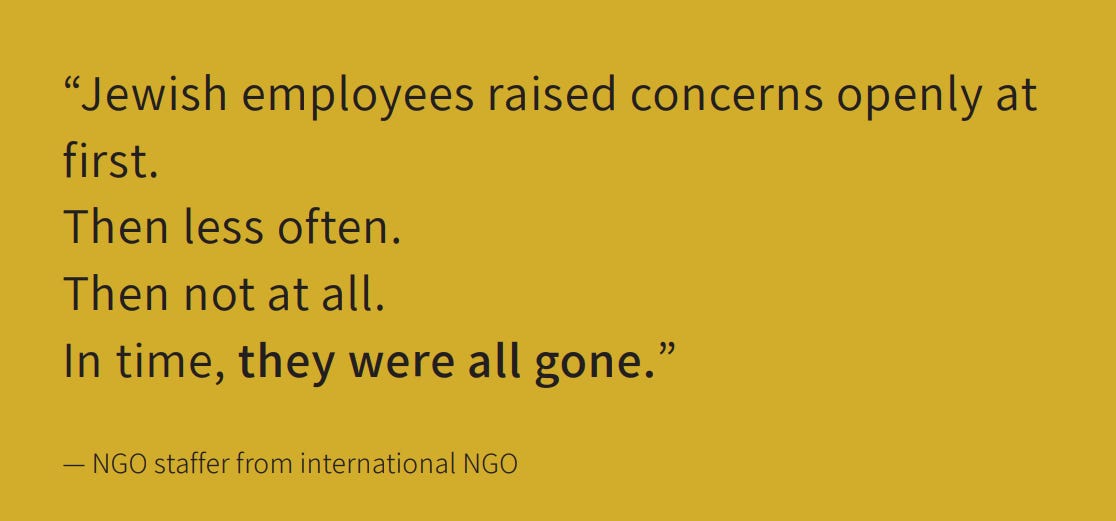
A Working Group on Antisemitism inside one international humanitarian organization with Australian operations wrote to management in August 2025 that proposals from the previous year—including a dedicated antisemitism taskforce—”have not seen follow-through,” and that management could no longer credibly claim it needed more time to understand the problem. One staffer at a global rights NGO said they raised concerns about the quality of the organization’s Israel-related work, after which their role was “eliminated” with no explanation—only to reappear months later under a different title.
Step Two: The Complaint Becomes a Definitional Debate
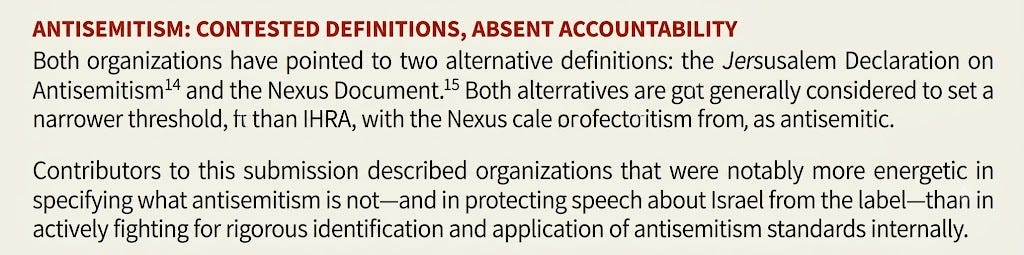
Where complaints did get a response, contributors said, it rarely addressed the underlying conduct. One staffer described the pattern to EiGHT: “The conversation never becomes: ‘What happened, and why did this employee experience it as antisemitic?’ Instead, it immediately becomes: ‘But what is antisemitism really? What about Zionism? What about Gaza?’ You end up circling the drain of definitions while nothing is actually investigated.” In one case, a former employee seeking a professional reference was asked by a former colleague whether the phrase “from the river to the sea” would count as antisemitic under the organization’s adopted definition before a reference would be considered.
Step Three: The Complainant Gets Discredited
When Danielle Haas, EiGHT’s executive director, left Human Rights Watch in October 2023 after 14 years as a senior editor, she detailed her concerns about Israel-related bias in an internal exit email. HRW’s public response did not engage the specifics. Separately, Sari Bashi—who had left her role as HRW Program Director—called Haas an “embittered ex-employee” in a July 2024 interview on Israeli radio. A similar dynamic played out in 2009, when HRW’s own founder, Robert Bernstein, wrote a New York Times op-ed criticizing the organization’s disproportionate Israel focus, prompting internal and public rebuttals that Bernstein said mischaracterized his argument.
Step Four: Retaliation, Exclusion, or a Diagnosis Nobody Acted On
A human rights lawyer at Amnesty USA said she went “from a valued member of the staff to being persona non grata” after objecting to the organization immediately blaming Israel for causing Hamas’s October 7 attacks. In one case at an environmental NGO, a clinical assessment diagnosed an employee with work-related PTSD and recommended a transfer; management declined to investigate the underlying complaint or approve the move, and the employee eventually left.
Where the Pattern Became Public
The report’s most novel argument is structural: that internal methodological failures don’t stay internal. Its clearest example is the case of Antoinette Lattouf, the Australian broadcaster fired by the ABC in December 2023 after resharing a Human Rights Watch claim that Israel was using starvation as a weapon of war.
The Federal Court found in June 2025 that Lattouf’s termination breached the Fair Work Act because her political opinion was a substantial reason for it, and awarded her A$70,000. Separately, the court heard evidence that ABC’s own Content Director had told Lattouf it would be fine to post material that was “fact-based” and from a “reputable organisation,” meaning HRW’s institutional standing functioned, in practice, as the only fact-check her post received before it triggered her firing.
Whether the underlying starvation claim was accurate was never before the court, since the case turned on employment law. According to the report, that omission is precisely the point: an NGO’s institutional credibility substituted for scrutiny everywhere upstream of the courtroom, in the newsroom, in the employer’s vetting, and in the public debate that followed, without anyone in that chain independently verifying the claim.
What the Report Documents
The report draws on interviews with current and former staff at Amnesty International, Human Rights Watch, Doctors Without Borders, Greenpeace, UNICEF, the International Committee of the Red Cross, Plan International, Save the Children, and Mercy Corps. Most organizations did not respond to requests for comment from media outlets covering the report.
Contributors described internal communications platforms at Doctors Without Borders where employees called Israel a “76-year-old crime scene,” dismissed rape allegations against “Palestinian resistance fighters” as “propaganda,” and said “Stop playing the Jewish card.” An internal Human Rights Watch document from October 10, 2023, three days after the Hamas attack, listed among the Middle East team’s “main objectives” to “influence the narrative — highlight the context of this latest round of hostilities (i.e., Apartheid etc.).”
EiGHT’s central recommendation is an independent, sector-wide complaints mechanism, funded independently of both government and the NGOs it would oversee, with binding authority to investigate and publish findings. The report frames the sequence it documents, not isolated incidents, but a structure that consistently absorbed complaints without resolving them, as evidence that self-regulation has failed.