



Over the past two years, violent rhetoric targeting Jews and Israelis has undergone a fundamental transformation across social media platforms. What was once confined to extremist forums or expressed through coded language like “Globalize the Intifada” has evolved into explicit calls for violence, detailed tactical instructions, and open justifications of terrorist attacks—delivered by influencers with millions of followers, activists with mainstream institutional ties, and public figures who face minimal consequences for their statements. The trend has reached new heights amidst Operation Epic Fury,
The shift reflects more than a change in tone: across multiple high-reach influencer accounts with millions of followers, content has included encouragement to build explosive drones, explicit calls to kill Israelis, and rhetoric defending attacks on synagogues—yet platform enforcement appears uneven and, in many cases, absent or delayed.
According to the American Jewish Committee’s State of Antisemitism in America 2025 Report, 91% of American Jews say they feel less safe as a Jewish person in the U.S. due to attacks on Jews in the past 12 months, and more than half (55%) say they changed their behavior out of fear of antisemitism, including 41% who avoided publicly wearing or displaying items that might identify them as Jewish
The report also found that 73% of American Jews experienced antisemitism online in 2025, with significant increases across all major platforms: Facebook (54%, up from 47% in 2024), Instagram (40%, up from 32%), YouTube (38%, up from 27%), and TikTok (23%, up from 18%).
Justifying Terrorism: When Synagogue Attacks Become “Self-Defense”
In March 2026, as news broke of a terrorist attack on Temple Israel in West Bloomfield, Michigan—where Ayman Muhammad Ghazali rammed his explosives-packed car into a synagogue housing a preschool—the response from some corners of the activist left was not condemnation, but justification.
Abubaker Abed, a contributor to Drop Site News, argued that Ghazali was acting “reasonably to defend himself” against what Abed characterized as the synagogue’s “criminality.” His reasoning: Temple Israel supports the Association of Reform Zionists of America, which backs the Reform movement in Israel. “The fact that they do this in a temple doesn’t rule out its gravity and criminality,” Abed wrote.
Far-left financier Fergie Chambers echoed similar sentiments in response to the attack, stating: “What’s the problem? Seems a measured and appropriate response.” The casualness with which public figures with mainstream connections justified an attack on a synagogue and Jewish school marked a threshold in acceptable discourse.


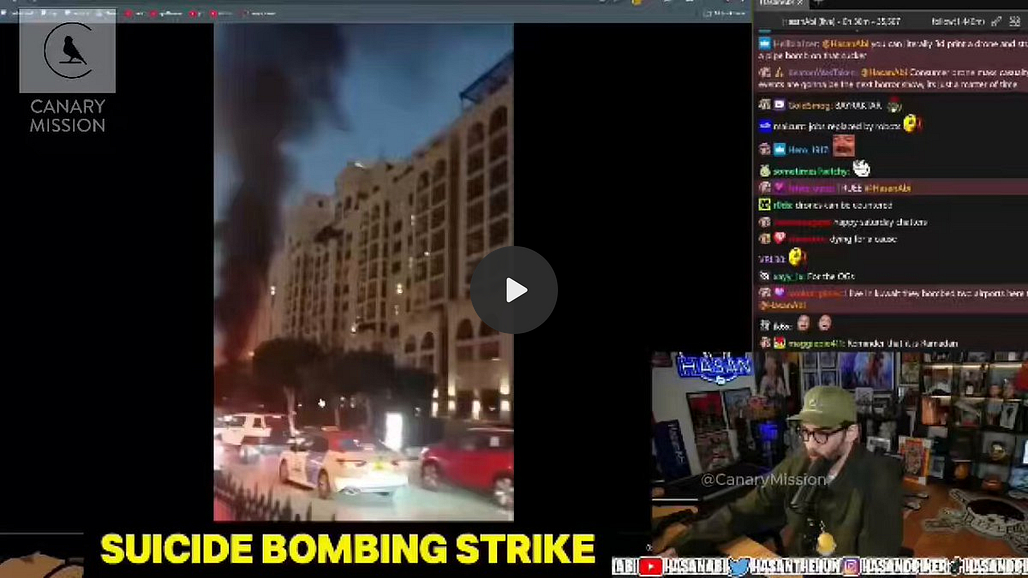
In March 2026, social media influencer Hasan Piker told his millions of followers that suicide bombing was “dead” but offered an alternative: “Just make f**king drones. You can purchase them from online marketplaces. China literally sells explosive ordnance delivery mechanisms that you can put on a DJI drone. You can buy them at virtually no significant cost.” The commentary, documented by Canary Mission, provided tactical instructions to an audience of 2.5 million Twitch followers.
Piker, who regularly appears on mainstream podcasts, represents a new category of influencer: politically engaged content creators who package extremist rhetoric as progressive activism. His drone bomb tutorial followed months of content glorifying terrorist organizations, downplaying Hamas violence, and describing Zionists in increasingly dehumanizing terms.

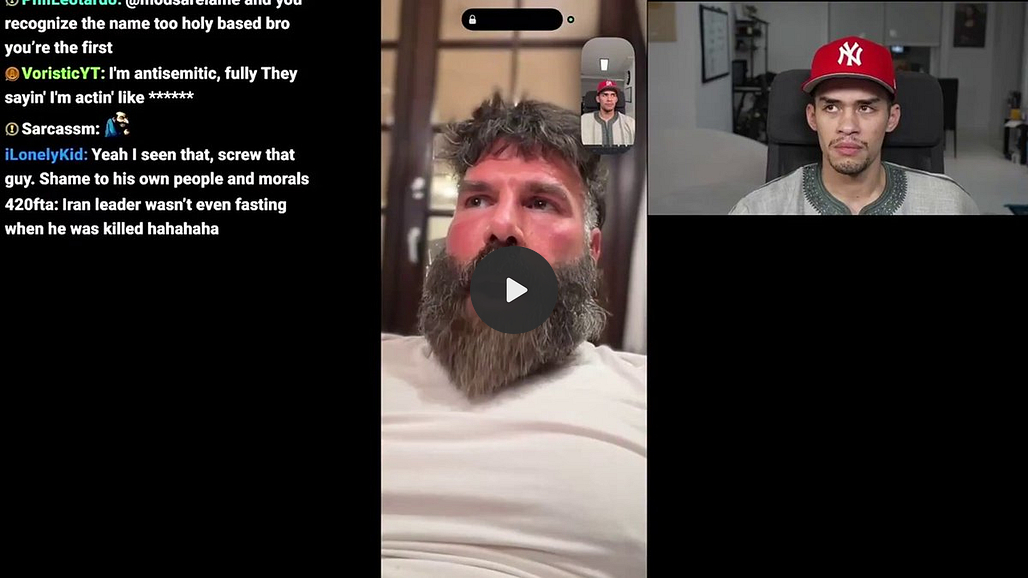
Influencer Dan Bilzerian took the rhetoric further, declaring in a clip from a podcast that later went viral on X—with one post of the clip receiving over 1.6 million views “The only battle today that I see worth fighting is exterminating Israel. I would sign up tomorrow to kill Israelis. Give me a rifle and send me the f**k over there. The majority of that country is evil, suppressing Palestinians, operating like terrorists, they’re arrogant bastards. They need to be wiped off the map.”
The statement—explicit genocide advocacy from a figure with over 29 million Instagram followers—generated significant engagement but faced no platform consequences.

The “Kill All Zionists” Phenomenon
Perhaps no phrase better captures the normalization than “Kill All Zionists,” which has appeared spray-painted inside UC Berkeley graduate housing, scrawled on campus buildings, and shared across social media platforms. When Hen Mazzig documented the UC Berkeley graffiti, he asked: “Are Jewish students expected to feel safe when someone is literally calling for their murder? Threats against Jews are escalating while the university looks away.”


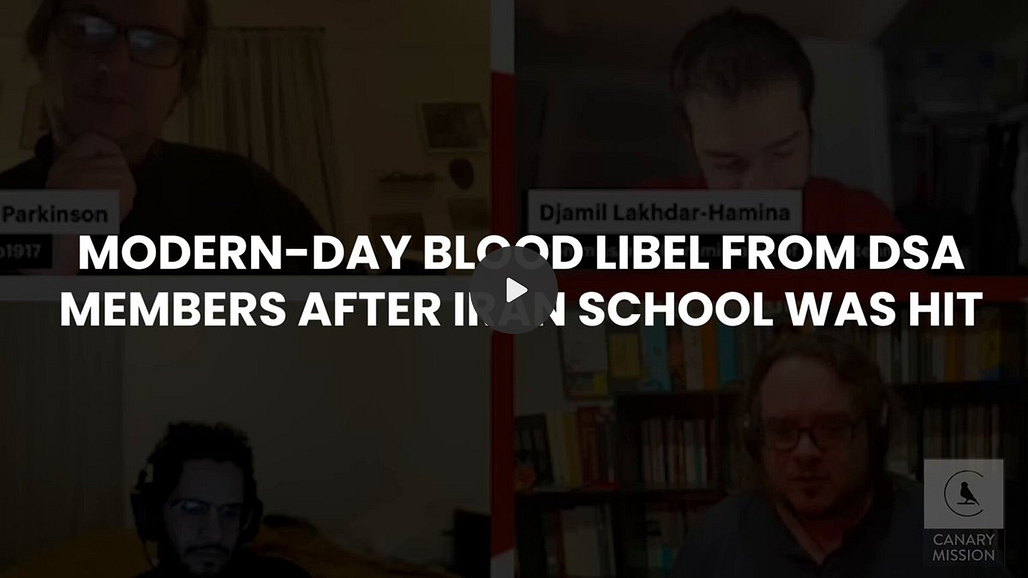
Democratic Socialists of America members Donald Parkinson and Utah high school English teacher Christopher Derick Varn took the rhetoric into even darker territory, evoking a modern blood libel when discussing an Iranian school attack. “When someone says there’s a secret cabal of pedophiles, satan-worshiping child-eaters, they are not totally wrong,” the DSA members stated. “They (Israelis) may not literally eat children, but it’s not like they won’t kill children to achieve their goals.”
Students for Justice in Palestine posted in October 2025: “Death to the occupation. Death to Zionism. Death to all collaborators”—language that directly echoed Hamas propaganda justifying the execution of Palestinians accused of working with Israel. The statement generated thousands of shares and inspired similar posts from affiliated chapters nationwide.
The Anti-Defamation League documented in its 2024 audit that for the first time in 46 years of tracking, a majority (58%) of antisemitic incidents contained elements related to Israel or Zionism. This represents a fundamental shift: opposition to Israel has become the primary vehicle for expressing and normalizing violence against Jews.
The Accountability Gap
This moment is defined by an accountability gap: high-reach content that promotes, excuses, or operationalizes antisemitic violence has often remained online with limited or no enforcement, even where platform rules appear to apply. The resulting inconsistency signals that violent rhetoric framed around “Zionists” or Israelis is treated differently than comparable hate speech and incitement.
These concerns extend to emerging amplification pathways. In the American Jewish Committee’s State of Antisemitism in America 2025 Report, 65% of American Jews say they are concerned that generative AI chatbots will spread antisemitism, and 69% say they are concerned that AI-generated information and misinformation will lead to antisemitic incidents.
With violent rhetoric already linked to real-world harm—including firebombings, arsons, and assaults—the key variable is whether platforms and institutions apply existing policies consistently and early enough to reduce the risk of further antisemitic violence.