


Jewish Onliner is an independent publication. If you find our work valuable, please consider becoming a paid subscriber.
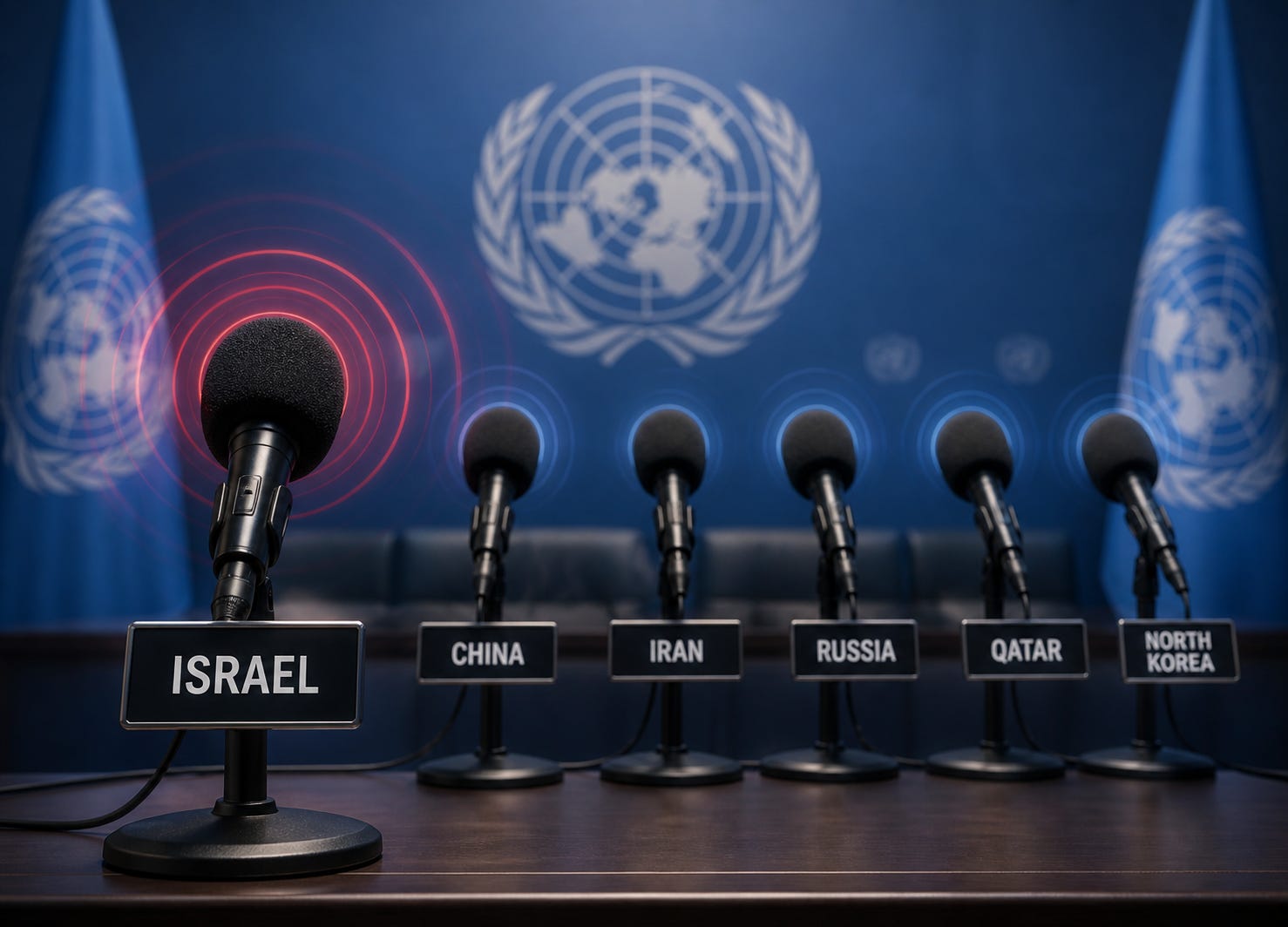
A new Jewish People Policy Institute report says UN Secretary-General António Guterres referred to Israel more often — and more negatively — than Iran, China, Russia, North Korea or Qatar in an analysis of 1,146 UN-published statements, press encounters and readouts from 2017 through April 14, 2026.
The findings land as Guterres is in the final year of his current term, which ends on Dec. 31, 2026, and as his role in the Israel-Hamas war remains fiercely contested. JPPI says it reached its findings by collecting UN-published statements, press encounters and readouts from the Secretary-General’s official website, then using keyword filtering, language filtering and AI-based sentiment analysis to classify country references.
The dataset behind the finding
JPPI’s researchers said they collected statements from the UN Secretary-General’s official website, searched for country references, removed duplicates, filtered out non-English text and excluded references made by speakers other than Guterres. The study then classified the tone of each remaining country reference as negative, neutral or positive.
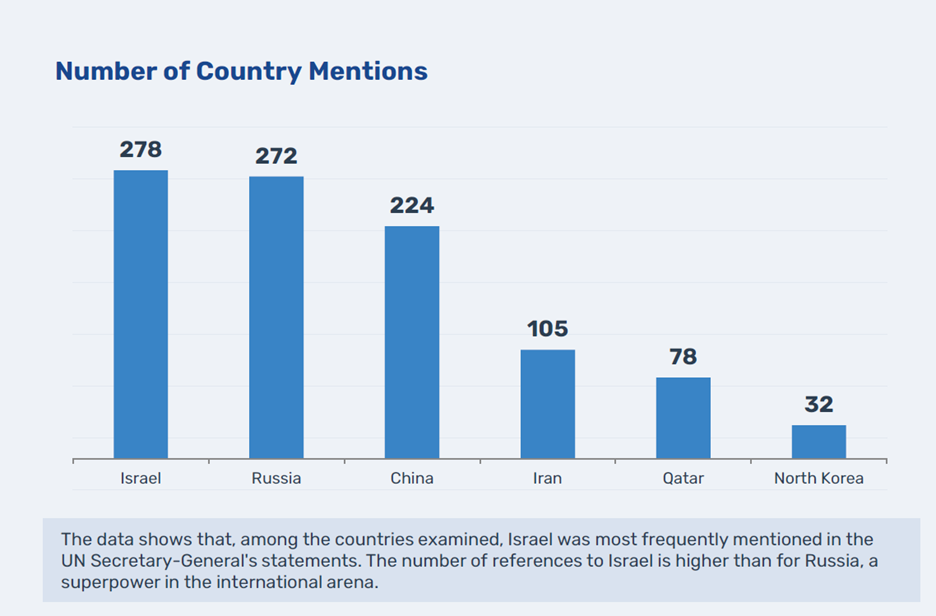
The report found 278 references to Israel, more than any other country examined and nearly three times Iran’s 105 references. More than half of the statements about Israel — 50.7% — were classified as negative, compared with 42.1% neutral and 7.2% positive.
Tone on Israel worsened over time
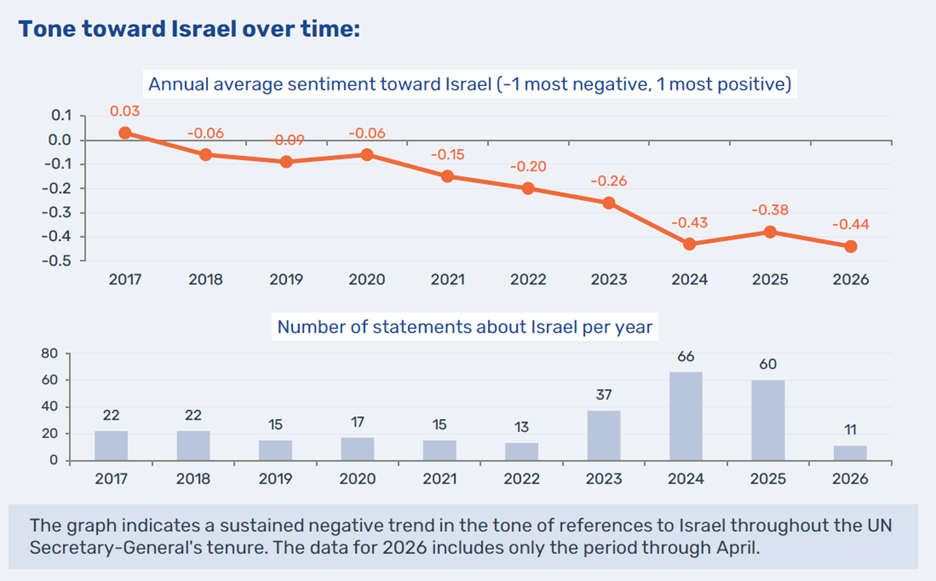
The trendline on page 6 of the report shows that Guterres’s average annual sentiment toward Israel moved from slightly positive in 2017 to deeply negative in 2024, 2025 and early 2026. The same page shows a sharp rise in Israel-related statements during the Oct. 7 and Gaza war period, with annual totals increasing from 13 in 2022 to 37 in 2023, 66 in 2024 and 60 in 2025.
JPPI highlights Guterres’s Oct. 13, 2023, remarks as a key example. In that statement, he opened by saying Gaza had reached “a dangerous new low,” condemned Hamas’s massacre in Israel, called for hostages to be released and urged leaders to oppose antisemitism, anti-Muslim bigotry and hate speech. But the report argues the remarks quickly shifted toward criticism of Israel’s military evacuation order and the humanitarian conditions inside Gaza.
China and Qatar drew a different profile
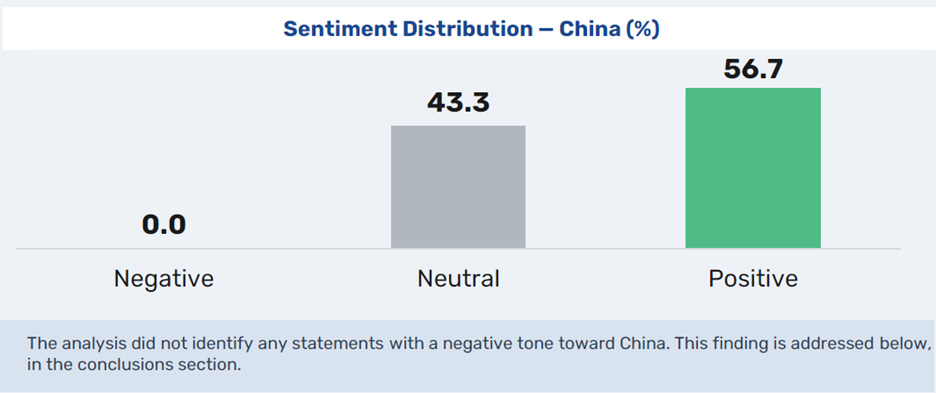
JPPI found no negative-toned statements about China in the analyzed dataset. The report describes Guterres’s treatment of China as “lenient,” including in a May 2020 press conference where he avoided directly addressing questions about Hong Kong’s 2020 National Security Law, which criminalizes what it describes as “secession,” “subversion,” “terrorist activities” and “collusion” with a “foreign country,” with the gravest offenses carrying penalties up to life imprisonment.
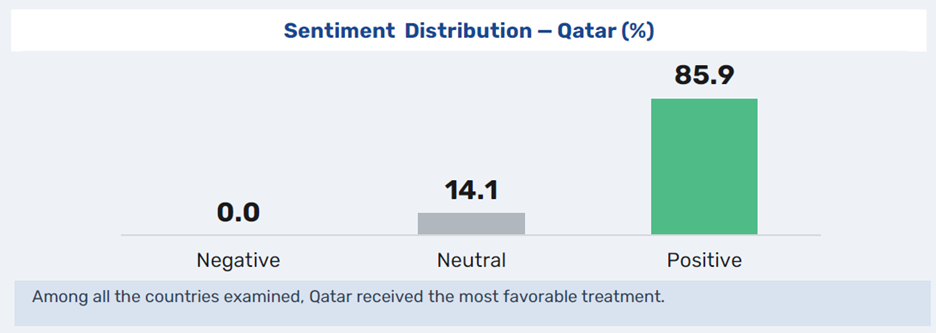
Qatar received the most favorable treatment in JPPI’s analysis, with 85.9% of references classified as positive and none classified as negative. In March 2023, Guterres praised Qatar’s partnership with the UN, including its “extremely valuable” contribution to counterterrorism work. JPPI included Qatar as a comparator partly because of the 2017 Gulf diplomatic crisis, when Saudi Arabia, Egypt, the UAE and Bahrain cut ties with Qatar over its support of terrorism and the Muslim Brotherhood.
Acknowledging Analytical Limitations
The report is strongest as a documented pattern in Guterres’s public language, not as proof of motive. Sentiment analysis can identify tone, frequency and trends, but it cannot fully measure context: Israel has been at the center of a prolonged war since Oct. 7, Russia’s invasion of Ukraine generated its own UN crisis, and some countries may appear in statements for diplomatic or humanitarian reasons rather than direct criticism.
Guterres and the UN have also pushed back against claims that he has ignored Hamas. In June 2024, Reuters reported that Guterres said he had condemned Hamas 102 times, including 51 times in formal speeches or statements. The JPPI report itself acknowledges that Guterres recognizes Israel’s legitimacy and security needs, condemned the Oct. 7 attack, met with hostage families and called for hostages’ immediate release.
A Consistency Question for the UN
The Secretary-General’s office carries unusual symbolic weight. The UN Charter defines the Secretary-General as the organization’s chief administrative officer. Article 100 says the Secretary-General and UN staff shall not seek or receive instructions from any government or external authority and must refrain from actions that could reflect on their position as international officials responsible only to the organization.
JPPI’s notes that its central claim is not that Israel should be exempt from criticism. Rather, it is that the volume and tone of criticism directed at Israel appear disproportionate when compared with how Guterres publicly discusses authoritarian states and governments facing extensive rights allegations. As JPPI President Prof. Yedidia Stern put it, the study “does not seek to rule out criticism of Israel,” but raises a question about consistency.