


A new Jewish Onliner report exposes how Qatar Foundation International (QFI) has established an extensive funding network that reaches over one million students in all 50 U.S. states. The organization operates through Arabic language programs, teacher training initiatives, and curriculum development.
Unlike its parent organization, the Qatar Foundation, QFI is not required to register as a foreign agent under U.S. law. This exemption allows QFI to avoid disclosing the full details of its funding activities—neither to parents nor to government authorities—including the nature, scope, and amounts of money it distributes throughout American educational institutions.
Upon reaching out to House Education and Workforce Committee Chairman Tim Walberg (R-MI) with a request for comment, the chairman told Jewish Onliner that “foreign actors use seemingly benign cultural programs to target students and indoctrinate our children.” He emphasized that his committee has passed multiple bills designed to “prevent foreign interference in our K-12 schools and ensure parents are informed about who is funding their children’s education,” adding: “We’re sending a clear message: foreign influence has no place in our K-12 schools.”
Corporate Restructuring Eliminated Transparency
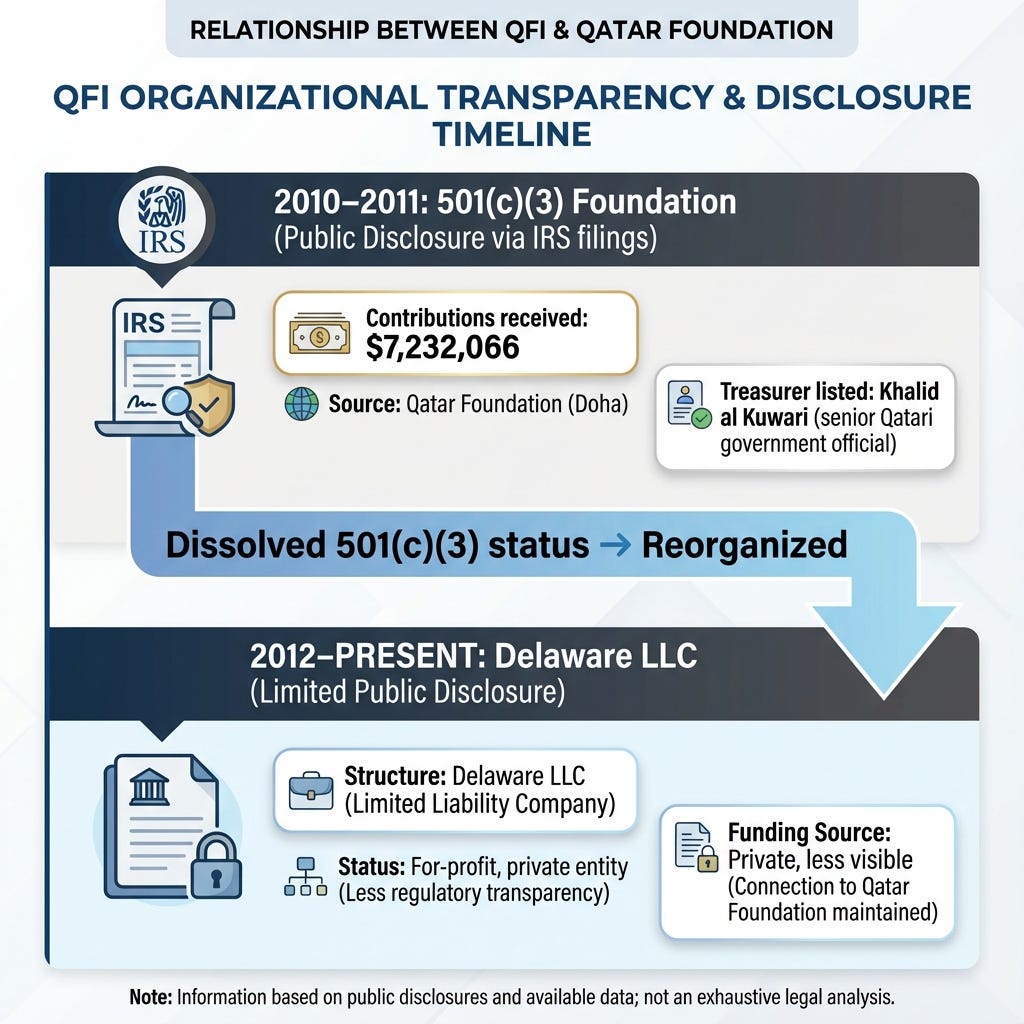
QFI initially operated as a 501(c)(3) tax-exempt foundation requiring public disclosure of its funding patterns through standard IRS filings. During 2010-2011, QFI received $7,232,066 in contributions from its parent organization for distribution. QFI’s treasurer was listed as Khalid al Kuwari, a senior Qatari government official.
However, QFI dissolved its 501(c)(3) status in 2011-2012 and reorganized as a Delaware-registered LLC, ending all public disclosure requirements. While the parent Qatar Foundation has been registered under the Foreign Agents Registration Act (FARA) since 2006 — acknowledging its role as a Qatari government agent — QFI operates without FARA registration, claiming educational exemption.
A May 2020 legal memorandum published by The Lawfare Project concluded that QFI should be required to register as a foreign agent because it functions as an agent of the Qatari government, disbursing funds “for or in the interest of” Qatar while engaging in political activities that go beyond genuine educational purposes.
Sophisticated Funding Network Targets Disadvantaged Districts
QFI distributed $30.6 million to K-12 schools between 2009 and 2017, according to the Wall Street Journal. Jewish Onliner’s report identified at least an additional $1.50 million after 2017, with the true total likely considerably higher. Unlike universities, which must report foreign gifts exceeding $250,000 under federal law, K-12 schools face no such federal disclosure requirements.
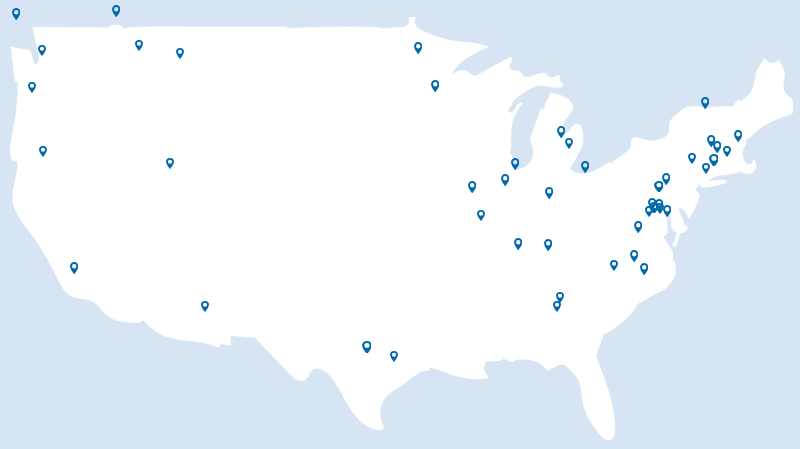
The funding architecture reveals what appears to be the frequent and deliberate targeting of economically disadvantaged school districts with diverse student populations. In New York City alone, QFI funding more than doubled from $275,000 in 2021 to $513,000 in 2022. Houston Independent School District has received ongoing QFI funding since 2015, including $85,000 as recently as 2025. Minneapolis, Tucson, Portland, Los Angeles, New Haven, and Washington D.C. schools have all received substantial grants, many serving economically disadvantaged student populations.
Brown University Program Shut Down After Qatari Influence Exposed
In March 2025, the Institute for the Study of Global Antisemitism and Policy (ISGAP) released a report documenting Qatari influence on Brown University’s Choices Program, a K-12 curriculum used by over 8,000 schools reaching more than one million students. The report found QFI co-sponsored teacher workshops and funded curriculum awards worth up to $328,000, while the program gradually modified Middle East content between 2011 and 2022 without notifying schools.
The modifications included removing the Balfour Declaration, misrepresenting Israel’s capital as Tel Aviv instead of Jerusalem, downplaying the Abraham Accords, and downgrading Hamas and Hezbollah from “labeled terrorist organizations” to groups merely “considered” terrorists while recasting Muslims as “indigenous” and Jews as “colonialists.” The proprietary digital format prevented parents and school boards from reviewing these changes.
Approximately one month after the report’s release, Brown University shut down the Choices Program after 35 years, claiming the decision was “exclusively financial.”
Teacher Training as Core Influence Strategy
QFI describes Arabic teacher training as the “core” of its activity, offering Teacher Professional Development grants of up to $2,000 for K-12 educators to attend conferences and travel programs to Arabic-speaking countries. Starting in 2020, QFI expanded grants to teachers across all subject areas—not just Arabic instructors—offering up to $1,000 for classroom resources and cultural events.
QFI has sponsored the establishment of the Arabic Teachers Council with seven branches coordinating Arabic educators across the United States and funds the Global Exploration for Educators Organization (GEEO), which provides travel programs to Morocco, Egypt, Oman, and Qatar. The organization provides teachers with reading lists presenting favorable portrayals of Qatar without addressing controversies regarding labor practices, women’s rights, or Qatar’s relationships with designated terrorist organizations.
Public Demands Transparency, But Current System Provides None
A 2021 HarrisX survey commissioned by the Lawfare Project revealed that 84 percent of American adults believe parents have the right to know if Qatar is funding their child’s education, 81 percent support stringent legislation requiring accountability for foreign funding, and 70 percent are concerned about foreign funding influencing classroom instruction. Yet the current regulatory framework provides no mechanism for parents to obtain this information about K-12 schools.
The Lawfare Project’s research concluded Qatar’s involvement through QFI is “substantial and significant,” with students learning about the Middle East “in a biased way that emphasizes only the positive aspects of Islam while omitting a balanced discussion of other religions or belief systems, most notably Judaism.”
Leading Organizations Call for Federal Action
Multiple prominent organizations—including ISGAP, Parents Defending Education, the National Association of Scholars, and the America First Policy Institute—have called for federal investigations into foreign influence in K-12 education, mandatory disclosure requirements, strengthened FARA enforcement, and full curriculum transparency. Their recommendations consistently emphasize transparency, parental notification, federal oversight, and enforcement of existing laws.
Qatar’s K-12 investment represents only a fraction of its broader American educational presence. Qatar is the largest foreign donor to U.S. universities, having invested more than $6.3 billion in American higher education since 1986, spending at least $405 million annually covering expenses for six U.S. universities operating branch campuses in Education City, Doha.
Jewish Onliner sought comment about its findings from House Education and Workforce Committee Chairman Tim Walberg (R-MI), who stated:
“We’ve seen countless examples of foreign actors exploiting our classrooms to undermine American education. Too often, foreign actors use seemingly benign cultural programs to target students and indoctrinate our children. In response to this threat, my Committee and the House passed multiple bills that prevent foreign interference in our K-12 schools and ensure parents are informed about who is funding their children’s education. We’re sending a clear message: foreign influence has no place in our K-12 schools.”
Jewish Onliner reached out to Houston Independent School District, New Haven Public Schools, LAUSD, Washington Latin Public Charter School, Minneapolis Public Schools, Bozeman School District, and Tucson Unified School District for comment. None of the school districts responded to requests for comment.
Read the full comprehensive report with detailed sourcing and additional findings at this link.
Important work. I should note that I published an extensive investigation of this exact phenomenon on December 17, 2025: 'How America's Education System Became a Weapon Against Itself' - documenting Brown's Choices Program, Professor Doumani's Qatari funding, the $13.1B in Middle Eastern university donations, and the complete teacher training pipeline. Your piece provides valuable additional detail on QFI's specific regulatory evasion tactics. The thesis and evidence base show substantial overlap, which either reflects independent research arriving at the same conclusions or indicates this story is finally getting the multiple investigations it deserves. https://sleuthfox.substack.com/p/the-trojan-horse-how-americas-education
And Trump got a plane from them