


Jewish Onliner is an independent publication. If you find our work valuable, please consider becoming a paid subscriber. You can also subscribe to us on WhatsApp and Telegram. Follow us on YouTube, TikTok, Instagram, Discord, and X.
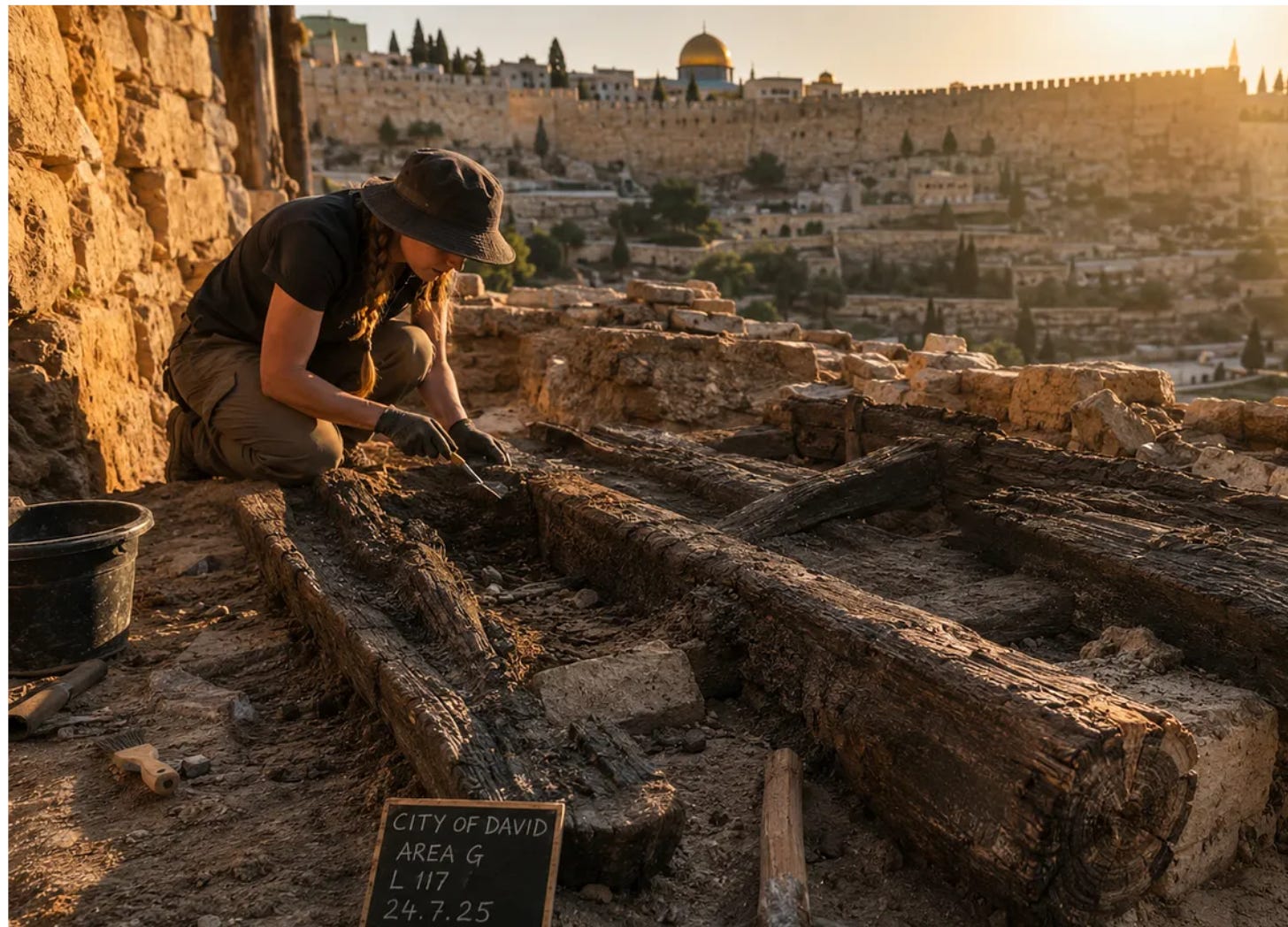
Israeli archaeologists excavating the Givati Parking Lot in Jerusalem’s City of David have uncovered massive charred wooden beams inside a building from the First Temple period.
The Israel Antiquities Authority announced the discovery on July 20, 2026, shortly before Tisha B’Av, the Jewish fast day commemorating the destruction of the First and Second Temples.
Researchers believe the beams burned during the Babylonian destruction of Jerusalem in 586 BCE, when forces under King Nebuchadnezzar II captured the city and destroyed the First Temple.
The building was uncovered within Jerusalem Walls National Park during an excavation conducted jointly by the Israel Antiquities Authority and Tel Aviv University. According to excavation director Efrat Bocher, the timbers appear to have supported the roof of an inner courtyard.
The beams were not part of the Temple itself, but belonged to a substantial building elsewhere in First Temple-era Jerusalem. They include sycamore wood, while separate coniferous specimens were also recovered from the destruction layer.
Physical Evidence Preserved for 2,600 Years
During the Babylonian attack, the building was consumed by an intense fire and its roof collapsed into the courtyard. Heat caused plaster coating the structure’s walls to fall over the charred timbers, sealing them beneath layers of debris.
The resulting protective layer preserved the wood for more than 2,600 years.
“We are just before Tisha B’Av,” Bocher said. “This discovery makes you feel that you are witnessing the very moment of destruction, the moment when it all happened. It’s deeply moving.”
The survival of substantial wooden beams from the Iron Age is exceptionally rare in Israel’s climate. In addition to preserving evidence of the building’s construction, the timbers contain numerous visible growth rings that could help researchers establish a more precise chronology for ancient Jerusalem.


Potential Breakthrough in Archaeological Dating
Dr. Johanna Regev, an Israel Antiquities Authority specialist in radiocarbon dating, is studying the beams and their unusually long sequences of growth rings.
“It is very rare in Israel to find wood with such a large number of growth rings,” Regev said. “Here, in the City of David, we found thick beams with many rings, offering significant research potential.”
By combining radiocarbon analysis with the sequence of preserved tree rings, researchers hope to date the wood much more precisely than would normally be possible.
“Until now, we could date finds within a range of hundreds of years,” Regev explained. “Now, we can attain much greater precision, narrowing the dating range down to as little as 10 years.”
The analysis could help archaeologists refine the chronology of Jerusalem during the final decades of the Kingdom of Judah and better understand the development of the city before the Babylonian conquest.
A Landscape of Memory
The excavation also revealed evidence that later residents may have intentionally left portions of the destruction layer undisturbed when Jerusalem was resettled.
Dr. Yiftah Shalev of the Israel Antiquities Authority, who directs the excavation alongside Professor Yuval Gadot of Tel Aviv University, said the inhabitants who rebuilt the area appear to have constructed new layers above some of the charred ruins rather than removing them completely.
“Preserving memory is a human need, seeking to preserve what once existed,” Shalev said. “Here we see it in its clearest form: a deliberate choice to leave ruins in place as a testament to the destruction and build the new layer over them.”
Researchers describe this as a possible “landscape of memory,” in which physical remains of a traumatic event were incorporated into the rebuilt city. The interpretation suggests that Jerusalem’s destruction continued to shape the city’s inhabitants long after the Babylonian conquest.


A Tangible Link to Ancient Jerusalem
Israeli Heritage Minister Amichai Eliyahu emphasized the discovery’s importance as physical evidence of Jewish history in Jerusalem.
“Jerusalem’s soil continues to provide tangible evidence of the city’s ancient past,” Eliyahu said. “The wooden beams burned in the destruction of the First Temple stand as a powerful reminder of the Jewish people’s presence in Jerusalem some 2,600 years ago.”


“On the eve of Tisha B’Av, this discovery underscores that our connection to Jerusalem is rooted not only in faith, but also in history, archaeology, and collective memory,” he continued. “It is our responsibility to continue uncovering, preserving, and passing this heritage on to future generations.”
According to the Hebrew Bible and Jewish tradition, the First Temple was built by King Solomon in the tenth century BCE and became the center of Jewish religious life. It stood until the Babylonian conquest of Jerusalem in 586 BCE.
The destruction ended the Kingdom of Judah and led to the deportation of thousands of Judeans to Babylon, particularly members of Jerusalem’s political, religious, military and skilled classes. Other inhabitants remained in the region or fled to neighboring territories.
The conquest became one of the defining events in Jewish history, shaping Jewish religious thought, collective memory and hopes for a return to Jerusalem.
Archaeological Evidence of Jerusalem’s Destruction
Excavations at the Givati Parking Lot have continued in phases since 2007, uncovering a complex sequence of remains from the Iron Age through the Persian, Hellenistic, Roman, Byzantine and Early Islamic periods.
Previous discoveries at Givati and elsewhere in the City of David include First Temple-era buildings, fortifications, seals, seal impressions, pottery and other objects associated with Judahite Jerusalem.
Evidence linked by archaeologists to the Babylonian conquest has also been uncovered at several sites across the city. These discoveries include ash deposits, charred wood, collapsed buildings, Iron Age pottery, oil lamps and arrowheads associated with the period.
At Mount Zion, excavators uncovered a destruction deposit containing ash, pottery, lamps, bronze and iron arrowheads, jewelry and the remains of a domestic building dated to the Babylonian conquest of 587-586 BCE.
Together, these finds provide a growing material record of the violent events that brought the First Temple period to an end.
The Tisha B’Av Connection
Tisha B’Av is observed through fasting, mourning and special prayers. It commemorates the destruction of the First Temple by Babylon and the destruction of the Second Temple by Rome in 70 CE, events that Jewish tradition associates with the same date centuries apart.
The day also recalls several other catastrophes in Jewish history and is widely regarded as the most solemn day on the Jewish calendar.
Announcing the discovery shortly before Tisha B’Av created a direct connection between the physical remains of ancient Jerusalem and a living commemorative tradition. The charred timbers offer a tangible link to the destruction Jews continue to mourn each year.
Research Continues
Researchers are continuing to analyze the beams using radiocarbon dating and their preserved growth-ring sequences. The results could provide new information about when the trees were felled, how timber was used in Jerusalem’s buildings and the chronology of the city during the final years of the Kingdom of Judah.
The beams also offer valuable evidence about First Temple-era construction methods and the scale of the fire that destroyed the building.
Their discovery adds to the substantial archaeological record of Judahite Jerusalem and the Babylonian destruction of the city.
For Jews who continue to mourn Jerusalem’s destruction each year, the charred timbers provide an unusually immediate connection to life in the city at the close of the First Temple period. Preserved beneath rubble for more than two and a half millennia, they now serve as both important scientific evidence and a powerful reminder of Jerusalem’s enduring place in Jewish history and memory.
These are really amazing finds! Love this! Sharing!!