


Jewish Onliner is an independent publication. If you find our work valuable, please consider becoming a paid subscriber. You can also subscribe to us on WhatsApp and Telegram. Follow us on YouTube, TikTok, Instagram, Discord, and X.
Israel has opened a grant competition offering up to NIS 100 million, approximately $33 million, to establish a national quantum-computing research and development infrastructure that will give Israeli companies and research institutions access to advanced systems.
The Israel Innovation Authority’s call for proposals opened on July 19 and was publicly announced on July 20. The grant will cover either 55% or 66% of an approved project’s budget, meaning NIS 100 million is the maximum government award rather than necessarily the infrastructure’s total cost.
The planned infrastructure must integrate at least three different quantum-processing technologies. Its intended users will be able to compare platforms, test algorithms, conduct proof-of-concept demonstrations and evaluate which technologies are best suited to particular applications.
The initiative comes as investment in the field accelerates. McKinsey reported that investment in quantum-technology startups reached $12.6 billion in 2025, with 90% going to quantum-computing companies. Israel is not attempting to match every larger country or multinational company dollar for dollar. Instead, the new infrastructure is designed to give its relatively small ecosystem access to several competing architectures while the industry is still determining which approaches will prove most useful.
Quantum Computing 101: Why Regular Computers Can’t Keep Up
To understand why Israel is making this move, you need to grasp what makes quantum computers different from the laptop you’re reading this on. Classical computers — the ones in your phone, car, and office — process information in bits, which are like tiny switches that can be either “on” (1) or “off” (0). Every calculation your computer makes involves flipping billions of these switches in specific sequences.
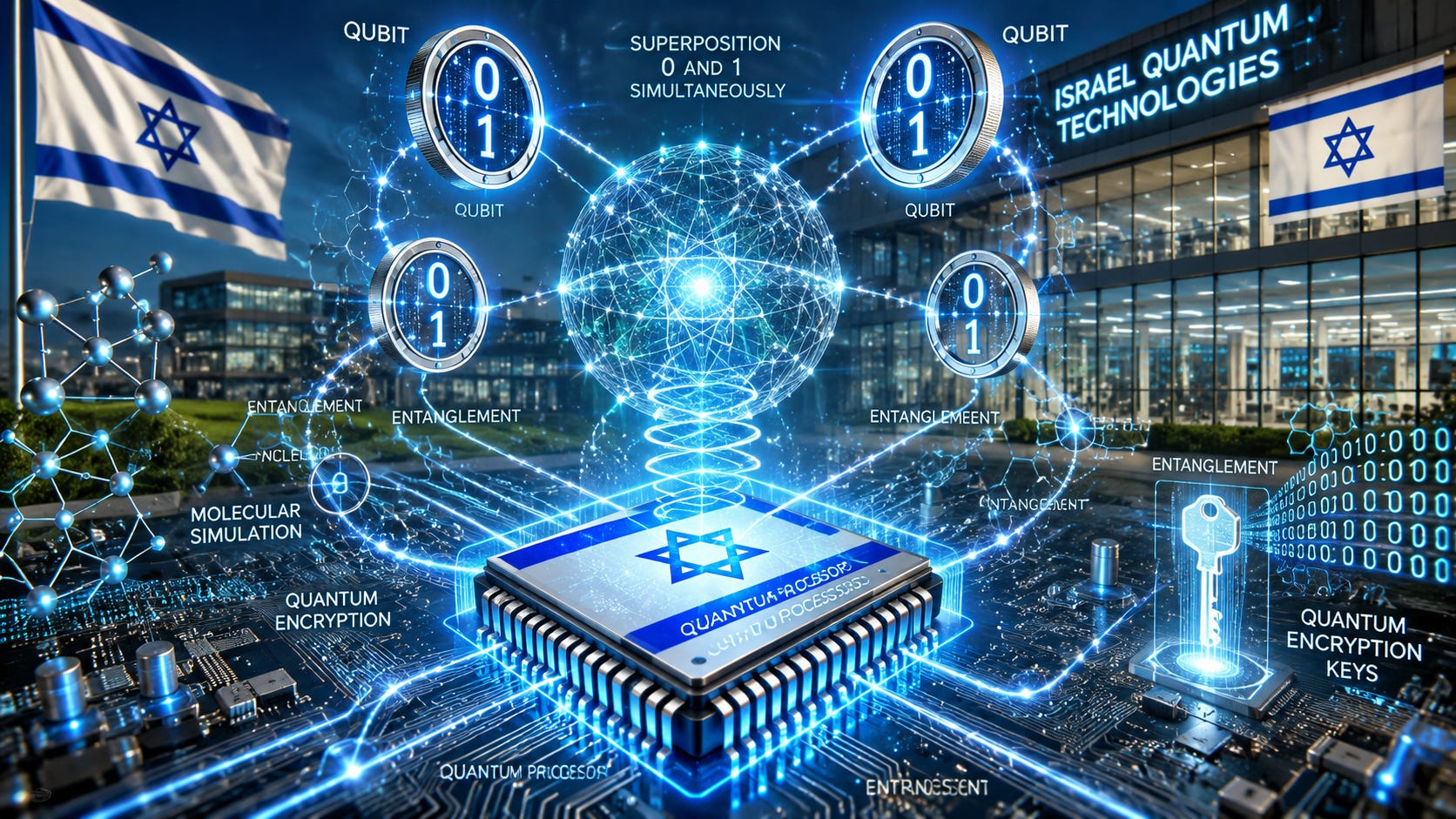
Quantum computers use quantum bits, or qubits. Unlike regular bits, qubits can be both 0 and 1 at the same time — a phenomenon called superposition. Think of it like a coin spinning in the air: while it’s spinning, it’s neither heads nor tails, but both simultaneously. Only when the coin lands (when the qubit is measured) does it “choose” a state. This allows quantum computers to explore multiple solutions to a problem simultaneously, making them exponentially more powerful for certain tasks.
The second quantum trick is entanglement — when multiple qubits become linked so that the state of one instantly affects the others, no matter how far apart they are. As NIST physicist Andrew Wilson explains, “you’ve got at least two things that are always connected; they have no independent existence.”


Why This Matters: The “Q-Day” Threat
The promise — and peril — of quantum computing centers on encryption. Most of the world’s sensitive data, from banking transactions to military communications, is protected by encryption that would take classical computers thousands of years to crack. In 1994, MIT scientist Peter Shor designed an algorithm proving that quantum computers could break this encryption in hours or minutes.
This potential “Q-Day” — when quantum computers become powerful enough to crack current encryption — is why governments are in a race. The U.S. intelligence community expects quantum computers to be “cryptographically relevant” by the early 2030s. China and the U.S. have accused each other of “harvest now, decrypt later” strategies: stealing encrypted data today to crack open once quantum computers mature.
Beyond code-breaking, quantum computers could revolutionize drug discovery by simulating molecular interactions, optimize supply chains, develop more efficient batteries, and accelerate climate solutions by modeling chemical reactions that produce greenhouse gases.
Israel’s Strategy: Specialize, Don’t Compete on Scale
Israel Innovation Authority CEO Dror Bin framed the initiative as a recognition of Israel’s limits — and advantages. “Israeli entrepreneurs and investors and also the state investments were much lower than other countries, but yet with very good results,” Bin told The Media Line. Rather than trying to build a complete quantum computer, Israel is betting that its startups can become “category leaders in some components.”


The planned infrastructure will integrate at least three quantum processing technologies, enabling companies to benchmark performance, develop algorithms, and test applications across different platforms. The facility must be fully operational within 18 months of approval, with R&D services available to users within the first 12 months.
Israel is home to about 20 quantum computing startups that account for 9 percent of global private investment in the field, including companies like Classiq and Quantum Machines. In 2025 alone, five Israeli quantum companies raised almost $500 million. But the country lacks the massive data centers and energy infrastructure that allow the U.S., UAE, and Saudi Arabia to make “huge leaps forward,” the Times of Israel reported.
The Global Race Israel Is Joining
China has announced more than $15 billion in public quantum investment — the most of any country — and is building a $10 billion national quantum lab. The U.S. doubled federal spending on quantum R&D following the 2018 National Quantum Initiative Act, though reauthorization of $3.6 billion in funding has stalled in Congress. Globally, governments and companies have invested $42 billion in quantum computing to date.
IBM aims to build a 100,000-qubit quantum computer by 2033; Google is targeting one million qubits. Today’s most advanced quantum computers have around 1,000 qubits — far short of the potentially millions needed for advanced decryption or drug simulation.
The Technical Hurdle: Qubits Are Incredibly Fragile
The biggest obstacle to practical quantum computing is noise — any disturbance to a qubit’s environment. A stray electric field, temperature fluctuation, or even a cosmic ray can destroy a qubit’s superposition, forcing it back into a regular 0 or 1 state. Current quantum computers make an error roughly once in every thousand operations; classical computers make one error per quintillion (1 followed by 18 zeroes) calculations.
That’s why quantum computers often require temperatures near absolute zero and specialized hardware, leaving few companies and governments capable of operating them. Different qubit types — from electrically charged atoms (ions) to superconducting circuits to particles of light (photons) — each have trade-offs between speed, stability, and scalability.
What Comes Next
The Israel Innovation Authority will accept proposals from industrial corporations and user consortia until October 8, 2026. The selected operator will be required to provide access to the most advanced versions of each quantum technology and continuously upgrade them as the global market evolves.


“Israeli high tech must be also in the forefront of the quantum computing innovation wave,” Bin said. Whether Israel’s NIS 100 million bet can keep it competitive against rivals spending 100 times more will depend on whether the country’s startups can do what they’ve done before: punch above their weight by specializing in the components that matter most — and getting there first