


Jewish Onliner is an independent publication. If you find our work valuable, please consider becoming a paid subscriber.

The Israeli government approved a comprehensive national artificial intelligence program in June 2026, positioning the country to compete with global powers in what Brig. Gen. (res.) Erez Askal, head of the National AI Directorate, described as the “central power infrastructure of the 21st century.”

The initiative, whose compute ambitions could cost tens of billions of dollars if fully implemented according to outside estimates, encompasses sovereign AI infrastructure, a national quantum computer, specialized research institutes, Cyber AI and Physical AI development, and AI-powered government services, representing Israel’s most ambitious technological mobilization since its cybersecurity revolution.
“Our goal is clear: to establish Israel as a global leader in the field of artificial intelligence, because artificial intelligence is not just another technology—it is a revolution,” Prime Minister Netanyahu stated.
100,000 GPU’s and the Sovereignty Push
At the program’s core lies an ambitious target: establishing sovereign computing infrastructure with 100,000 processing units for Israeli government, academic, and industry use. The plan aims to reduce Israel’s dependence on foreign cloud and technology providers, including the AWS and Google-backed Project Nimbus ecosystem. Tel Aviv University professor Nadav Cohen commented that achieving this scale “could easily cost tens of billions of dollars,” signaling Israel’s commitment to compete at the highest infrastructure levels.
The initiative builds on Israel’s 2021 National AI Program, which has deployed significant funding across research infrastructure, talent development, and pilot programs. However, Israel’s State Comptroller warned in 2024 that earlier AI efforts suffered from slow implementation and under-execution, including low realization of the high-performance computing component. Demonstrating market momentum, private company DREAM opened Israel’s first sovereign AI data center in February 2026, proving the country’s technical capability to build secure, independent AI computing environments. The national compute buildout is now a stated government target alongside private sector innovation.


Quantum Computing
The government resolution establishes a national quantum computer based on Israeli-developed technologies, building on Israel’s National Quantum Initiative, launched in 2018, and a quantum-computing-center effort advanced in 2022. Israel’s quantum ecosystem has expanded significantly, with research groups growing from 144 to 240 and quantum companies increasing from five to 20 by 2025. Israel has also joined EuroHPC, the EU-backed high-performance and quantum computing initiative with a €7 billion 2021–2027 budget, positioning the country within a major European computing collaboration.
National AI Institute and Specialized Focus
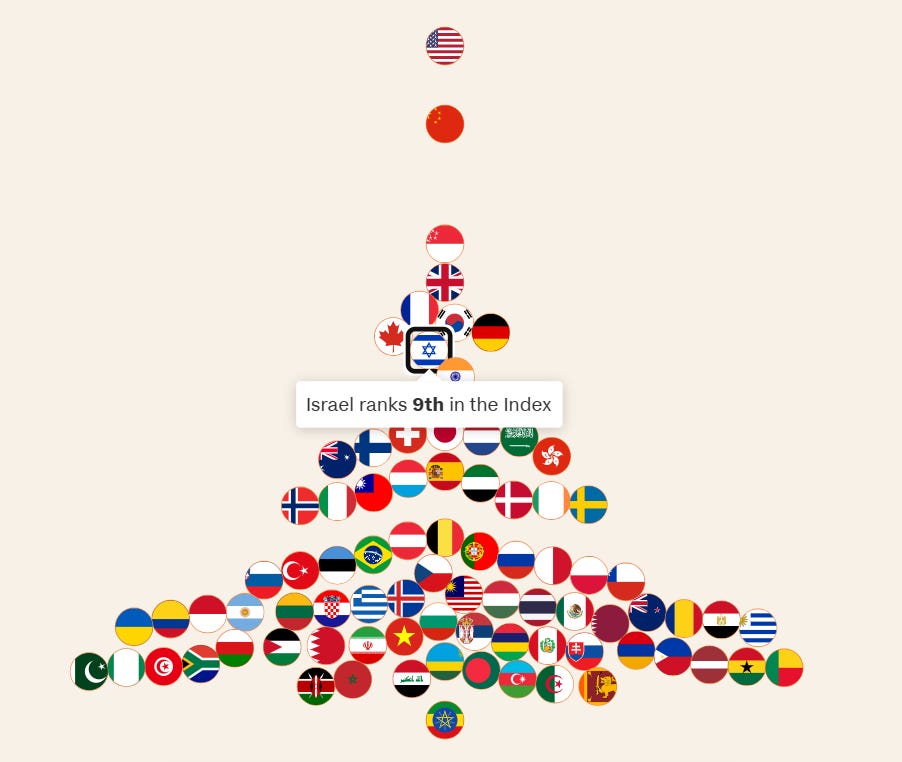
The plan establishes a National Artificial Intelligence Institute to connect government, academia, industry, and investors, alongside specialized acceleration hubs. Israel ranks 9th in the Tortoise Global AI Index and 4th globally in the number of AI companies that received funding between 2013 and 2024, with 492 companies, it ranks 5th by total AI investment over that period.
The government concentrates national efforts on Cyber AI for digital security and Physical AI for real-world autonomous systems. Prof. Nadav Cohen has argued that Israel holds a significant competitive advantage in Physical AI, edge computing systems that operate in physical environments, drawing on decades of defense experience with autonomous systems, drones, and battlefield technologies that demand extreme reliability in critical conditions. This focus builds on Israel’s broader defense, cyber, and intelligence-technology ecosystem. The program also establishes capabilities to counter deepfake technologies and AI-based threats.
Transforming Government Services
Earlier, in May 2024, nine government entities won competitive grants totaling over NIS 45 million to implement AI-driven projects. Selected initiatives include the Ministry of Transportation developing AI tools for traffic congestion (estimated NIS 6 million annual savings), the Tax Authority creating automatic product classification (NIS 15 million annual savings), and the Ministry of Justice using AI to identify suspicious non-profit activities related to money laundering and terrorism financing. Other projects span medical claims processing, capital market document analysis, and workers’ rights platforms.
From Cyber Nation to AI Superpower
Israel’s comprehensive AI strategy positions the country to replicate its cybersecurity success story in the artificial intelligence domain. Askal emphasized “The decisions we make today will determine Israel’s stature for many years to come.”