


Jewish Onliner is an independent publication. If you find our work valuable, please consider becoming a paid subscriber. You can also subscribe to us on WhatsApp and Telegram. Follow us on Instagram, Discord, and X.

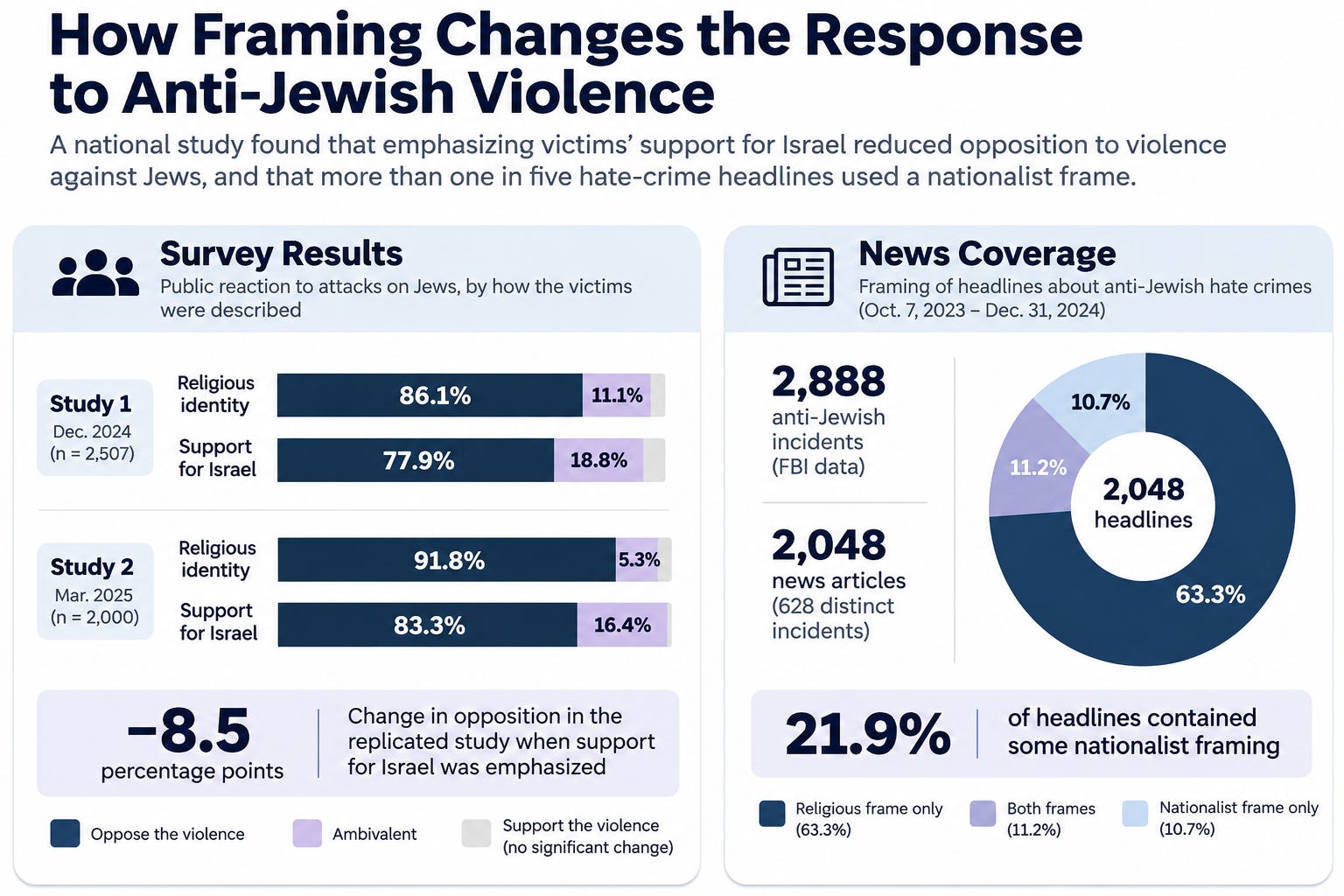
A new study published in PNAS Nexus found that Americans shown attacks against Jews through victims’ support for Israel were significantly less likely to oppose the violence than those shown attacks through victims’ Jewish religious identity. In a preregistered, nationally representative survey of 2,000 U.S. adults, opposition fell by 8.5 percentage points when victims were described through expressions of Zionism rather than religious faith. The shift did not significantly increase support for the attacks. Instead, more respondents moved into an ambivalent position.
The study, by Princeton University researchers Rafaela Dancygier and Jonathan Mummolo and Dartmouth College professor Sean Westwood, also examined news coverage of U.S. anti-Jewish hate crimes after October 7, 2023. The researchers found that more than one in five headlines in their sample introduced Israel, Palestine, Gaza or another nationalist or geopolitical dimension.
Opposition Fell When Support for Israel Was Emphasized
The researchers conducted two experiments testing whether descriptions of an attack changed public reaction. In the religious condition, respondents were told about Jews attacked while entering a synagogue or because they wore a kippah. In the nationalist condition, they were told about Jews attacked for carrying an Israeli flag or saying Israel should exist as a homeland for the Jewish people.
The first experiment, conducted in December 2024 with 2,507 respondents, found an 8.17-point difference in opposition between the two treatments. Opposition stood at 86.1% under the religious condition and 77.9% under the nationalist condition, while ambivalence increased from 11.1% to 18.8%. Support remained essentially unchanged. After a multiple-comparisons correction, however, the first study’s results fell just short of conventional statistical significance.
The researchers then replicated the experiment in March 2025 with a preregistered YouGov survey of 2,000 U.S. adults. Opposition to attacks on Jews stood at 91.8% under the religious treatment and 83.3% under the nationalist treatment, an 8.5-point difference. Ambivalence rose from 5.3% to 16.4%, while the difference in outright support was not statistically significant.
One in Five Headlines Used a Nationalist Frame
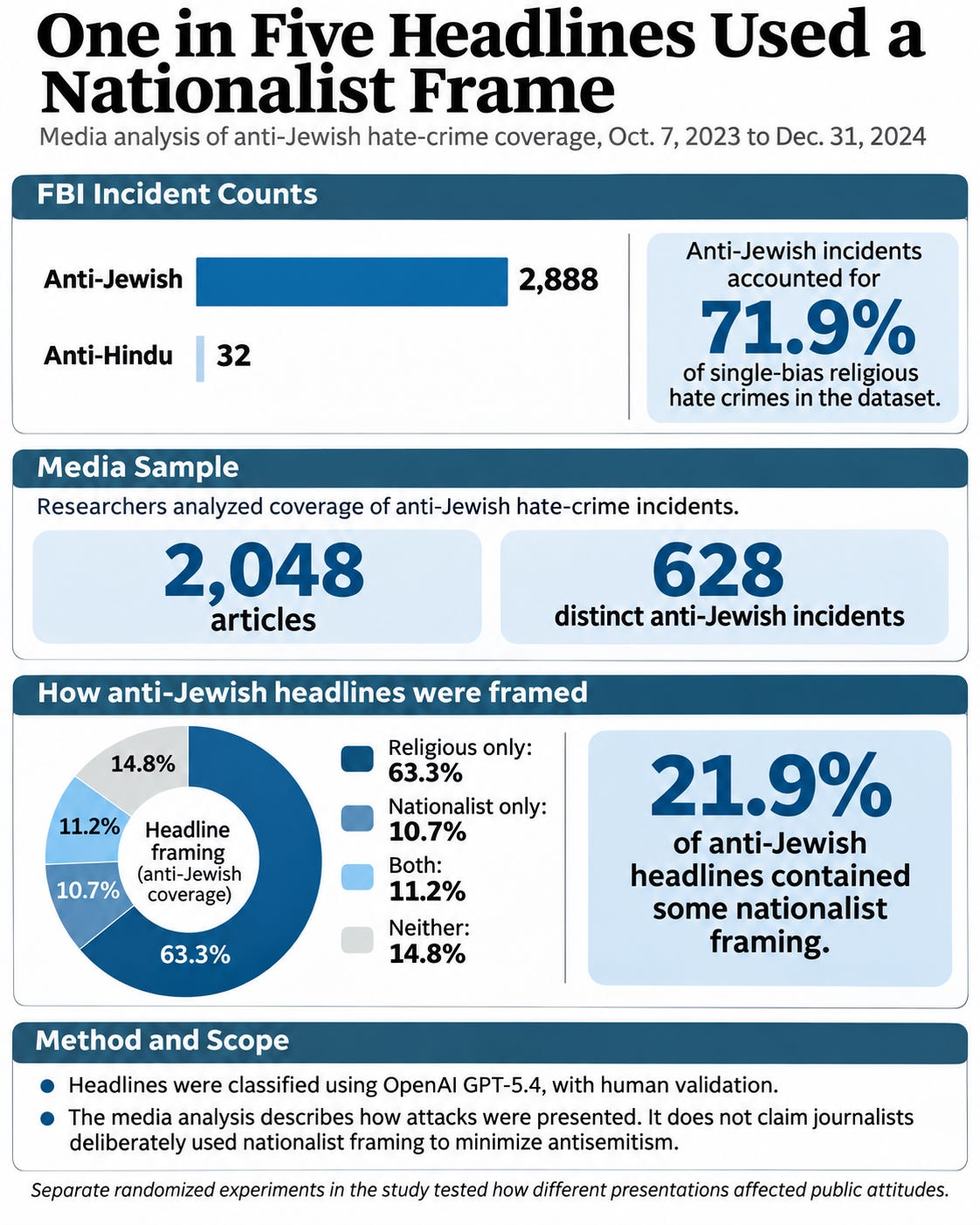
The researchers separately analyzed news coverage of religious hate crimes reported between October 7, 2023 and the end of 2024. FBI data included in the study recorded 2,888 anti-Jewish incidents during that period, compared with 348 anti-Muslim incidents and 32 anti-Hindu incidents. Anti-Jewish incidents accounted for 71.9% of the single-bias religious hate crimes in the dataset.
Their media sample contained 2,048 articles covering 628 distinct anti-Jewish incidents. Among headlines about those attacks, 63.3% used only a religious frame, 10.7% used only a nationalist frame and another 11.2% combined both.
The researchers used OpenAI’s GPT-5.4 to classify headlines into nationalist, religious, both or neither categories, with human validation of the classifications. The study does not claim journalists deliberately used nationalist framing to minimize antisemitism. Its media analysis documents how attacks were presented, while the randomized experiments tested how those presentations can affect public attitudes.
Capital Jewish Museum Killings Illustrate the Divide
The study used the May 2025 killings of Israeli Embassy employees Sarah Milgrim and Yaron Lischinsky outside the Capital Jewish Museum in Washington as a case study. According to a Justice Department superseding indictment, alleged gunman Elias Rodriguez called out “Free Palestine” during the shooting. Prosecutors allege that after entering the museum he said, “I did it for Palestine. I did it for Gaza.”


Crucially, the researchers emphasized that there was no evidence Rodriguez knew Milgrim and Lischinsky worked for the Israeli Embassy or had selected them because of that affiliation. The paper states that he therefore could simply have been seeking to harm people he believed were Jewish. Milgrim was Jewish, while Lischinsky was not.
That distinction is central to the study’s framing analysis. The victims’ Israeli government employment gave news outlets a factual basis to describe them through an Israeli or geopolitical lens, even though the researchers found no evidence that their Embassy affiliation was known to the attacker when he targeted them.
Across three collections of coverage, including major U.S. newspapers and a broader LexisNexis sample, nationalist framing appeared frequently. The researchers also found that religious or antisemitism-related language appeared roughly two to five times farther into stories whose headlines used nationalist framing than in stories whose headlines used religious framing. They noted that readers who consumed only a headline or the opening portion of an article could therefore encounter the attack without seeing its Jewish or antisemitic dimension.
Federal lawmakers framed the killings differently. Among 369 comments examined by the researchers, 44% used only a religious or antisemitism frame and another 48% used both. Just 8% relied exclusively on nationalist framing.
Israel Framing Shifts Condemnation Toward Ambivalence
Taken together, the study finds that presenting violence against Jews through Israel or Zionism can materially change public reaction. The effect did not generally make respondents endorse anti-Jewish violence, but it weakened the near-consensus against it by moving more people toward ambivalence.
That finding is notable alongside the researchers’ media analysis. Israel-related framing appeared in more than one in five headlines about anti-Jewish hate crimes in their post-October 7 sample, while the Capital Jewish Museum case showed how victims’ Israeli affiliation could become a prominent element of coverage even when there was no evidence the attacker knew about that affiliation. The study concludes that such framing choices can affect how strongly the public condemns anti-Jewish violence.