


Jewish Onliner is an independent publication. If you find our work valuable, please consider becoming a paid subscriber.
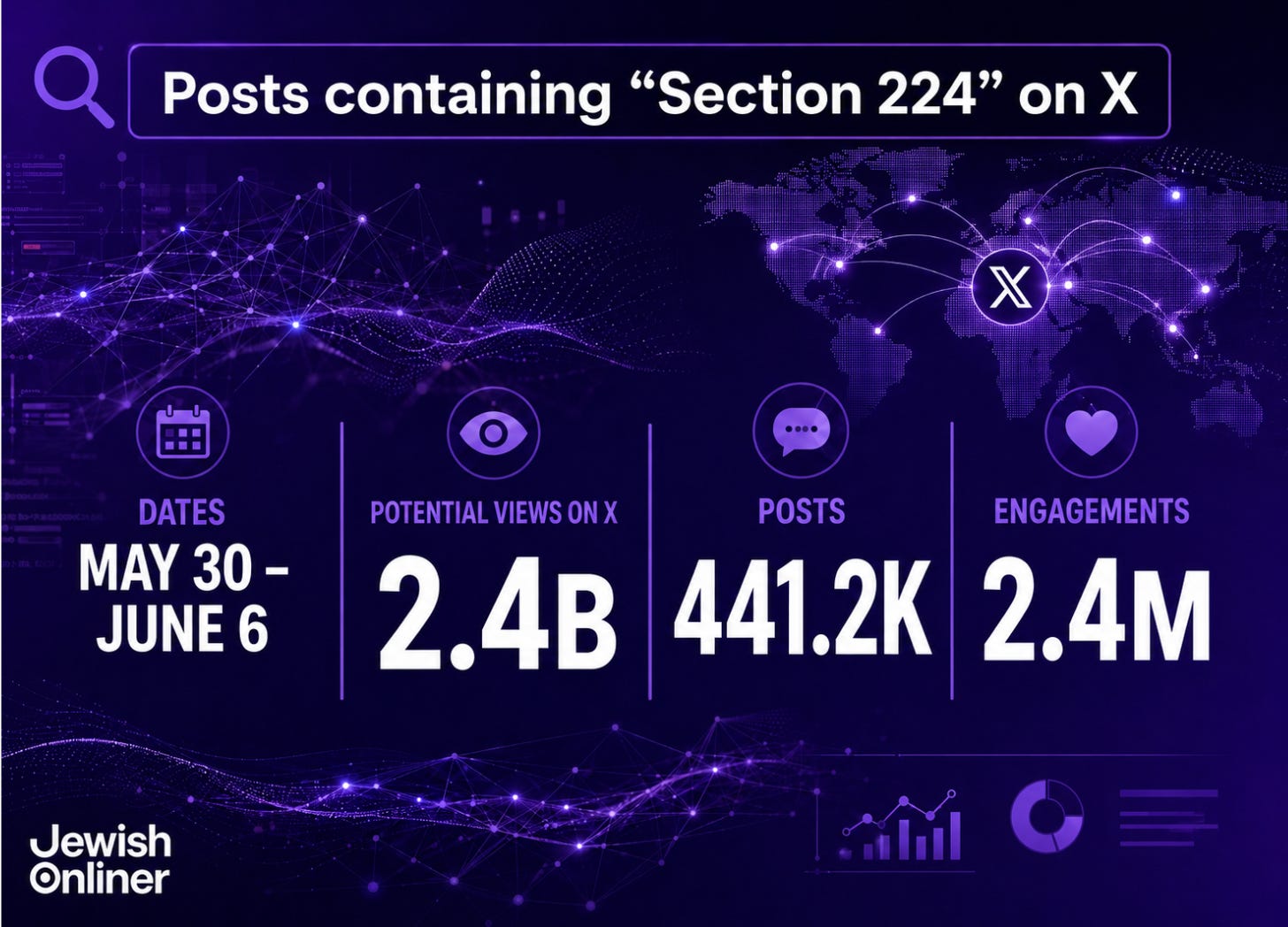
A Jewish Onliner analysis of X posts containing “Section 224” during a seven-day window ending June 6 found 441,200 posts, 2.4 million engagements, and an estimated 2.4 billion potential views. Within that conversation, high-amplification posts described Section 224 of the House Armed Services Committee’s FY2027 NDAA chairman’s mark as a U.S.-Israel “military merger,” a characterization not supported by the legislative text.
Prominent amplifiers included right-wing, populist, and conspiratorial figures and accounts such as Alex Jones, Marjorie Taylor Greene, Stew Peters, and Thomas Massie. Another high-reach amplifier was Mario Nawfal, whom Jewish Onliner previously reported on in connection with misleading X location-label behavior.


What Section 224 Actually Proposes
Section 224 would create a Pentagon-led initiative to synchronize and accelerate U.S.-Israel defense technology research, development, testing, evaluation, integration, and industrial cooperation. Nothing in Section 224 creates a joint U.S.-Israel command structure, transfers U.S. military decision-making authority to Israel, or provides a dedicated new military-aid authorization. The provision instead directs the Defense Department to coordinate and accelerate bilateral defense-technology cooperation within existing U.S. acquisition and oversight frameworks.
John Spencer, Chair of War Studies at the Madison Policy Forum and Executive Director of the Urban Warfare Institute, argued that the misinformation strategy relied on audiences never examining the actual legislative text.
“The hate-filled accounts are banking on you never reading it yourself,” Spencer noted, pointing out that Section 224 simply creates coordination mechanisms for bilateral technology cooperation rather than merging command structures. Many high-engagement posts advanced the claim without quoting the operative legislative language.
This gap between false characterization and documented fact created an opening for sustained misinformation despite readily available evidence contradicting the core claims. Posts describing Section 224 as a merger appeared to draw far more attention than many posts pointing readers to the actual provision or official summaries.


A Case Study in Legislative Distortion
The Section 224 episode illustrates how a narrow defense-technology provision became the basis for a viral claim that was not supported by the bill text. The provision concerns coordination on areas such as missile defense, artificial intelligence, cybersecurity, and counter-drone systems. It does not create a U.S.-Israel “military merger”.
The gap between the text and the online framing was central to the spread. Posts describing Section 224 as a merger drew far more attention than posts pointing readers to the actual provision or official summaries, allowing a legislative distortion to harden into high-volume political messaging before the underlying text became part of the debate.