


Jewish Onliner is an independent publication. If you find our work valuable, please consider becoming a paid subscriber.
The Israel Innovation Authority and the AI Directorate of the Prime Minister’s Office have released a draft national AI strategy that abandons any pretense of competing with Washington or Beijing on raw capital and compute, and instead stakes Israel’s future on four pillars: AI-native applications, infrastructure “enablers,” Physical AI, and geopolitical alignment through the U.S.-led Pax Silica alliance.
The April 2026 document arrives months after Israel joined Pax Silica and nearly a year after the Trump administration moved to rescind the Biden-era AI Diffusion Rule, which had placed Israel outside the top tier for advanced AI chip access.
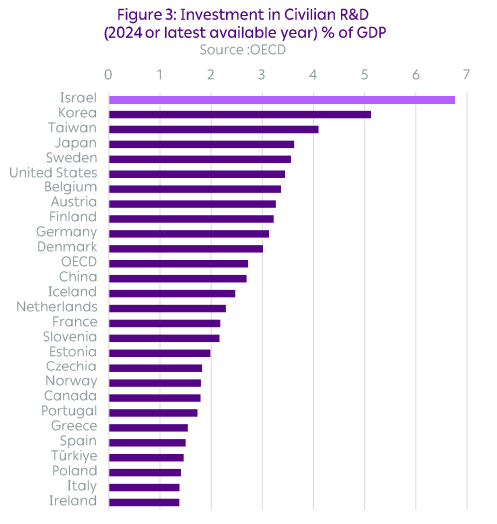
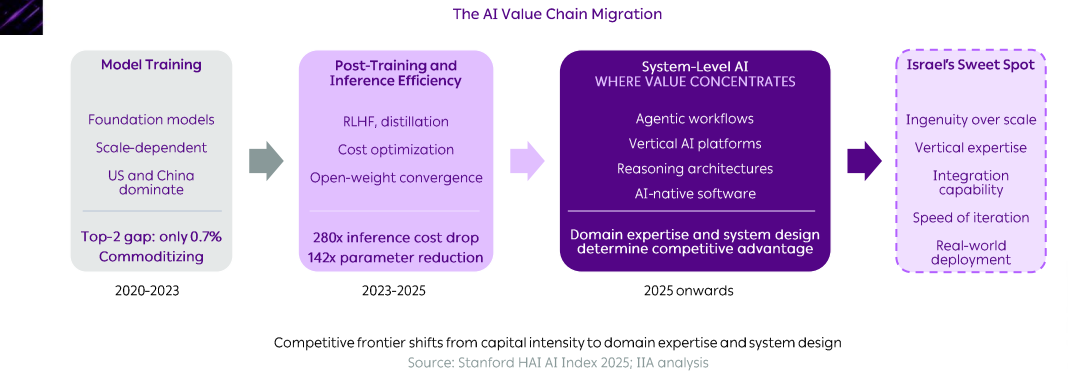
The strategy openly argues that Israel should not try to compete with the United States and China on scale, capital, or compute, but should instead lead in domains where specialization, speed, and integration matter more.
The “Excellence Over Scale” Doctrine
The strategy’s central premise is blunt. “The United States will continue to lead in developing large-scale models and infrastructure. China will lead in industrial deployment,” the document states, before carving out Israel’s lane: “domains where innovation, specialization, and speed matter more than size.”
The Authority points to a near-doubling of Israeli AI companies from 1,250 to 2,350, $15.6 billion in venture capital in 2025, and $82 billion in M&A — figures inflated by Google’s $32 billion acquisition of Wiz. Israel’s ranking in the government-strategy pillar of the Tortoise Global AI Index, now the Observer Global AI Index, climbed from 47th in 2023 to 14th in 2025.
Pillar Four: The Geopolitical Bet
The most consequential pillar is geopolitical. The document argues that “access to advanced AI resources is increasingly determined through geopolitical alliances such as Pax Silica,” and sets a five-year target of “Tier 1 equivalent” status under whatever framework replaces the rescinded Diffusion Rule.
That matters because Israel was classified as Tier 2 under the Biden rule, capping its access to advanced GPUs. The Trump administration scrapped that framework in May 2025 but has not yet replaced it — leaving an open negotiation that the Innovation Authority wants Jerusalem to win.
Israel formally joined Pax Silica in late 2025, and on January 16, 2026, Prime Minister Netanyahu and U.S. officials signed a bilateral AI partnership in the City of David in Jerusalem — making Israel the first of the alliance’s nine leading nations to formalize ties with Washington. The State Department has announced that it intends, working with Congress, to allocate $250 million in foreign-assistance funding for a new Pax Silica Fund.
Physical AI and the Defense Edge
The third pillar — Physical AI — leans heavily on Israeli defense capabilities. The strategy states that “Israel’s defense industries are developing operational AI systems at a scale few countries can match” and proposes channeling that operational experience into civilian regulatory pathways through a new Physical AI Institute and sector-specific sandboxes.
The plan sets a target of putting at least one Israeli company among the top three global leaders in Physical AI within five years, alongside ten new startups in AI chip design and ten or more AI-native unicorns.
Infrastructure and Talent
Underwriting the strategy is the National AI Program launched in November 2021 with a budget of roughly NIS 1 billion. The National AI Program, launched in November 2021, had a budget of roughly NIS 1 billion. Its flagship compute project, operated by Nebius, involved total investment of more than half a billion shekels, including NIS 150 million from the program budget.
The Nebius-operated infrastructure includes roughly 4,000 NVIDIA B200 accelerators, about one quarter of which are subsidized through the TELEM program for startups and academia. The Innovation Authority opened discounted access to 1,000 B200 accelerators, with 70 percent reserved for industry and 30 percent for academia. The new strategy adds an “AI Visa” for international experts, expanded reskilling pipelines for STEM graduates, and the RIKMA project for opening government datasets.
The Regional Dimension
The document also identifies the Abraham Accords as a platform for “systematic AI partnerships with the UAE,” and calls for technological ties with at least three Pax Silica members beyond the United States. That tracks with reports of an emerging Israel-UAE framework for AI supply-chain coordination and deepening defense-tech cooperation.
The Broader Significance
The draft strategy is Israel’s attempt to answer a strategic question facing smaller, export-driven technology economies: in an AI landscape increasingly shaped by U.S. capital, infrastructure, and frontier models on one side, and China’s scale and industrial deployment on the other, where can Israel build durable advantage?
The Innovation Authority’s answer is that Israel fits inside the Western bloc — as the indispensable specialist in cybersecurity, edge computing, semiconductors, and defense-linked autonomous systems that the strategy argues are central to Israel’s comparative advantage.