


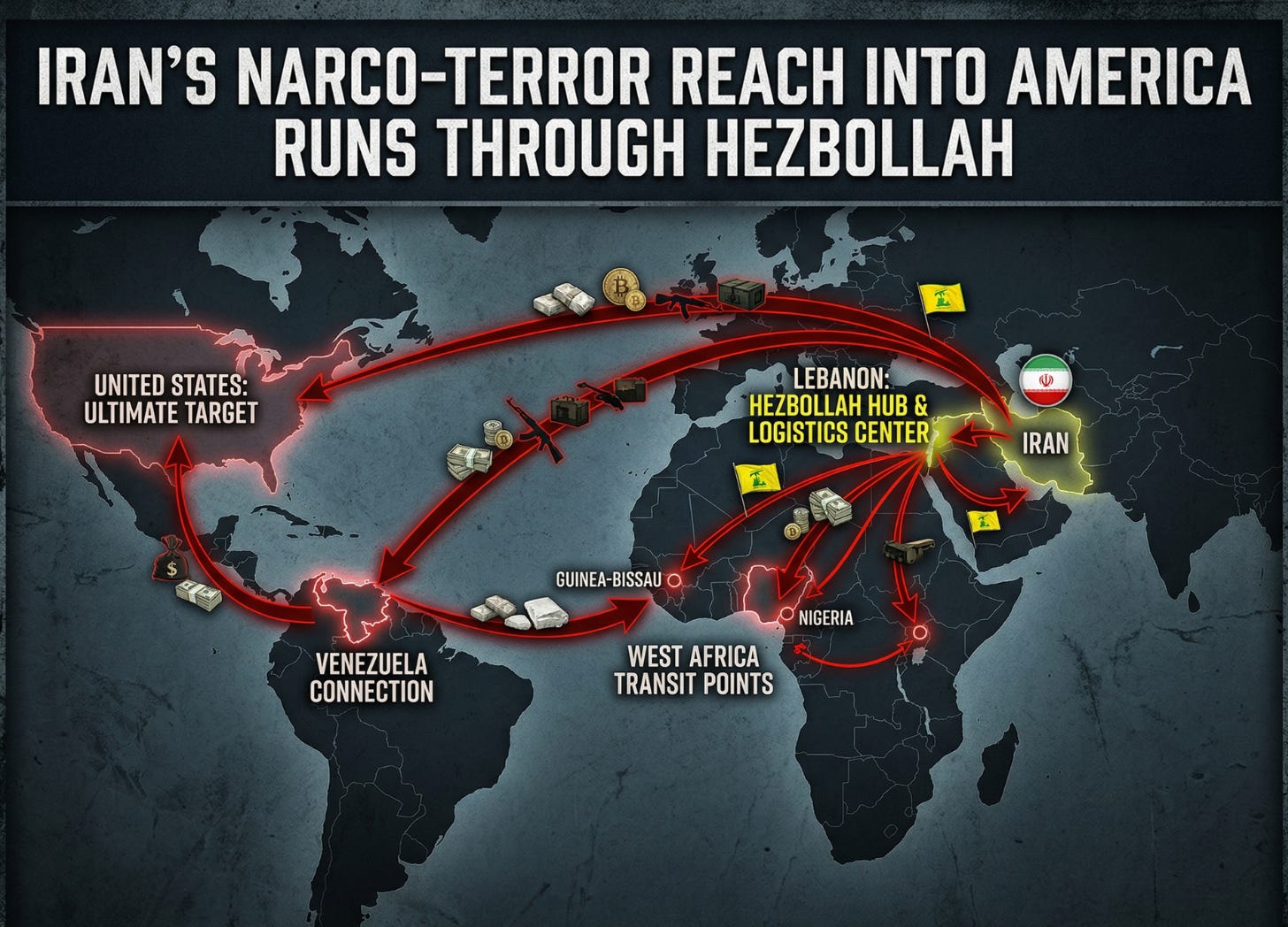
For years, U.S. law enforcement and Treasury officials have documented Hezbollah not only as a Lebanese terrorist organization, but as a transnational criminal-terror network whose financial operations have directly intersected with American markets and banking systems
The evidence comes from DEA announcements, Treasury designations, FBI asset seizures, and FinCEN advisories spanning 2011 to 2024. Across the enforcement actions, federal agencies describe a consistent pattern: Hezbollah-linked operatives establishing business relationships with South American drug cartels, laundering cocaine proceeds through trade-based schemes, and routing hundreds of millions of dollars through U.S. commercial channels.
Direct Cartel Partnerships and U.S. Cocaine Flows
In a 2016 DEA announcement, the agency stated that members of Hezbollah’s Business Affairs Component had established business relationships with South American drug cartels, including La Oficina de Envigado, which DEA said was responsible for supplying large quantities of cocaine to European and United States drug markets.
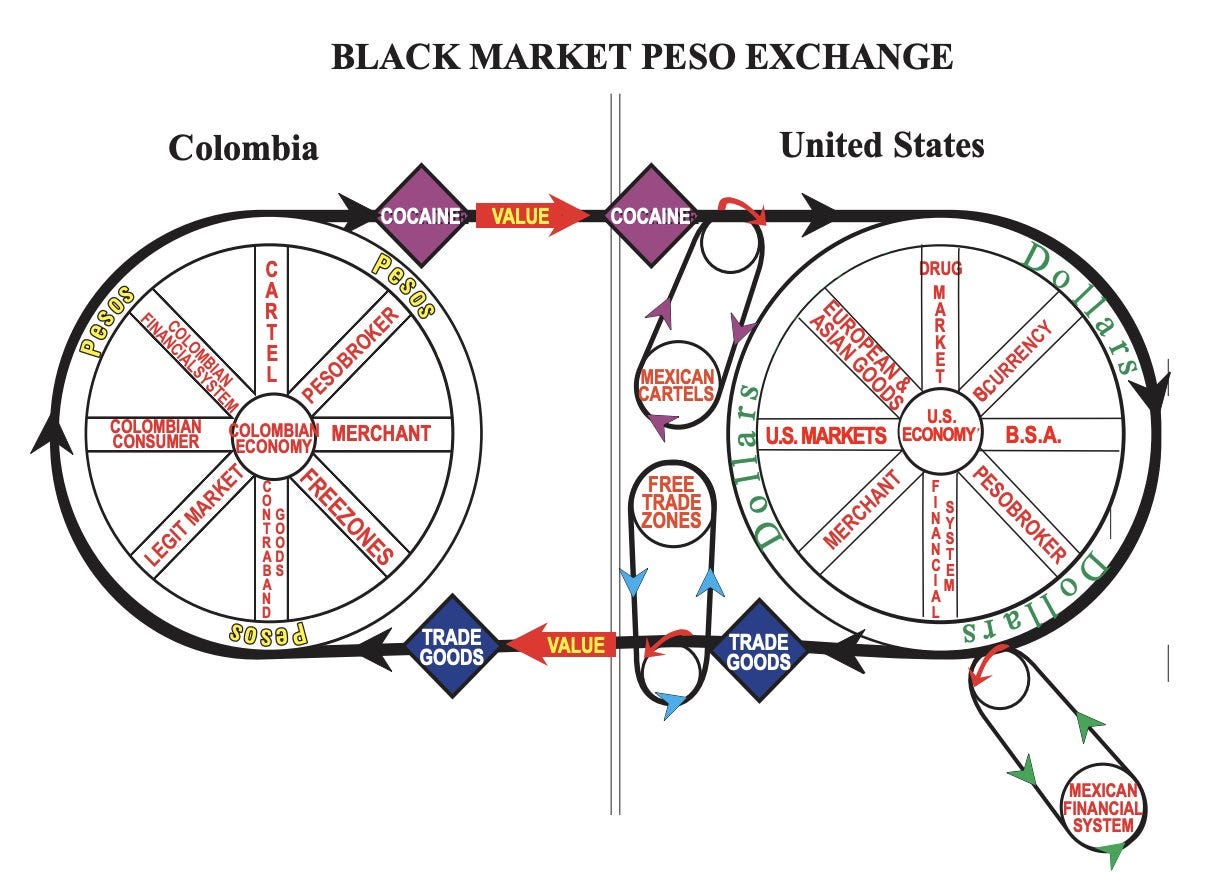
DEA also identified the same Hezbollah-linked structure as continuing to launder significant drug proceeds through the Black Market Peso Exchange, a method historically used to clean cartel cash through legitimate-appearing trade transactions.
$150 Million Seized, $329 Million Routed Through U.S. Accounts
In February 2011, the U.S. Department of the Treasury designated the Lebanese Canadian Bank as a financial institution of “primary money laundering concern.” Treasury said the bank had facilitated a global narcotics trafficking and money laundering network that moved illegal drugs from South America to Europe and the Middle East via West Africa.
Furthermore, the bank was accused of laundering hundreds of millions of dollars monthly through accounts and through trade-based schemes involving consumer goods shipped to the United States, including used car dealerships.
One year later, the FBI’s New York field office announced the seizure of $150 million tied to what it described as a Hezbollah-related money laundering scheme. According to the FBI, entities linked to Hezbollah used the U.S. financial system to launder narcotics trafficking and other criminal proceeds through West Africa and back into Lebanon.
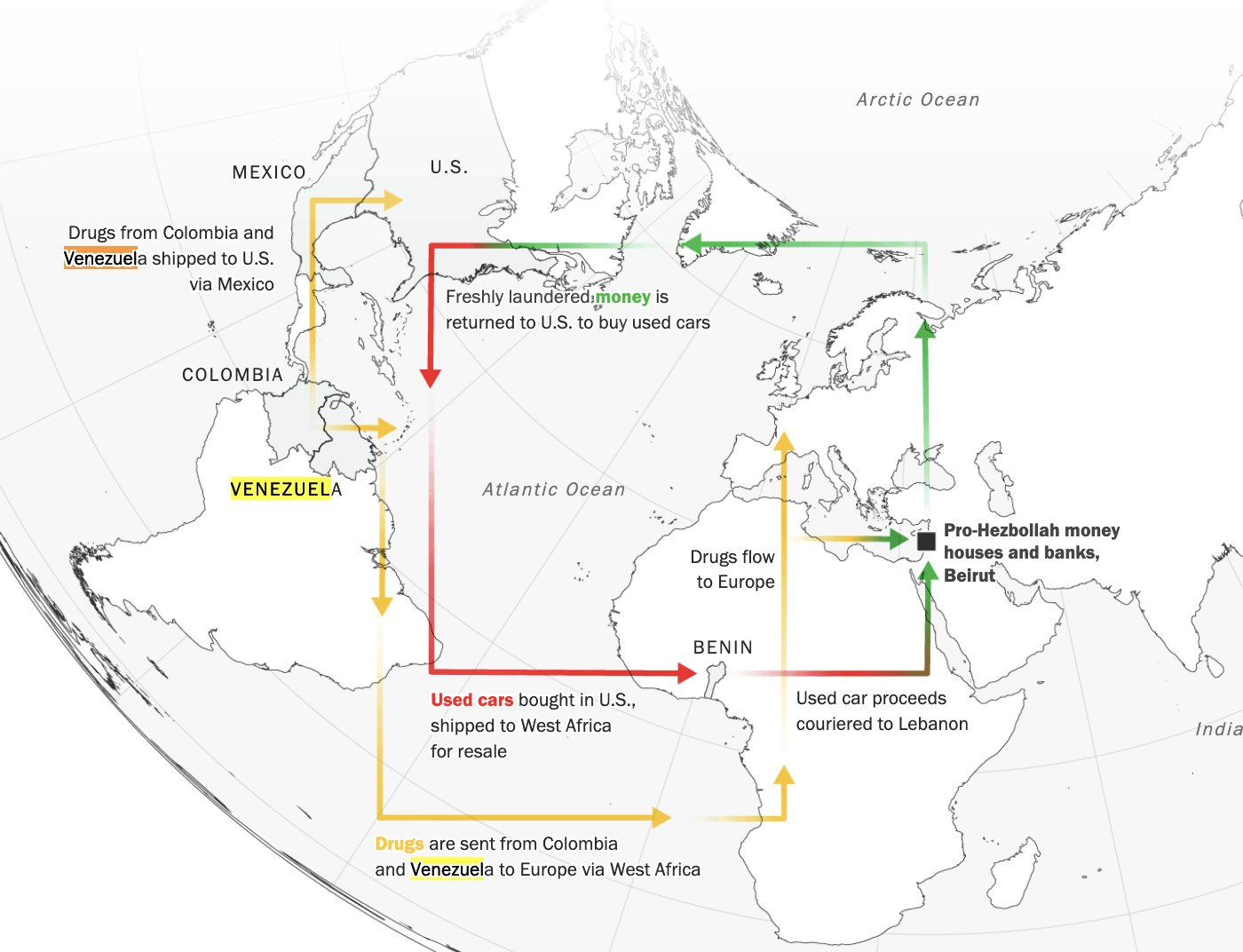
The bureau said at least $329 million had been wired into the United States to buy used cars for export to West Africa, where cash from those sales, combined with narcotics proceeds, was funneled back through the broader laundering network.
Hezbollah Money Laundering Operations in the U.S.
Treasury’s Office of Foreign Assets Control reinforced the pattern in a 2019 designation targeting Lebanese money launderer Kassem Chams. OFAC said Chams laundered drug proceeds around the world on behalf of narcotics trafficking organizations while also facilitating money movements for Hezbollah.
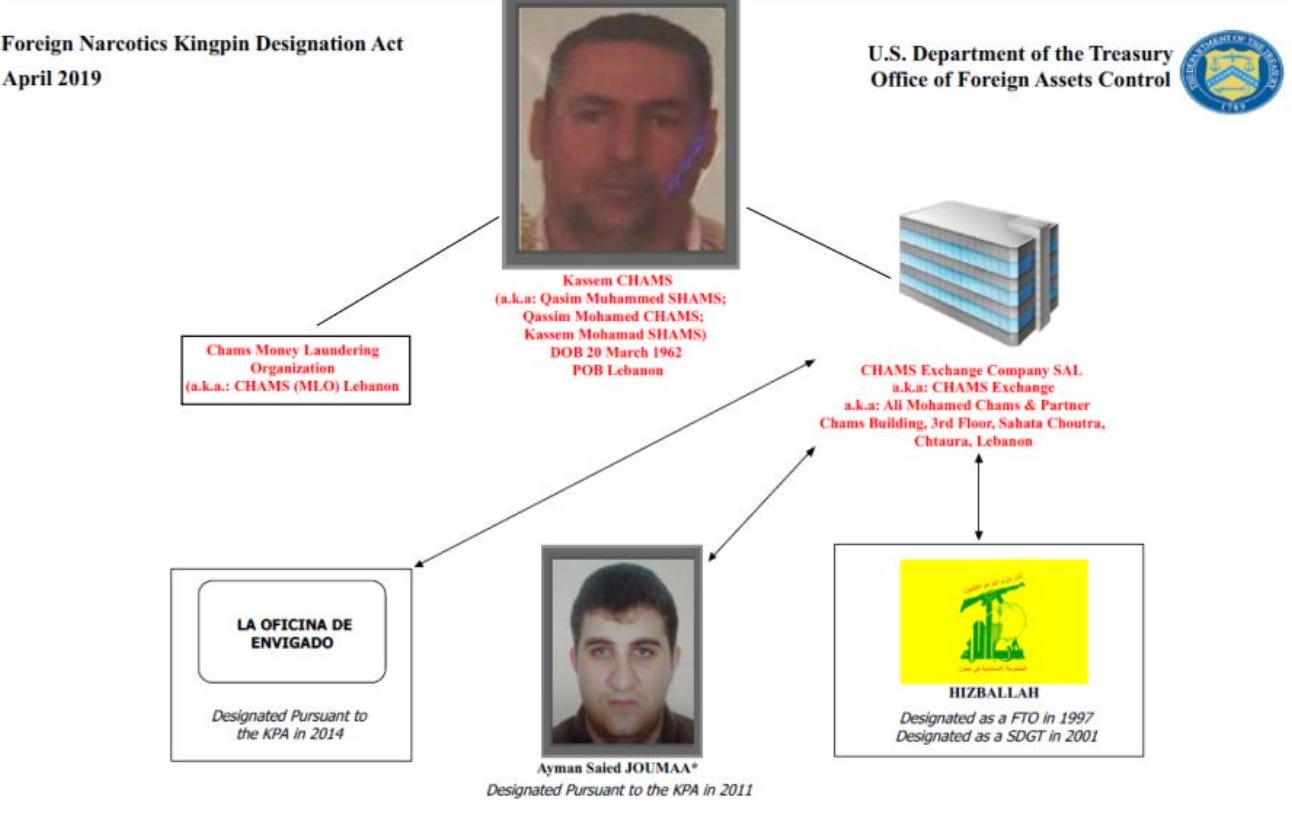
Treasury specifically noted that his network moved money to and from multiple countries, including the United States, as part of its narcotics money laundering activity. The designation also linked Chams to major traffickers and to the same Colombian criminal ecosystem cited in earlier DEA cases.
Hezbollah Funds “More Likely” to Touch U.S. Banks
The 2022 National Terrorist Financing Risk Assessment issued by Treasury summarized the broader pattern in plain terms. The document stated that Hezbollah members, supporters, and sympathizers are involved in large-scale criminal schemes around the world, including money laundering, fraud, counterfeiting, narcotics trafficking, and weapons procurement.
Notably, Treasury also wrote that Hezbollah-linked funds are more likely than those of many other terror groups to come through U.S. banks.
Advisory Flags Hezbollah’s Use of U.S. Financial System
In October 2024, the Financial Crimes Enforcement Network (FinCEN) issued an alert explicitly describing Hezbollah’s global criminal financial networks and its use of the U.S. financial system in money laundering, smuggling, and trafficking schemes.
FinCEN said the alert built on Treasury’s broader May 2024 advisory on Iran-backed terrorist organizations, underscoring that Hezbollah’s financial activities are understood within the context of broader Iranian state sponsorship.
Maduro’s Venezuela: A Critical Node in Hezbollah’s Drug Networks
In 2020, federal prosecutors charged former Venezuelan National Assembly member Adel El Zabayar with narco-terrorism offenses, alleging he served as a crucial intermediary between the Cartel of the Suns and both Hezbollah and Hamas.

The Trump administration designated the Cartel of the Suns as a terrorist organization in July 2025, asserting that it is headed by President Nicolás Maduro and other high-ranking officials in his administration. In February 2026, U.S. forces captured Maduro in what officials described as a bold commando operation, bringing to a head years of escalating pressure on the Hezbollah-Venezuela nexus.
Sponsorship of a Proxy Tied to U.S. Drug and Money Laundering Networks
Hezbollah, Iran’s most capable and best-funded foreign proxy, has been repeatedly linked by U.S. authorities to drug-related revenue streams, cartel partnerships, and laundering systems that have touched U.S. markets and financial institutions.
Because Hezbollah operates as an extension of Iranian foreign policy and receives material support from Tehran, its narco-terror infrastructure functions as part of the broader apparatus through which the Islamic Republic projects power and raises revenue through deniable networks.
Only Narco??
Beside drugs Hezbollah are dealing with weapons and namely with slaves. Usually women from Eastern Europe and from Africa.