


Jewish Onliner is an independent publication. If you find our work valuable, please consider becoming a paid subscriber.
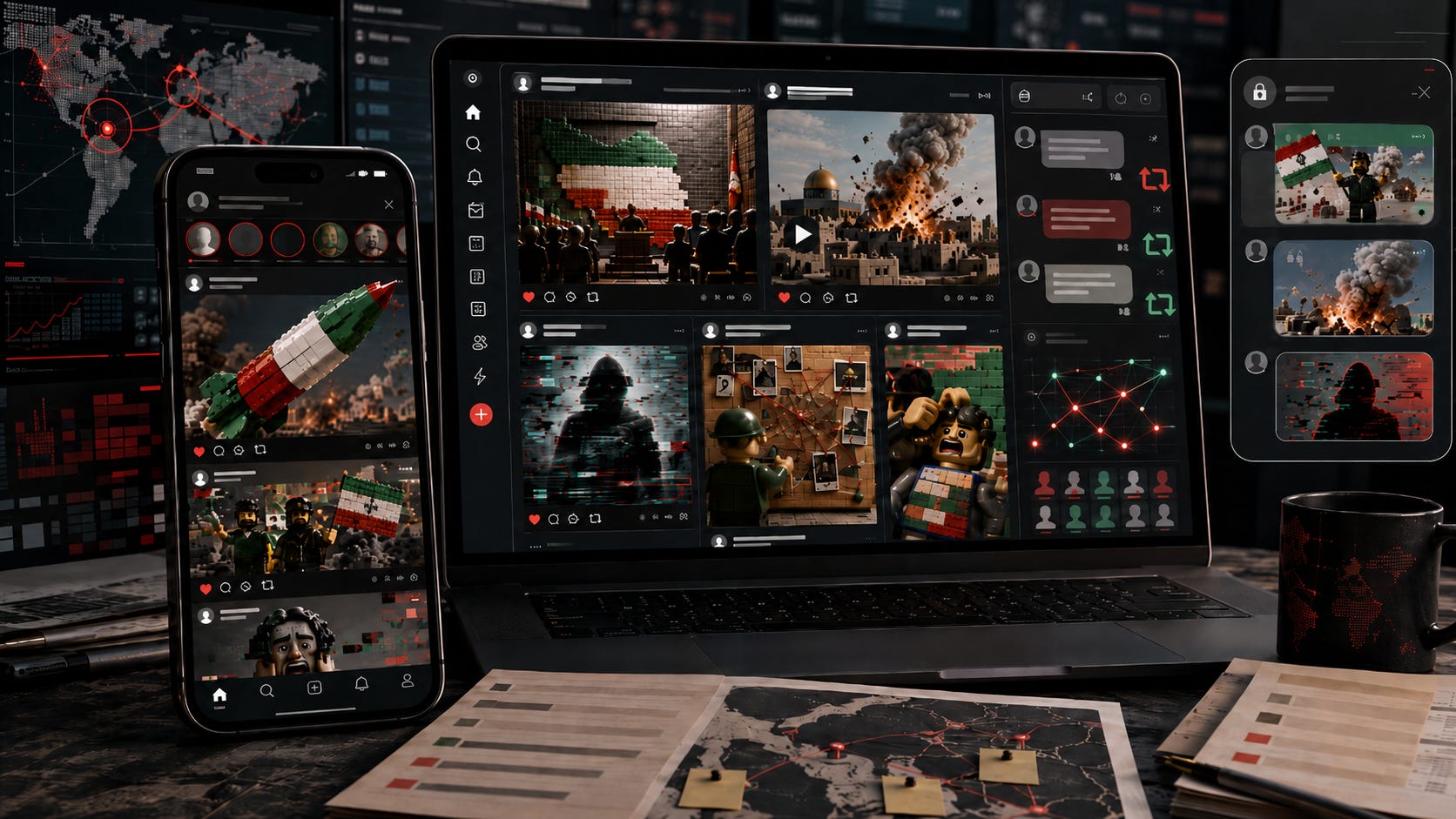
An Iranian AI-video campaign that Western users encountered as surreal anti-Trump satire is part of a state-backed propaganda network with direct ties to the Islamic Revolutionary Guard Corps cultural apparatus, according to a new open-source investigation by Third Lantern. The operation, known as Explosive Media, has produced Lego-style clips depicting Donald Trump, Benjamin Netanyahu, Jeffrey Epstein, missile strikes, and attacks on U.S. and Israeli targets—accumulating millions of views and celebrity amplification before Western platforms began removing the content.

The investigation identifies multiple operatives, traces their connections through Iran’s state media training pipeline, and follows cryptocurrency donations to sanctioned exchanges—revealing an influence operation designed not to convert Americans to Iranian ideology, but to deepen existing political divisions by supplying shareable content that obscures its foreign origin.
The Network Behind the Videos
Third Lantern’s investigation identified at least four key operatives and multiple institutional connections linking Explosive Media to Iran’s “soft war” infrastructure. M. Taha Ansari Mohseni, the primary on-camera personality who referred to himself as “Mr. Explosive” in November 2025 Telegram videos, attended Hozeh Honari—the Islamic Regime’s Art and Cultural Organization—for a September 2024 screening of a regime-aligned propaganda film about the Syrian war.
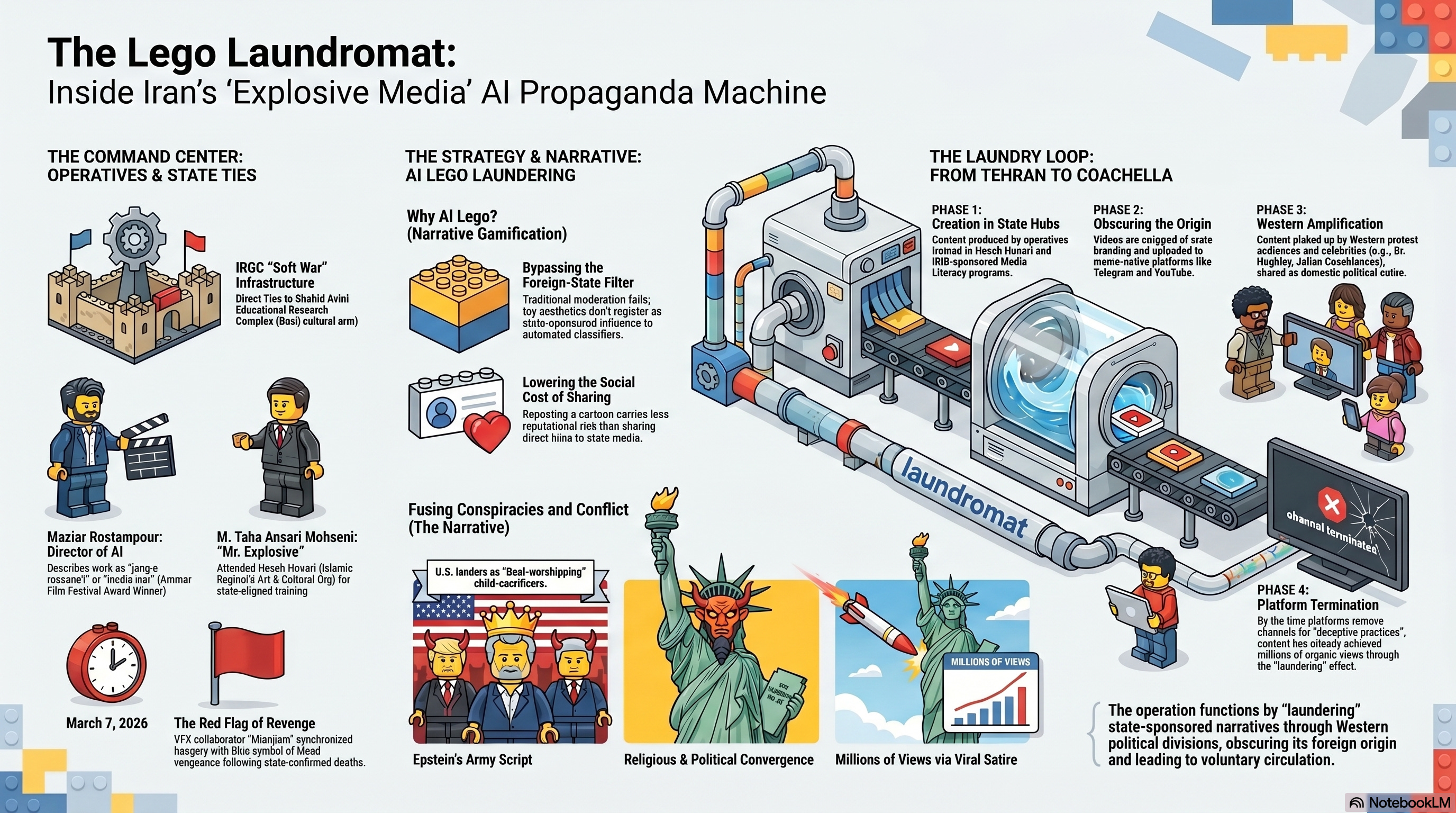
His social media history shows participation in the Media Literacy Olympiad, a program run by the Iranian Media Literacy Club and sponsored by the Shahid Avini Educational Research Complex, the formal cultural arm of IRIB’s Basij paramilitary organization. The U.S. Treasury designated IRIB in 2022 for its cooperation with the IRGC and the Ministry of Intelligence and Security.
Maziar Rostampour, identified by the regime-affiliated Mehr News Agency as Explosive Media’s director of artificial intelligence, received an Honorary Diploma at the 16th Ammar Popular Film Festival in January 2026 for work in the “Virtual Space and Artificial Intelligence” category. The Ammar Festival, described by state media Jame Jam as a revolutionary cultural gathering where speakers invoked “Death to America” and “Death to Israel,” functions as the regime’s primary talent hub for information warfare. Rostampour told Iranian state media that the campaign represents Iran as “a freedom-loving country standing up to Epstein’s army of cannibals,” and openly described his work as “media war” (jang-e resaane’i)—terminology belonging to information warfare doctrine, not creative content production.
A third operative, Seyed Mehdi Hashemi, serves as creative director and maintains a documented working relationship with Rostampour dating to July 2024, months before the Lego campaign’s public launch. An additional technical collaborator operating under the handle “Mianjism” provided VFX and motion graphics for the operation and changed its Telegram profile photo from blue to red on March 7, 2026—the day Explosive Media launched its coordinated Lego campaign and six days after Iranian state media confirmed Ayatollah Khamenei’s death in U.S.-Israel strikes. The red imagery aligns with the “red flag of revenge” raised over Jamkaran Mosque in Qom, a Shia symbol of blood vengeance.

A Campaign Built to Bypass Detection
Explosive Media’s videos spread because they do not look like conventional Iranian propaganda. The outlet’s Lego-style clips accumulated millions of views, were reshared by Iranian-government accounts, promoted by Russian state media, and adopted by Western protest audiences for their anti-Trump imagery. Celebrities including DL Hughley and Julian Casablancas of The Strokes amplified the content, with Casablancas praising the Iranian regime’s messaging from the Coachella stage.
The format serves four functions that conventional propaganda cannot achieve, according to Third Lantern’s analysis: it bypasses the foreign-state filter because children’s toys do not read as state media; it defeats automated moderation because no platform classifier is trained on AI Lego as coordinated foreign influence; it lowers the social cost of sharing because reposting a Lego cartoon carries less reputational risk than amplifying RT; and it plays perfectly on every short-form platform without modification. The investigation characterizes this method as “narrative gamification”—content that does not require viewers to embrace Iran’s worldview, only to find it funny or relatable enough to share.


Epstein, Netanyahu, and Antisemitic Convergence
The campaign repeatedly fuses anti-Israel themes with Epstein conspiracism and religiously charged imagery. The Jerusalem Post reported that a Lego video shared by Iran’s Tasnim News Agency opened with Netanyahu and the Devil showing Trump a “Jeffrey Epstein File,” after which Trump launches a U.S.-flagged missile at a girls’ school in Iran, prompting retaliatory Iranian strikes against Israel, Cyprus, the UAE, Saudi Arabia, Bahrain, and Iraq.
The Forward documented a broader pattern of regime messaging invoking Epstein, Baal, and child-sacrifice imagery, including a video that paired Lego versions of Trump and Pete Hegseth with lyrics about a “Baal-worshipping Epstein Island crew.” Newsweek separately reported that an AI clip broadcast on Iranian state television depicted an Iranian missile destroying the Statue of Liberty, whose head had been replaced by Baal, ending with the slogan “one vengeance for all.”
Rostampour’s use of the phrase “Epstein’s army of cannibals” in interviews with Iranian state media indicates these references are scripted from the top of the operation, not organic user-generated content.
How Foreign Propaganda Becomes Domestic Content
The campaign’s reach depends on what Third Lantern describes as a “laundering effect.” A video may originate in Iranian state media infrastructure, but once clipped, reposted, or embedded in protest messaging, its source becomes less visible than its emotional payload. Anti-Trump users share it as satire, anti-war users share it as criticism of U.S. policy, and anti-Israel users share it as confirmation of their narratives. The New Yorker found that Explosive News content moved through Iranian-government accounts, Russian state media, and Western protest spaces before YouTube terminated the channel for violating policies on spam and deceptive practices.
By the time Western users encounter the content, the question is often no longer who made it, but whether it fits the politics of the moment. Iran’s narrative warfare, Third Lantern concludes, is no longer limited to state television or embassy accounts—it is AI-generated, English-language, meme-native, and designed for Western users to circulate voluntarily.