


The U.S. Department of Treasury’s Office of Foreign Assets Control (OFAC) has designated 35 entities and individuals overseeing Iran’s shadow banking apparatus on April 28, 2026, as part of a coordinated campaign to dismantle the financial networks facilitating tens of billions of dollars in sanctions evasion and terrorism sponsorships. The action was taken as part of “Economic Fury,” Treasury’s maximum-pressure campaign targeting Iran’s shadow banking, money laundering, and sanctions-evasion networks.
Treasury Secretary Scott Bessent characterized the network as “a critical financial lifeline” for Iranian military operations. Treasury said the designations were intended to increase costs and reduce revenue available for the regime’s “destabilizing activities” across the Middle East.


The action builds directly on OFAC’s January 15, 2026 shadow banking designations targeting Bank Melli and Shahr Bank, signaling an acceleration of economic pressure under President Trump’s National Security Presidential Memorandum 2 (NSPM-2). Since February 2025, OFAC has sanctioned approximately 1,000 Iran-related persons, vessels, and aircraft.
How Iran’s Shadow Banking Architecture Operates
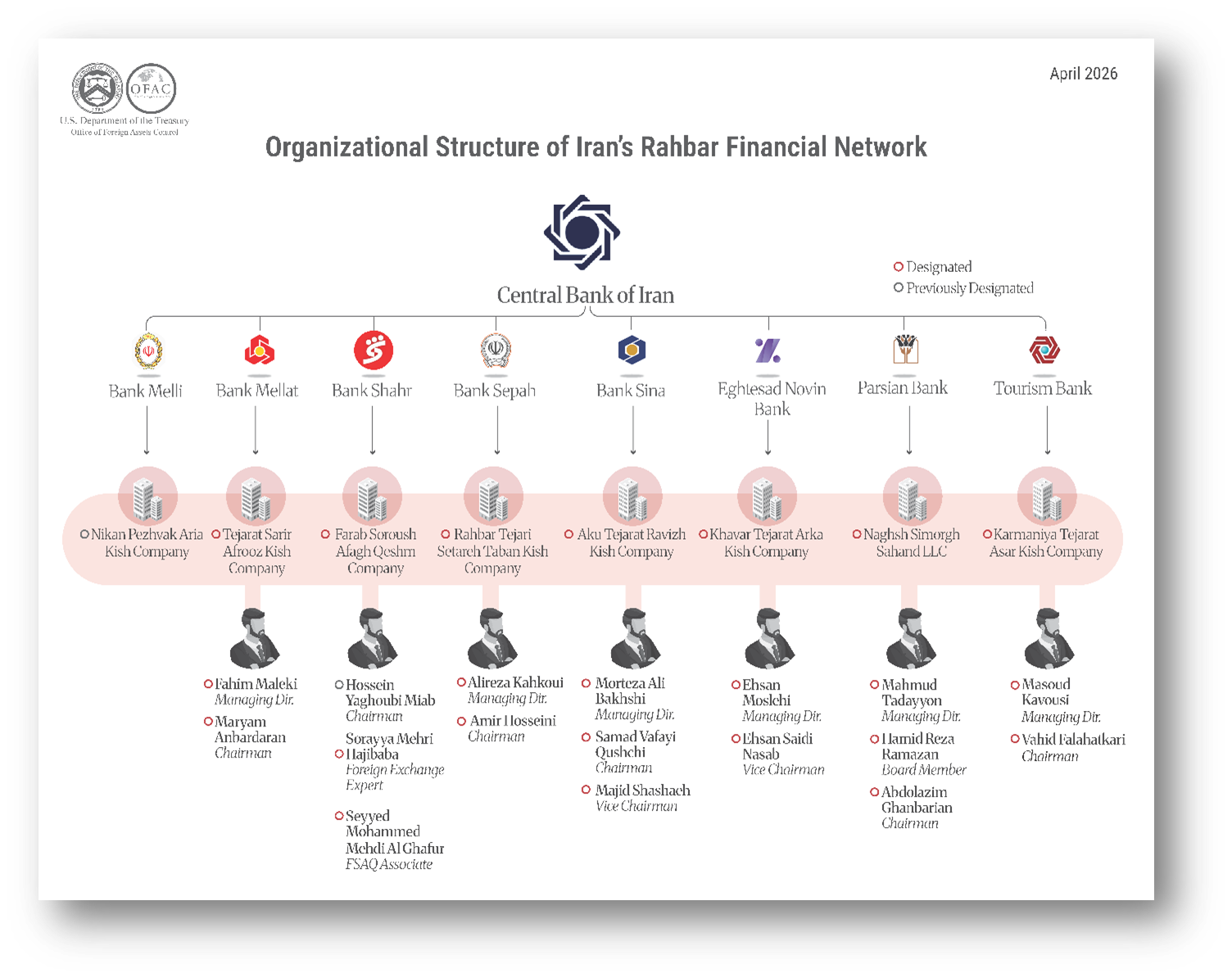
The designated networks operate through a sophisticated system of “rahbar” companies—private entities that manage thousands of overseas shell corporations on behalf of sanctioned Iranian banks cut off from formal international financial systems. These rahbars coordinate with Iranian exchange houses and front companies across multiple jurisdictions to execute payments for Iran’s sanctioned trade, defense procurement, and energy sales.
The structural complexity is deliberate. By fragmenting financial flows across numerous jurisdictions and intermediaries, Iran’s banking sector obscures transaction chains and evades detection. Rahbar companies hold shell company accounts at foreign banks in key financial hubs, allowing sanctioned Iranian banks to access the formal international financial system indirectly.

Shahr Bank’s Oil Trafficking Network
Among the most significant targets is Farab Soroush Afagh Qeshm Company (FSAQ), the rahbar operator for Shahr Bank. FSAQ oversees movement of funds for Shahr Bank’s clients through a network of foreign front companies, with particular focus on facilitating Iranian crude oil and petroleum distillate sales.
Treasury said the network had direct connections to state oil enterprises and military entities. U.S.-sanctioned HMS Trading FZE acts on behalf of Shahr Bank and FSAQ to facilitate oil shipments for Iran’s National Iranian Oil Company (NIOC), Triliance Petrochemical Company, and Sepehr Energy Jahan—identified as a front company for Iran’s Armed Forces General Staff (AFGS). Between them, these entities coordinate financing, guarantees, and payment facilitation for oil producers and third-party nominees.
A critical node in this network is UK-based Shuqun LTD, owned by Filipino national Janelyn Eusebio Emperador. Through 2024, Shuqun transferred over $70 million in payments for Iranian crude oil and oil distillates on behalf of NIOC.


Military-Linked Banks and Ballistic Missile Financing
Today’s designations also target rahbar companies serving military-controlled financial institutions. Bank Sepah, described as “a key provider of financing for Iran’s ballistic missile program,” operates through designated rahbar company Rahbar Tejari Setareh Taban Kish Company. Similarly, the Supreme Leader’s Office-controlled Bank Sina utilizes Aku Tejarat Ravizh Kish Company as its shadow banking facilitator.
Four additional rahbar companies were designated for operating in Iran’s financial sector on behalf of Eghtesad Novin Bank, Parsian Bank, Tourism Bank, and Bank Mellat, while Treasury separately detailed Bank Melli’s previously sanctioned rahbar network and newly designated front companies tied to it.
Bank Melli’s Billion-Dollar Transaction Pipeline
Bank Melli’s rahbar network, operated by Nikan Pezhvak Aria Kish Company, processes billions in transactions for NIOC, the IRGC, and Iran’s Central Bank. The network utilizes front companies including Fratello Carbone Trading Limited—which transferred more than $20 million on behalf of NIOC—along with RQI Commodity HK Limited, Gasolix International Corporation Limited, Globenture Limited, Redwing Global Limited, and Nooseb Trade Limited (formerly Besoon Trade Limited). All six entities were designated for operating in Iran’s financial sector.
Two additional front companies, Nix Energy Limited and Tai Lung Trading Limited, were designated for channeling millions of dollars through sanctioned exchange houses, including Sadaf Exchange, as part of Iran’s clandestine banking infrastructure.


Organizational Leadership and Continuity
The designations identify key individuals directing these networks. Hossein Yaghoobi (also known as Hossein Yaghoubi Miab), chairman of FSAQ, was previously designated in November 2018 for supporting IRGC-Qods Force external operations while serving as the Central Bank of Iran’s Vice Governor for International Affairs—illustrating how personnel with official government backgrounds continue directing shadow banking operations.
Similar patterns appear across multiple rahbar companies. Mahmud Tadayyon chairs Naghsh Simorgh Sahand (serving Parsian Bank), while Abdolazim Ghanbarian serves as managing director. Alireza Kahkoui and Amir Hosseini lead Rahbar Tejari Setareh Taban Kish Company (Bank Sepah). These individuals were designated alongside their respective organizations for operating Iran’s financial sector or providing material support to designated entities.
Enforcement Implications and Strategic Impact
All designated property and interests held in the United States or controlled by U.S. persons are blocked. OFAC generally prohibits all transactions by U.S. persons or within U.S. jurisdiction involving blocked persons unless specifically authorized. Non-U.S. persons are also prohibited from causing U.S. persons to violate sanctions or engaging in conduct that evades U.S. restrictions.
OFAC also issued FAQ 1249 warning that payments to the Government of Iran or the IRGC for safe passage through the Strait of Hormuz are not authorized for U.S. persons and create significant sanctions exposure for non-U.S. persons.
Treasury framed the shadow-banking networks as directly connected to Iran’s ability to fund sanctioned trade, weapons procurement, and support for terrorist proxies. The designations represent the latest phase of what Treasury describes as “maximum economic pressure” against Iran’s financial architecture—a campaign that has accelerated significantly since February 2025.