


Jewish Onliner is an independent publication. If you find our work valuable, please consider becoming a paid subscriber. You can also subscribe to us on WhatsApp and Telegram. Follow us on Instagram, Discord, and X.
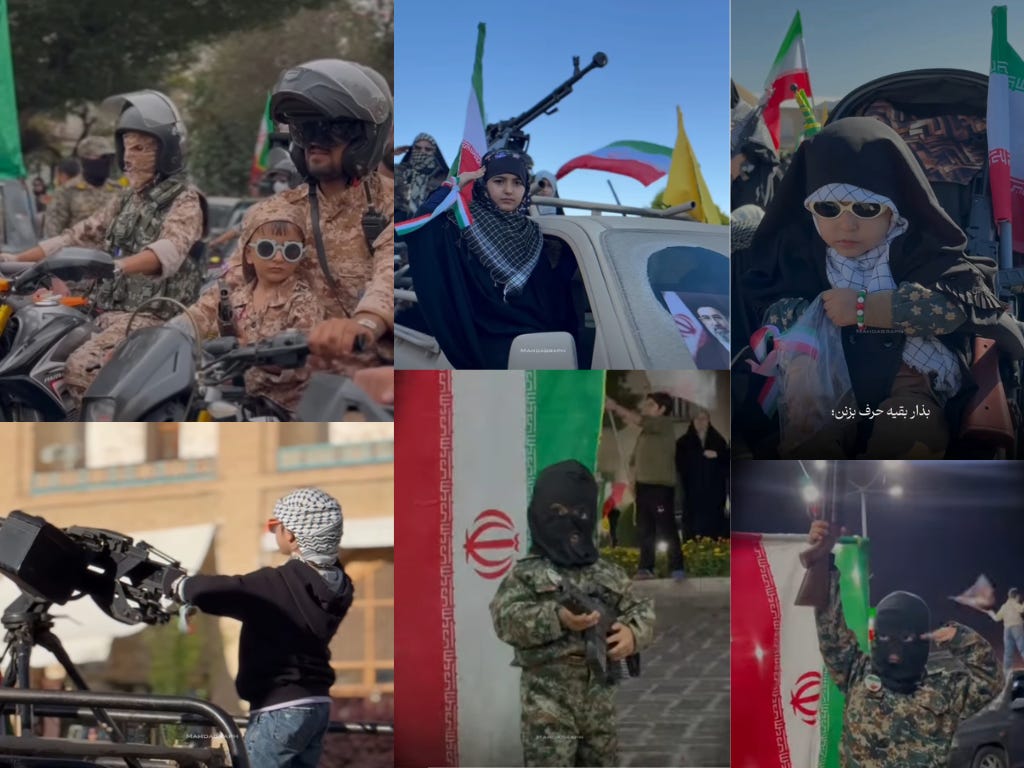
Iran has launched specialized military training for women under the “Janfada-ye Iran” (“Sacrifice for Iran”) campaign, a nationwide mobilization effort overseen by institutions affiliated with the Islamic Revolutionary Guard Corps (IRGC). The first dedicated Janfada military training center opened at Imam Hussein Square in Tehran on September 23, with women-specific courses reported days later. Female volunteers have received firearms and military instruction, while the broader Janfada curriculum includes drones, shoulder-fired anti-aircraft and anti-tank weapons, guerrilla tactics and urban warfare.
Iranian officials claim women make up nearly 32 percent of Janfada registrants and that the campaign has attracted more than 31 million people. That figure, promoted by state media, has been challenged by independent fact-checkers who found technical evidence inconsistent with the government’s claims.
The expansion comes amid a broader IRGC push to militarize civilians, including minors. Amnesty International and Human Rights Watch have documented children as young as 12 armed at checkpoints under a separate IRGC recruitment initiative. Promotional material reviewed by Jewish Onliner goes younger still, depicting toddlers and other young children posed with rifles and military equipment at pro-regime rallies.
From Recruitment Drive to Armed Training Centers
The Janfada campaign was launched on March 28, 2026, by the “Gharb Baqiyatallah Cultural and Social Headquarters,” an entity affiliated with the IRGC, following the assassination of Supreme Leader Ali Khamenei on February 28, 2026, in U.S.-Israeli airstrikes. Within weeks, Iranian officials claimed more than 31 million people, representing nearly half of Iran’s population over age 12, had registered via website, SMS, and in-person platforms.
However, IranWire’s fact-checking outlet FactNameh evaluated this claim as “False” after technical analysis revealed the registration system permitted multiple sign-ups using different phone numbers, and the highest registered user ID was under four million—incompatible with claims of 30-plus million participants.
By September, the campaign had transitioned from passive registration to active military organization. Iranian media reported coordination with armed forces to train and organize 1,000 “Jan-Fada National Resistance Battalions,” with women receiving dedicated training courses during Sacred Defense Week in late September.
Women Train with Anti-Tank Weapons and Combat Drones
The women’s training program covers an extensive military curriculum. According to campaign spokesperson Sasan Zare, instruction includes local security, war readiness, surveillance, intelligence gathering, drone operation, shoulder-fired weapons, and first aid—with sessions taking place both at military centers and in public squares.
Iranian state media documented footage showing women at Imam Hussein Square receiving instruction in firearms, including handguns and rifles, as well as training with FPV (first-person-view) drones—the same type of unmanned aerial vehicles used extensively in modern combat zones. Additional reporting indicated training in anti-tank weapons and urban warfare techniques.
The training facilities were opened at two locations in Tehran: the first at Imam Hussein Square, followed by a second center at Haft-e Tir Square on October 3. Footage from these centers showed participants crossing obstacle courses, using virtual reality headsets for weapons training, and conducting drills with camouflage-painted anti-aircraft equipment.
Propaganda Features Children as Young as Toddlers with Weapons
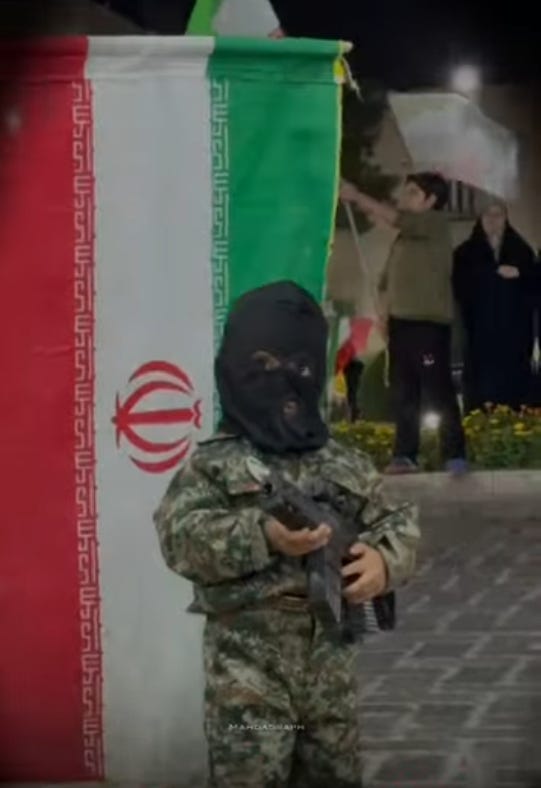
Promotional material for the Janfada campaign, shared across social media and reviewed by Jewish Onliner, depicts children as young as toddlers wielding weapons at rallies and parades. One image shows a child approximately 3 to 5 years old wearing full military camouflage and a black balaclava, holding what appears to be an assault rifle while standing in front of an Iranian flag at a nighttime gathering.
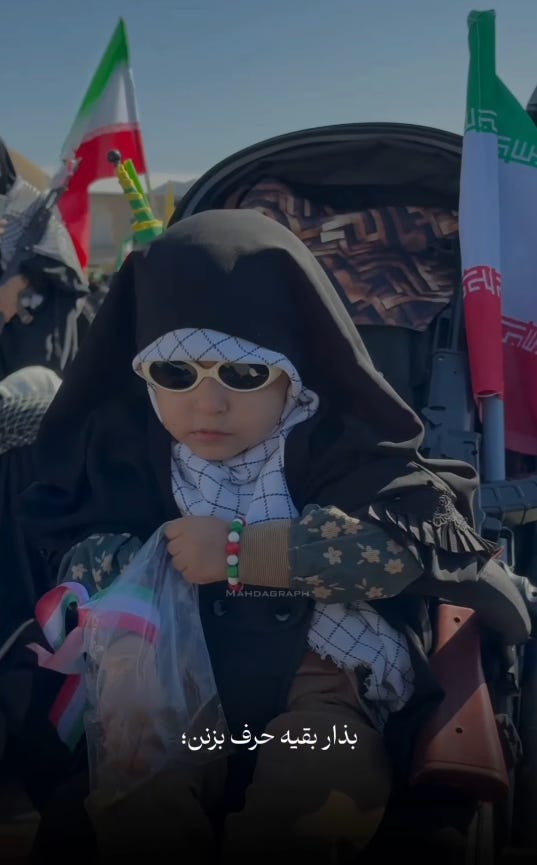
Another shows an infant girl seated in a stroller with a rifle positioned beside them, wearing a black head covering and sunglasses while surrounded by Iranian flags at a daytime parade.
A third image depicts a young girl leaning from a pickup truck mounted with a heavy machine gun, saluting while wearing a black chador and keffiyeh.
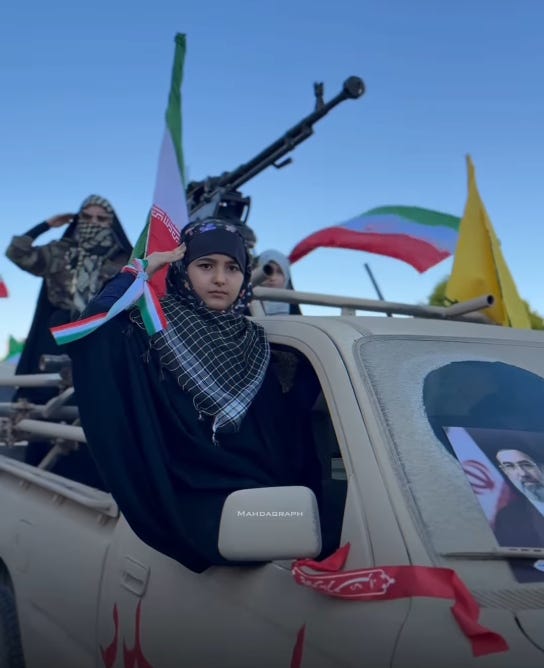
The imagery has been promoted by Press TV, the English-language channel of Islamic Republic of Iran Broadcasting (IRIB), which has been designated by the U.S. Treasury Department’s Office of Foreign Assets Control (OFAC) on the Specially Designated Nationals (SDN) list and subject to secondary sanctions. IRIB was sanctioned by the United States for participating in censorship and forced confessions.
Children as Young as 12 Armed at Checkpoints
The IRGC has recruited children as young as 12 into the campaign. Rahim Nadali, an IRGC official with the 27th Mohammad Rasulullah Division in Tehran, told state television in March that the “Homeland Defending Combatants for Iran” campaign set the minimum age at 12, explaining: “We have had many young people and teenagers demanding to be present in [Basij checkpoints]. Given the ages that were making demands, we have set the [minimum] age at 12. Meaning now there are kids of 12 and 13 who want to be present in this space.”
Amnesty International analyzed 16 photos and videos appearing online since March 21, 2026, showing children wielding AK-pattern assault rifles at checkpoints, on patrols, and during state-organized militarized rallies in Tehran, Mashhad, and Kermanshah. Eyewitnesses told BBC Persian they observed armed children at checkpoints in Tehran, Karaj, and Rasht, with one witness describing teenagers “holding a gun at the cars” and searching vehicles.
France24 reported a Tehran resident’s account of encountering “teenagers aged 13 or 14, weapons in their hands, who were stopping vehicles” at checkpoints. One boy reportedly entered her vehicle and searched her phone, including photographs. BBC reported that an 11-year-old boy, Alireza Jafari, was killed while accompanying his Basij-member father at a checkpoint in Tehran on March 29.
Amnesty International stated that “recruiting children under 15 into the armed forces constitutes a war crime” under customary international humanitarian law, which is legally binding on Iran.
Basij Commander Oversees Military Integration
Hossein Taeb, head of the Basij Organization, announced on September 18 that hundreds of thousands of Jan-Fada enrollees have been organized in Tehran, with integration into defense battalions and military units officially underway. The training center at Imam Hussein Square opened September 24 in Taeb’s presence, with Basij officials stating that similar centers will gradually be set up in other cities and provinces.
An informed government source told IranWire that the government, the Supreme National Security Council, and even many IRGC commanders oppose the campaign’s expansion, viewing it as a pressure group established by Taeb to influence other sectors of the Islamic Republic regime.
Regional Context and Strategic Implications
The mobilization campaign coincides with escalating regional tensions. Iran has blocked shipping traffic through the Strait of Hormuz since February 28, 2026, while the U.S. maintains a naval blockade of Iran’s southern ports. The campaign also follows mass killings during protests in December 2025-January 2026, when security forces reportedly killed over 36,000 civilians according to Iran International.
A UN fact-finding mission alleged the Islamic Republic committed crimes against humanity during the crackdown, raising questions about whether the newly trained civilian battalions, including armed children, could be deployed domestically as well as against external threats.