


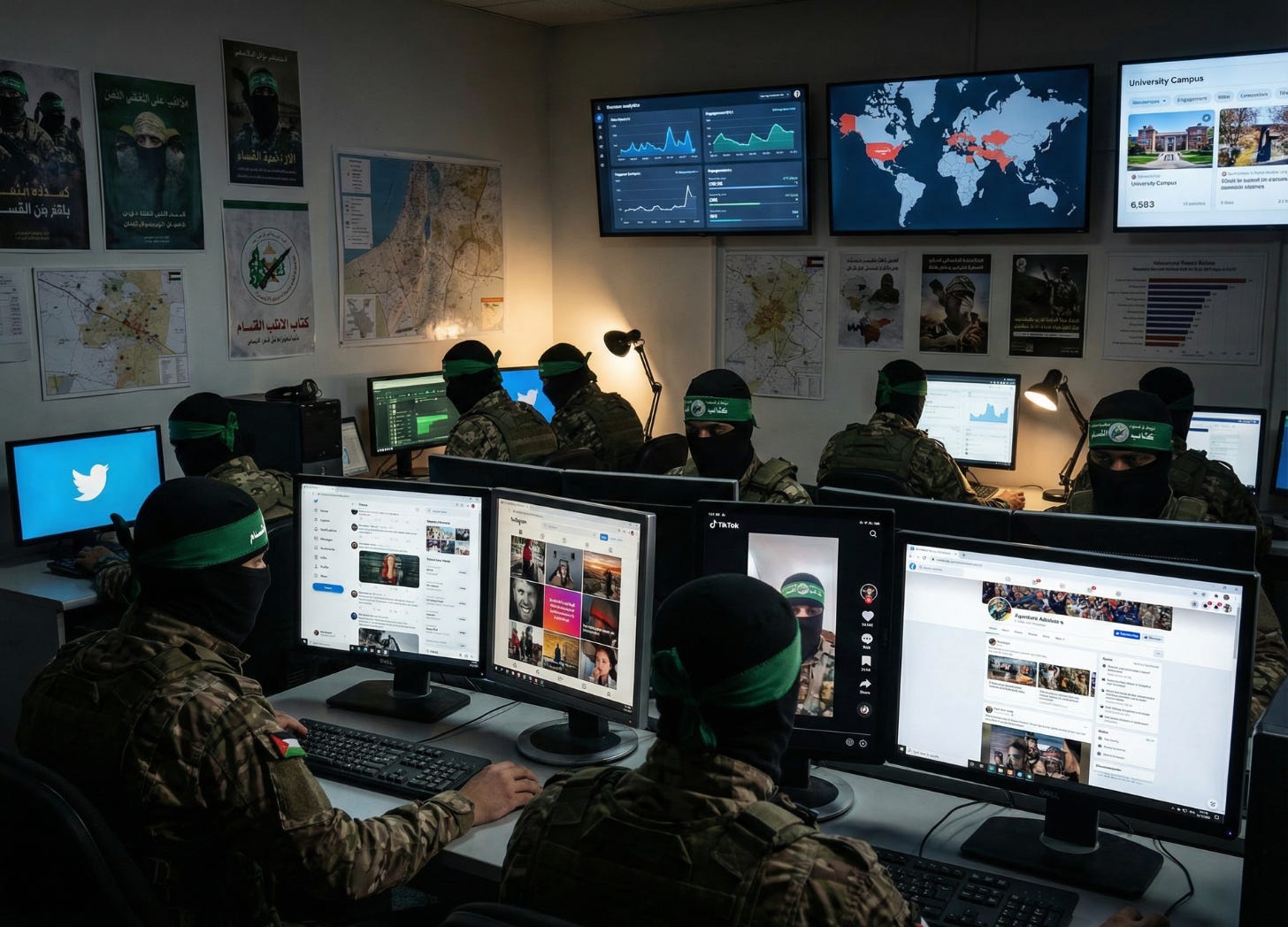
An article from INSS, the Institute for National Security Studies, breaks down how Hamas systematically appeals to the West through appropriation of human rights language, strategic media partnerships, and psychological manipulation. In their analysis, researchers Batsheva Neuer and Ofir Dayan argue that Hamas deliberately constructs different narratives for different audiences—using “freedom fighters” exclusively in English translations while maintaining Islamist framing in Arabic versions.
The strategy appears to have achieved measurable success, with Harris polling data conducted with Harvard University showing 60 percent of Americans aged 18-24 supporting Hamas rather than Israel.
From Islamic Rhetoric to Western Appeals
Hamas’s appeal to the West marks a calculated departure from its 1988 founding charter’s religious rhetoric. By 2017, the organization adopted secularized Western language invoking human rights and international law, accelerating as it cultivated relationships with NATO member Turkey and U.S. ally Qatar. Growing acceptance on university campuses and within civil society organizations enabled this transformation.


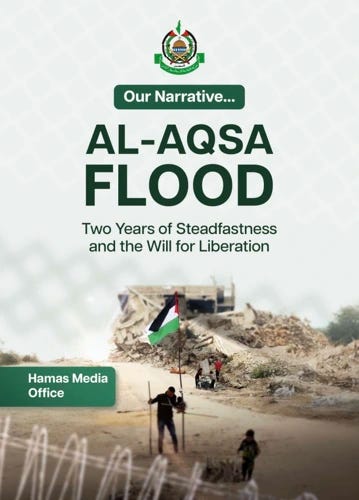
The December 2025 document titled, “Al-Aqsa Flood: Two Years of Steadfastness and the Will for Liberation,” “exemplifies this strategy. Hamas operatives labeled “mujahideen” in Arabic become “freedom fighters” in English—a linguistic duality revealing precise audience segmentation.
The document employs Western progressive vocabulary: human rights, international law, anti-racism, and liberation narratives. Rather than defending itself, Hamas mounts what Neuer and Dayan call a “direct moral indictment of Israel’s wartime conduct” using liberal democratic discourse.
Gaslighting on Civilian Harm
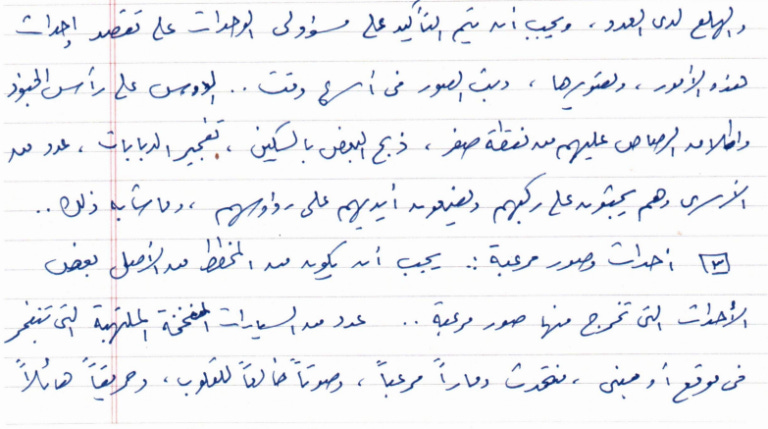
Central to Hamas’s Western appeal is systematic denial of civilian harm responsibility. The December document claims that “killing civilians is not part of our religion, morality, or education; and we avoid it whenever we can.” This directly contradicts operational orders recovered from Hamas operatives explicitly directing them to maximize civilian casualties and film atrocities for psychological impact.
Instead of acknowledging this evidence, Hamas employs “inversion”—relocating accusations of civilian slaughter to Israel. The document asserts that “killing civilians, committing brutal massacres, and ethnic cleansing are original Zionist behaviors since this entity’s establishment.” This rhetorical maneuver has resonated in Western progressive circles, where selective amnesia about Hamas’s crimes combines with magnified focus on Israeli conduct.
Weaponizing Human Rights Language
Hamas has appropriated the vocabulary through which Western liberal democracies claim moral authority and weaponized it against Israel. Terms like “genocide” and “settler colonialism” now circulate widely in global discourse, with Hamas deliberately elevating Palestine as a universal “moral yardstick” for justice. The organization frames support for Palestine as a prerequisite for being considered “enlightened” and “just” in Western contexts.
Neuer and Dayan argue the goal transcends rhetoric—it aims to “mobilize external pressure as a strategic asset” by positioning the conflict as “a defining moral test of our age.” By rebranding the conflict as a decolonial struggle, Hamas positioned itself within Western progressive ideological frameworks.
Journalists and Al Jazeera as Strategic Assets
Hamas formally classifies journalists as “civilian heroes,” revealing how it views the conflict as “cognitive as much as kinetic.” Organizational documents show Qatar-based Al Jazeera functioned as “a propaganda arm of Hamas and had full cooperation from the organization, benefiting both parties.” Social media influencers received similar access to senior Hamas figures and combat sites, demonstrating sophisticated grasp of contemporary opinion-shaping.
Hamas continuously alleges Israel kills journalists and restricts media access, deploying these claims as instruments for reputational harm. These allegations have achieved broader Western acceptance despite Israel’s counterarguments.


Israel’s Strategic Disadvantage
While Hamas mounted a coordinated persuasion campaign targeting the West, Israel “has not produced an adequate public-facing response to these Hamas claims,” the researchers argue. Israel’s strategic restraint has backfired, leaving “Western public opinion more exposed to Hamas’s framing.”
Measured Success
According to Neuer and Dayan, Hamas’s narrative campaign has achieved its objective “to some extent.” Public opinion surveys, campus activism, and solidarity movements demonstrate the reframing’s effectiveness among younger generations and progressive constituencies. For Jewish communities in the West, this strategic success carries particular significance: the delegitimization of Israel operates simultaneously as delegitimization of Jewish political claims and moral standing.