


Jewish Onliner is an independent publication. If you find our work valuable, please consider becoming a paid subscriber.
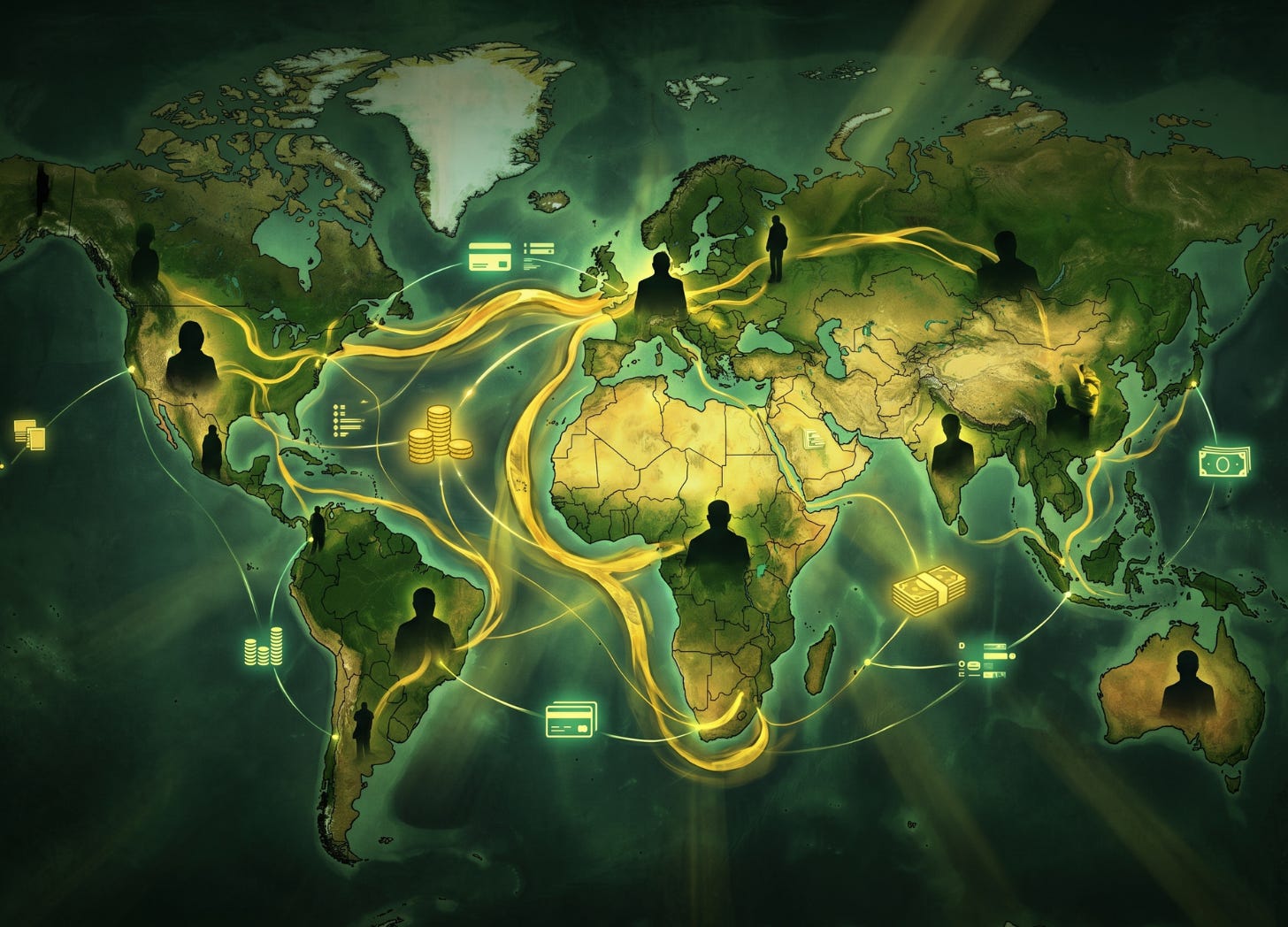
A new analysis from Israel’s Institute for National Security Studies (INSS) documents Hezbollah’s decentralized global financial infrastructure, identifying account holders and intermediaries operating across Europe, North America, Africa, and South America.
In their May 3, 2026, study, researchers Noam Binstok, Orna Mizrahi, and Esteban Klor synthesize data from a 2020 leak of al-Qard al-Hassan’s internal databases, U.S. Treasury OFAC designations, and Lebanese diaspora voter registration records to map the organization’s international financial reach.


The Database Leak and Scale
A 2020 data breach exposed nearly 400,000 accounts within al-Qard al-Hassan, which INSS describes as Hezbollah’s primary financial institution and, effectively, its banking system. INSS argues that, given the size of the leaked database relative to Lebanon’s adult Shiite population, al-Qard al-Hassan appears deeply embedded in civilian economic life, making it difficult to isolate through military means alone.


Cross-referencing al-Qard al-Hassan account data with Lebanese diaspora voter-registration records, Binstok, Mizrahi, and Klor examined overseas Lebanese voter populations across Europe, North America, Africa, and the Gulf states. INSS says those voter lists included more than 51,000 registered voters in Europe, more than 34,000 in North America, more than 9,500 in Africa, and more than 12,500 in the Gulf states.
Within that broader dataset, the analysis identified hundreds of individuals in those countries holding accounts linked to Hezbollah’s financial system, while thousands more maintained familial or business ties with account holders. Some accounts, the study says, were explicitly marked as belonging to Hezbollah members.


Diaspora Remittances as Financial Backbone
By 2023, diaspora remittances reached roughly one-third of Lebanon’s GDP, among the world’s highest ratios, according to World Bank data cited in the study. The researchers state that roughly 95% of remittance transfers bypass Lebanon’s banking system and move through the country’s cash economy, including money-transfer operators and informal channels.
This informal infrastructure provides ideal conditions for Hezbollah’s financial integration within legitimate economic flows. The organization exploits these channels by embedding its funding operations within diaspora communities, leveraging trusted relationships and established remittance routes to move money internationally with minimal regulatory friction.
Hawala Networks and Trade-Based Laundering
Hezbollah’s financial architecture incorporates hawala—informal cross-border transfers facilitated through intermediaries settling accounts via trade arrangements rather than direct financial transactions. These networks leave minimal records and operate outside formal regulatory frameworks.
According to the researchers, Hezbollah’s illicit revenue, including proceeds from drug trafficking in Latin America and globally, is first laundered through trade-based mechanisms, such as the purchase and resale of legitimate goods, and then transferred internationally via hawala networks. This structure provides what Binstok, Mizrahi, and Klor describe as “high adaptability” and rapid reconstitution when specific financial nodes are targeted.


International Evasion Mechanisms
INSS argues that Lebanon’s FATF gray-list status does not significantly hinder Hezbollah because the organization can exploit diaspora networks and informal financing channels to route funds through jurisdictions with stronger financial reputations, thereby avoiding scrutiny.
According to the researchers, recent U.S. sanctions highlight that Hezbollah’s financial activity does not depend on a single institution, but on a network of interchangeable nodes, including companies, money changers, and intermediaries across multiple jurisdiction.
Policy Recommendations
The researchers propose five coordinated strategies to disrupt Hezbollah’s financial network. They recommend expanding financial cooperation with the United States, European countries, and key African states where Lebanese diaspora communities are present. They also call for targeting financial intermediaries, including money changers, hawala brokers, and trade-based laundering networks, rather than focusing only on al-Qard al-Hassan.
The study further recommends greater oversight of diaspora-linked financial flows, especially in countries with large Shiite communities. It also calls for a permanent Israeli interagency task force combining intelligence, legal, financial, and law-enforcement expertise.
Finally, the researchers urge Israel and its partners to use economic diplomacy to pressure Lebanon’s government to take concrete action against Hezbollah’s financial infrastructure, including by conditioning international assistance on measurable steps.
The INSS team identifies this decentralized and socially embedded structure as a central reason Hezbollah’s financial system is difficult to target. Because the network is spread across diaspora communities, informal transfer systems, legitimate economic activity, companies, money changers, and intermediaries, disruption of any single node is unlikely to produce lasting strategic effects.