


Jewish Onliner is an independent publication. In an age when grotesque libels about Jews and Israel spread with alarming speed, data-driven research matters more than ever. If you find our work valuable, please consider becoming a paid subscriber.
When Ramy Abdu, chairman of the alleged Hamas-linked Euro-Med Human Rights Monitor, posted on May 23, 2026 that "inside the mass graves, [Gazans] found children & babies with their hands bound with zip ties," the claim was not new. The image embedded in his post had already circulated on X and Instagram for more than two years, spreading across 71 countries. Jewish Onliner's analysis of 1,221 X posts containing the claim found it had generated more than 294,000 likes, shares, and comments.
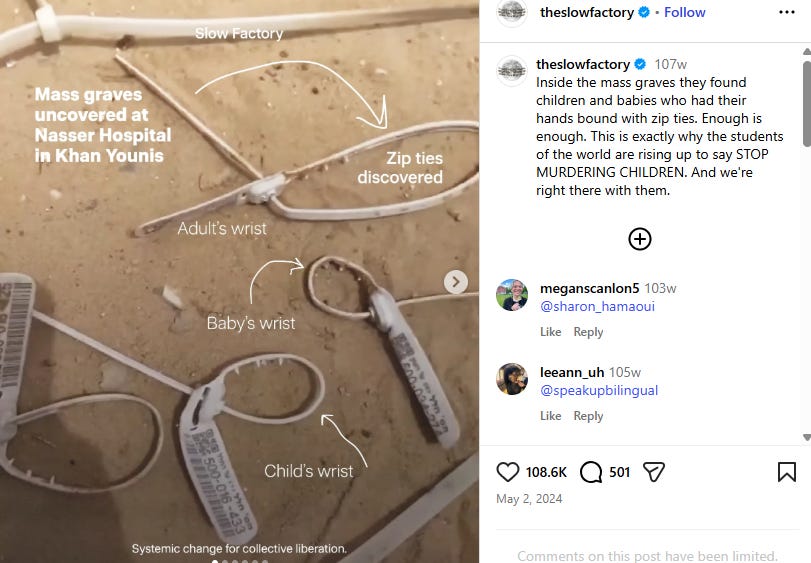
Yet the central evidentiary problem remained unresolved. The image is not a forensic document. It is an Instagram graphic produced by Slow Factory, a New York–based fashion-activism nonprofit, with overlaid labels reading “Adult’s wrist,” “Baby’s wrist,” and “Child’s wrist.” No public source has produced forensic documentation, autopsy reports, an independently identifiable victim, on-the-record medical testimony, or chain-of-custody evidence connecting the items in the photograph to bodies recovered at Nasser Hospital, let alone to babies.
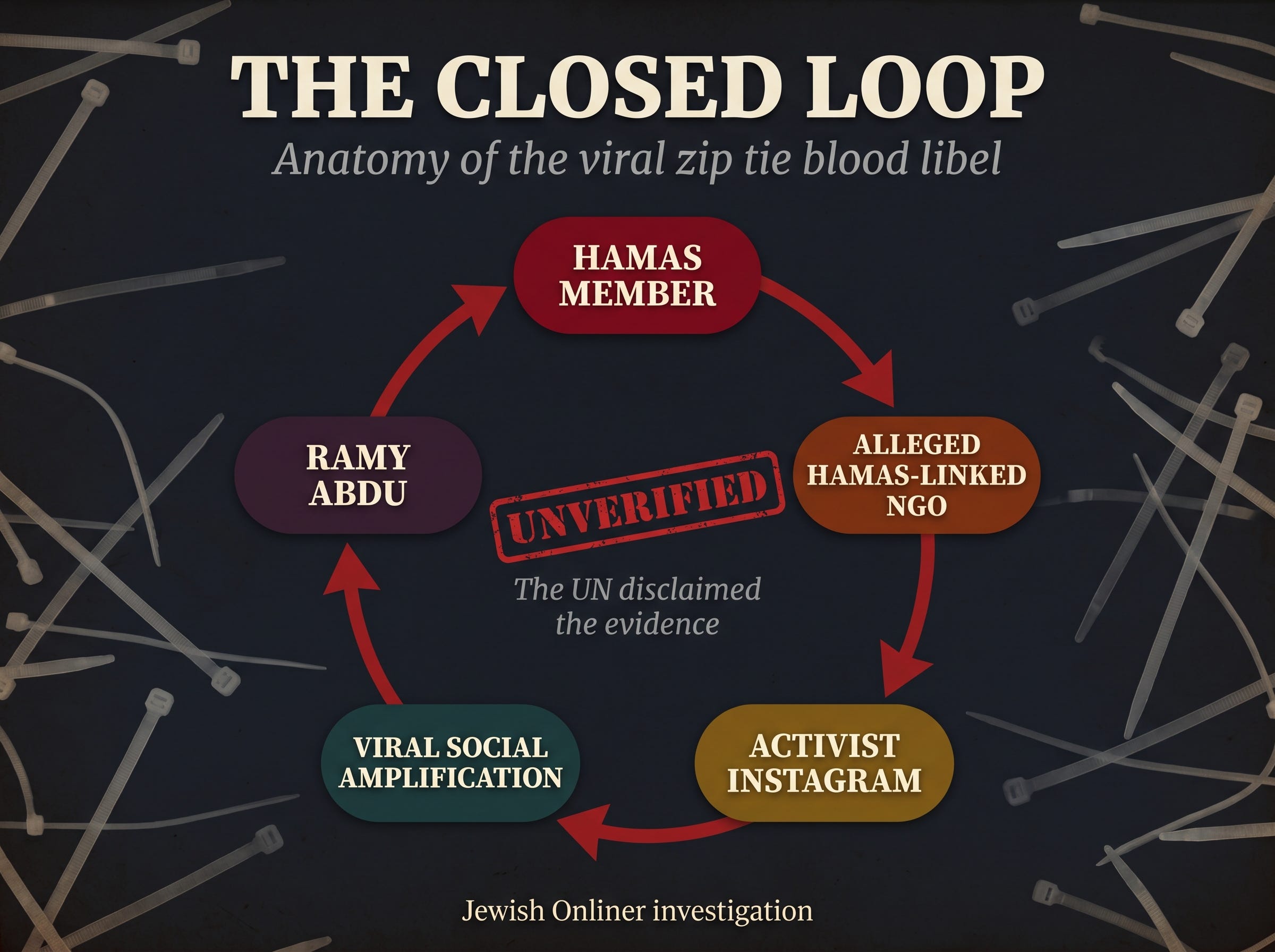
This article examines how an unverified claim by a Hamas member was upgraded by a Hamas-controlled Civil Defense spokesman in Gaza, visually escalated by an American activist nonprofit nine days later, then recycled and amplified across 24 months by a network of Pro-Palestinian advocacy figures, anti-Israel commentators, and high-reach social media accounts — many of whom cited each other as if they constituted independent verification.


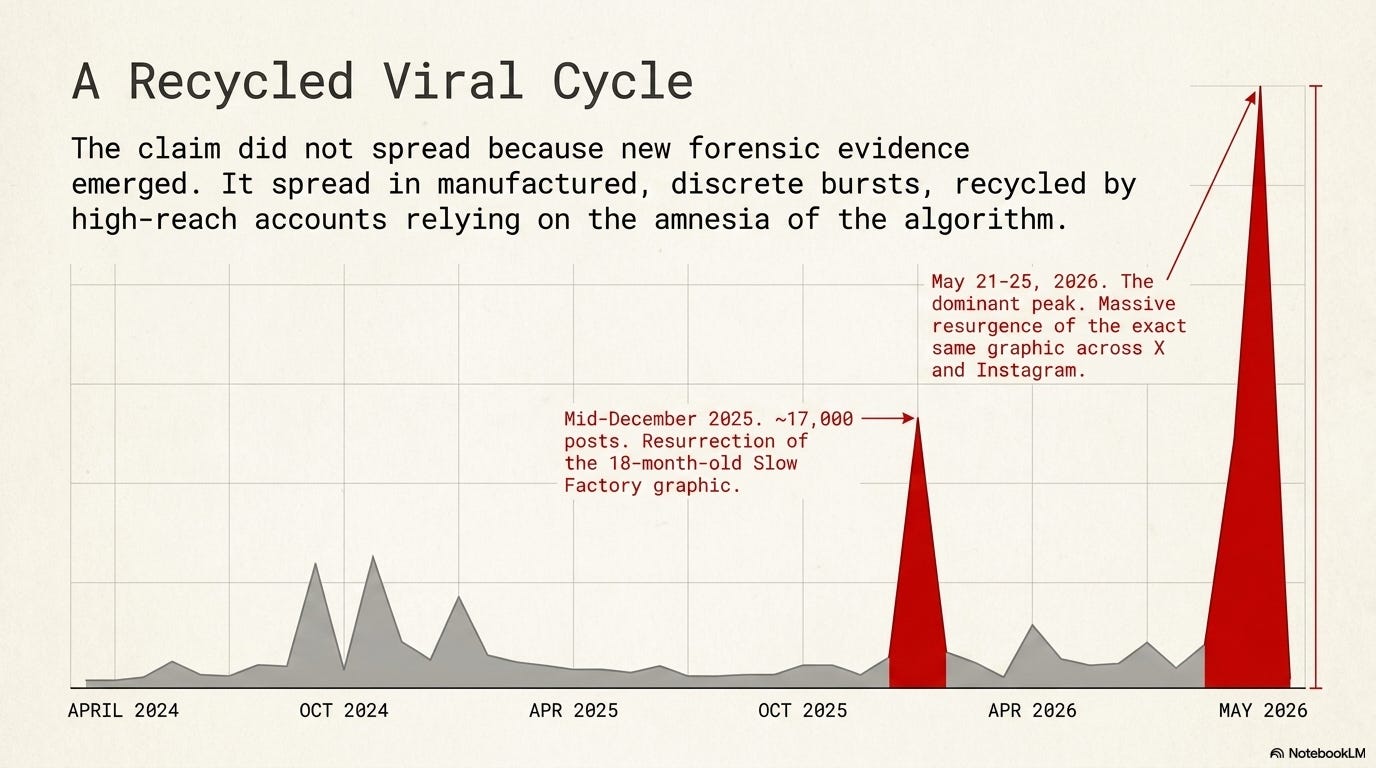
A Recycled Viral Cycle
Jewish Onliner's X analysis tracked 82,900 posts about the allegation over the past 12 months, generating 294,400 engagements in total. The volume wasn't steady — it arrived in two discrete bursts: a spike of roughly 17,000 posts in mid-December 2025, and a dominant peak around May 21–25, 2026.
A deeper review of 1,221 individual posts starting from October 7, 2023 found that 47% originated from accounts classified as U.S.-based. Engagement was heavily concentrated among a small group of high-reach anti-Israel accounts, including @CensoredMen, @RamAbdu, @caitoz, and @QudsNen. Posts containing skeptical or debunking language made up only 5.3% of the dataset — and generated just 597 engagements. Non-skeptical posts, by contrast, generated 276,217: a ratio of 463 to 1.
The Original Claim
On April 22, 2024 — two days after Palestinian families returning to Nasser Hospital first reported temporary graves dug during the Israeli siege — Mahmoud Bassal, spokesman for the Hamas-run Civil Defense in Gaza, told BBC Arabic’s “Gaza Today” programme that the Israeli army had “established a mass grave, pulled out the bodies that were in Nasser hospital, and buried them in this mass grave.”
In June 2025, Bassal was identified as an active terror operative in the Zeitoun Battalion of the Izz ad-Din al-Qassam Brigades, Hamas’s armed wing from Hamas’s own military records found in Gaza.


The same day, Col. Yamen Abu Suleiman, director of Civil Defense in Khan Younis, told CNN that some bodies had been found with “hands and feet tied.” CNN explicitly stated it was “unable to verify Suleiman’s claims.” Abu Suleiman later described the restraints to Mondoweiss as “plastic tape” — not zip ties.


On April 24, 2024, the UN’s own Palestine office disclaimed the evidence. Ajith Sunghay, head of the UN Human Rights Office for the Palestinian territories, told the BBC that while he had seen photographs of bodies with hands tied, “the evidence did not meet the standard of proof required by the UN and so could not be stated as a fact.”
The next day, analyses by the New York Times, Sky News, and open-source verification group GeoConfirmed confirmed through satellite imagery and dated video that Palestinians themselves had dug the Nasser graves between January 22 and February 3, 2024 — weeks before Israeli forces entered the complex on February 15.
The Slow Factory Escalation
On May 1, 2024 — nine days after the original Civil Defense claim — the New York–based nonprofit Slow Factory posted an infographic to its 961,000-follower Instagram account. The graphic overlaid white plastic items with the labels “Adult’s wrist,” “Baby’s wrist,” and “Child’s wrist,” accompanied by the caption: “Inside the mass graves they found children and babies who had their hands bound with zip ties.” The post accumulated nearly 109,000 likes and 502 comments before commenting was restricted.
Slow Factory was founded in 2012 by Lebanese-Canadian designer Céline Semaan and her husband Colin Vernon. The organization describes itself as a “movement organization and knowledge lab” producing “Media Justice & Narrative Change” content. Its tax filings show it has received support from foundations including Donor Advised Charitable Giving Inc., the Greater Houston Community Foundation, and the Silicon Valley Community Foundation, per InfluenceWatch.
On Instagram, the organization has characterized Zionism as “genocide, ethnic cleansing, state-sanctioned terrorism, ecocide, supremacy, settler colonialism, illegal land annexation, fascism, and segregation.” Semaan, in a 2024 interview with Drilled Media, said that “Zionist funders” were “working around the clock to defund the work that we’re doing.”
The Slow Factory graphic introduced three escalations not present in the original Civil Defense claim: the substitution of “plastic tape” with “zip ties,” the addition of “Baby’s wrist” and “Child’s wrist” labels, and the visual presentation of the claim as established fact. The image has since circulated across at least six other Instagram accounts using a standardized caption that names both Slow Factory and Euro-Med as sources.
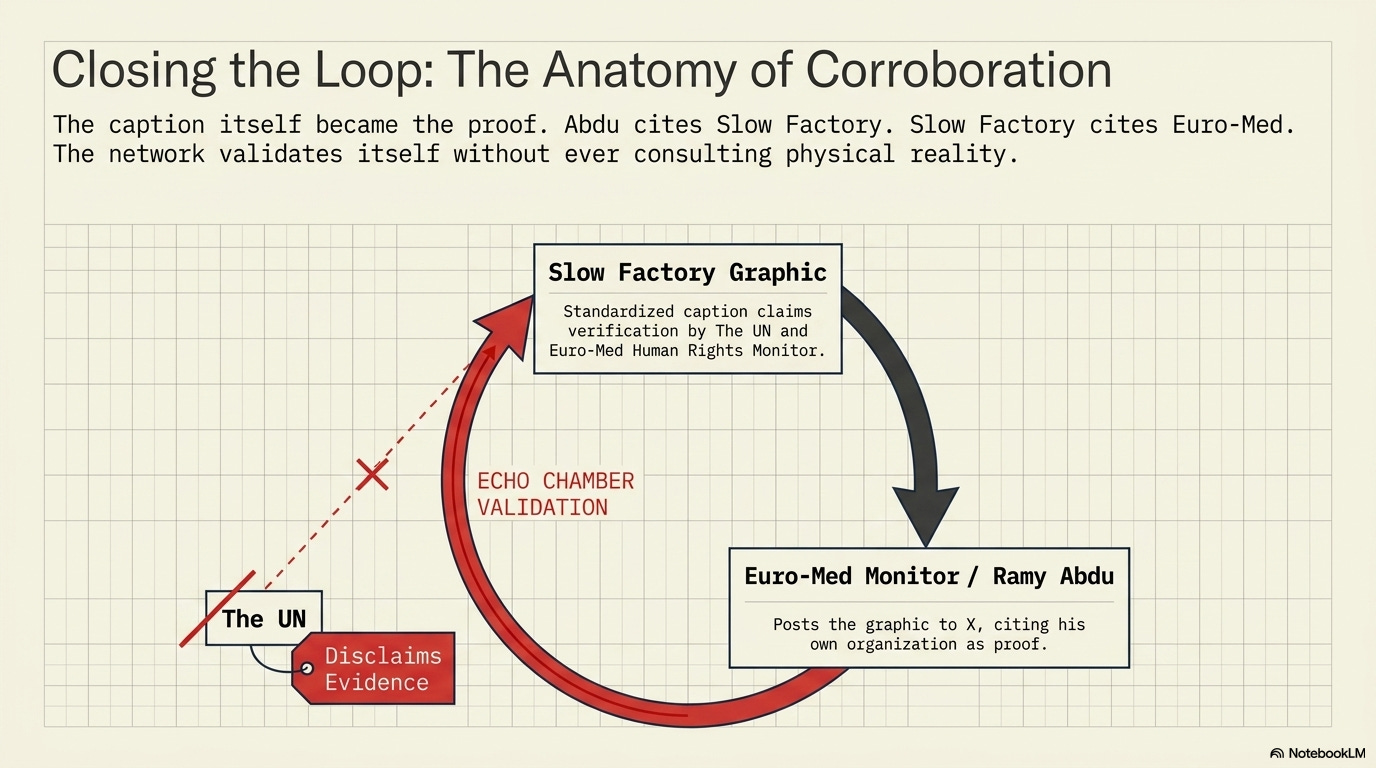
Closing the Loop
The allegation has been recycled in waves. Between 2024 and May 2026, Ramy Abdu posted the same wording and image at least five separate times on X, per JO's dataset. His Euro-Med has been identified by Israeli authorities in Hamas-related counterterror financing materials; his brother was arrested in Italy in December 2025 in connection with an alleged Hamas financial network. His most viral post generated 17,400 likes and 12,213 reposts, with his May 2026 repost adding another 9,871 likes.
By May 2026, the chain of citation had closed. The visual originated with Slow Factory. The standardized caption attached to it claimed verification by both “the UN (OHCHR) and Euro-Med Human Rights Monitor.” But the UN’s Palestine office had publicly disclaimed the evidence. Euro-Med’s chairman was the same figure now amplifying the Slow Factory graphic on X — citing his own organization as proof. And the original “plastic tape” reference from a Hamas military operative had been transformed, nine days later by an activist designer in New York, into “zip ties on babies.”
The findings suggest the allegation did not spread because new evidence emerged. It spread because repetition across terrorist, activist, NGO, and social media channels created the appearance of corroboration — even as forensic verification remained, two years on, wholly absent.
This despicable slander was fabricated specifically to justify the massacre carried out by the Palestinian terrorist organization Hamas.
Hamas is affiliated with the Muslim Brotherhood. The Muslim Brotherhood is extremely anti-Israel and extremely anti-Jewish. Hamas is a typical Muslim terrorist organization with one goal: to destroy Israel and murder Jews. This is a commandment in the Quran.