


Jewish Onliner is an independent publication. If you find our work valuable, please consider becoming a paid subscriber. You can also subscribe to us on WhatsApp and Telegram. Follow us on Instagram, Discord, and X.
Indiana Attorney General Todd Rokita opened investigations into National Students for Justice in Palestine (SJP) and the Council on American-Islamic Relations (CAIR) on October 7, 2026, demanding documents to determine whether the organizations qualify as affiliates of foreign terrorist organizations under Indiana law. The announcement came on the third anniversary of Hamas’s October 7 massacre.
In the parallel SJP inquiry, Rokita’s demand requires the group to describe its relationships with U.S.-sanctioned groups Samidoun and Masar Badil, and turn over related records.
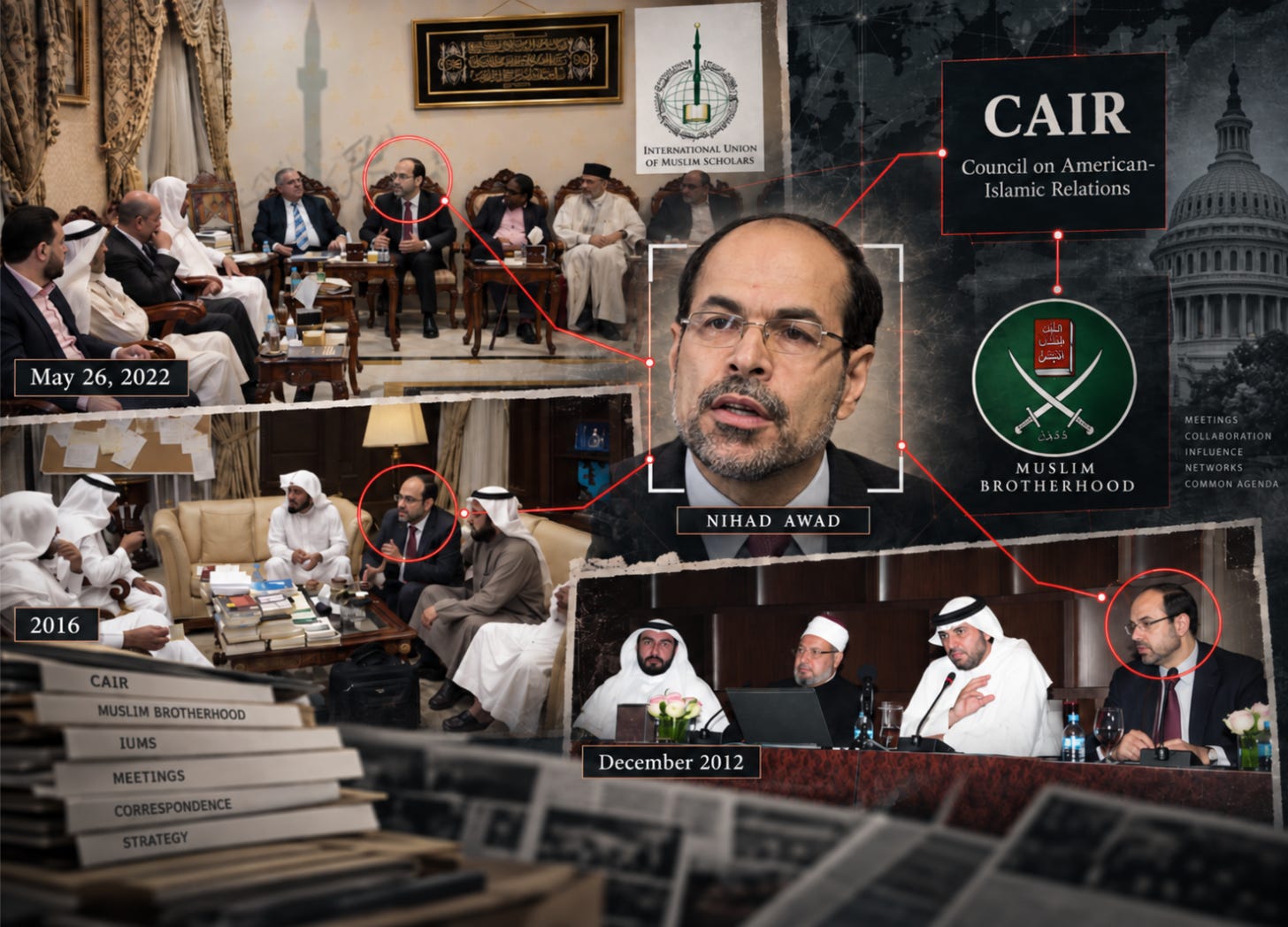
The CAIR investigation, first reported on by Daily Signal reporter Tyler O’Neil, asks CAIR to “identify and describe all instances in which CAIR Executive Director Nihad Awad has met with members or agents of members of the Muslim Brotherhood.” For each meeting, the attorney general seeks its location and date, the identities of those Awad met, the Muslim Brotherhood chapter or branch with which each person was affiliated, and the purpose of the meeting.


It also asks CAIR to identify any person or entity designated by the U.S. government as a foreign terrorist organization with whom a CAIR employee or agent communicated, directly or indirectly, on behalf of CAIR.
Records reviewed by Jewish Onliner document repeated meetings between Awad and figures linked to the Muslim Brotherhood, and a 2008 visit to Islamic Jihad financier Sami al-Arian.


Years of Meetings With IUMS Figures
Awad’s documented contacts with figures associated with the International Union of Muslim Scholars (IUMS) span nearly a decade.
In testimony submitted to an August 5, 2026 Senate Judiciary subcommittee hearing on the Muslim Brotherhood, Arielle Klepach, senior litigation counsel at the National Jewish Advocacy Center, described IUMS as the Muslim Brotherhood’s “transnational scholarly authority” and said it maintains a close relationship with the Egyptian Muslim Brotherhood.
The U.S. Treasury Department designated the Egyptian branch as a Specially Designated Global Terrorist entity on January 13, 2026.
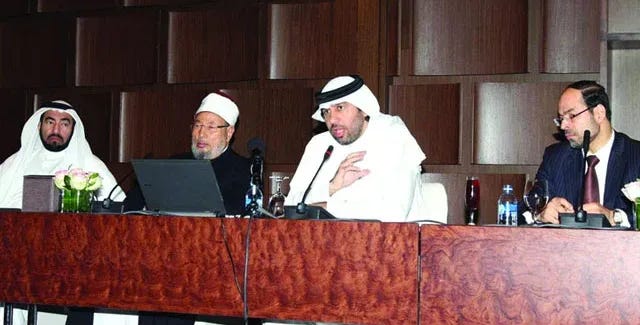
In December 2012, Awad appeared at a news conference in Qatar promoting Al-Noor Holding’s proposed film series about Muhammad. A report credited to Kuwait’s Al-Nahar identifies Awad, Yusuf al-Qaradawi and Tariq al-Suwaidan as speakers.
Qaradawi was then president of IUMS and was widely described as a spiritual leader of the Muslim Brotherhood. Suwaidan headed Al-Noor’s advisory team. In 2013, Prince Alwaleed bin Talal dismissed Suwaidan from Al-Resalah television after saying Suwaidan had publicly identified himself as a Brotherhood leader.
A separate December 2012 account on Ali al-Qaradaghi’s website described a meeting between Qaradaghi and Awad. Qaradaghi was then IUMS secretary-general.
The account, published December 24, 2012, said Awad discussed providing political training, including instruction on how American policy decisions are made. It reported that the two sides agreed to continue exchanging expertise and strengthen academic ties between IUMS and CAIR.
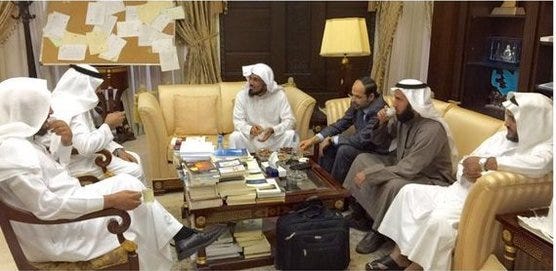
Another documented meeting followed in 2016. A January 28 report, republishing an IUMS account, said Salman al-Ouda, identified as an IUMS board-of-trustees member, received Awad at his office north of Riyadh. The discussion reportedly concerned the circumstances and future of Muslims in the United States.
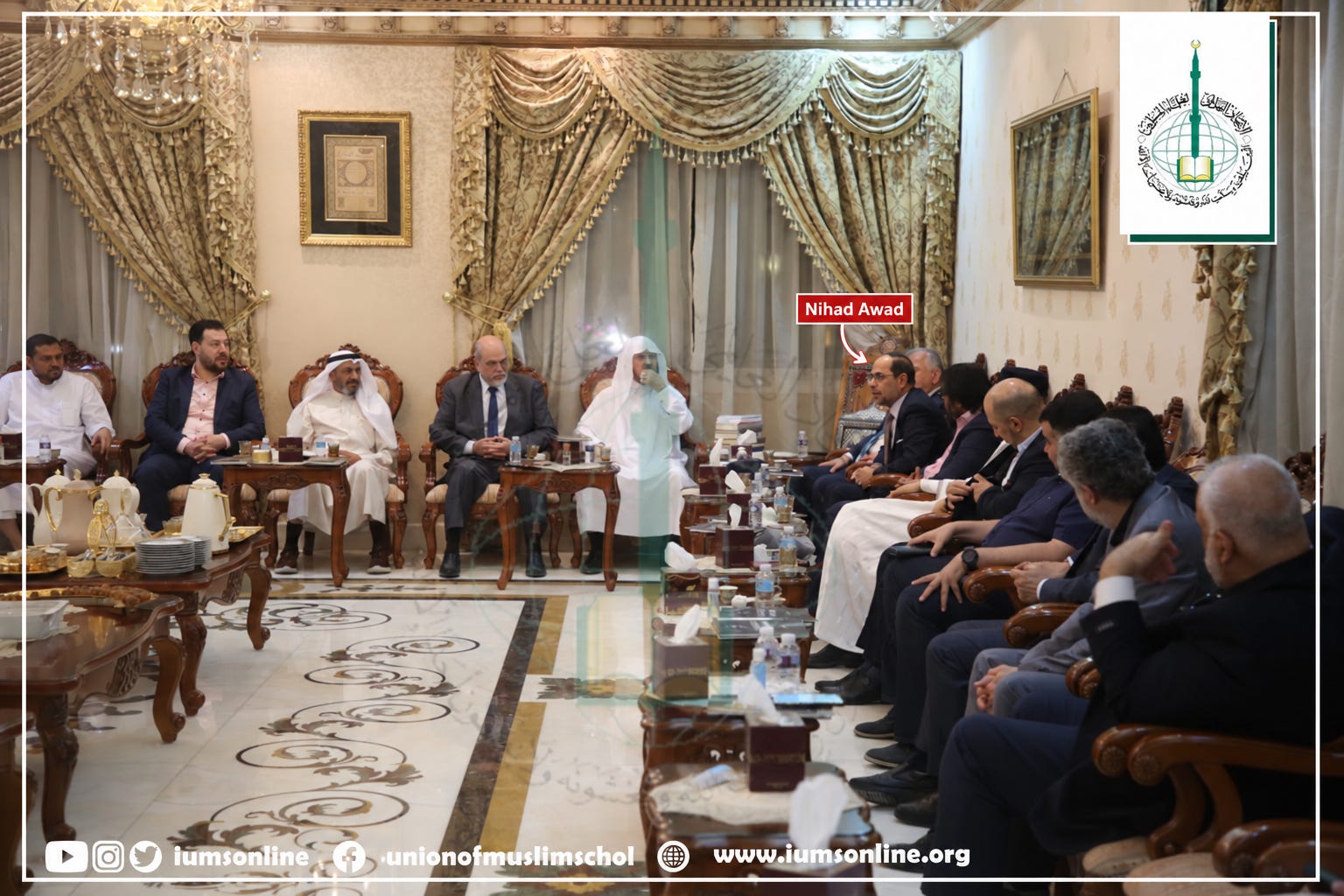
Six years later, Awad attended a May 26, 2022 dinner in Qatar with Abu Jarra Sultani, the former head of Algeria’s Movement of Society for Peace. An IUMS account says the dinner was hosted by Ali al-Qaradaghi for participants in the Doha interfaith dialogue conference and identifies Sultani as an IUMS member and president of the World Forum for Moderation. A 2007 UPI report described Sultani as the leader of Algeria’s Muslim Brothers, while the Brotherhood’s own Ikhwan Online described his party as “Algeria’s Movement of Society for Peace (the Muslim Brotherhood).”
Awad Visited PIJ Financier Sami al-Arian in Jail
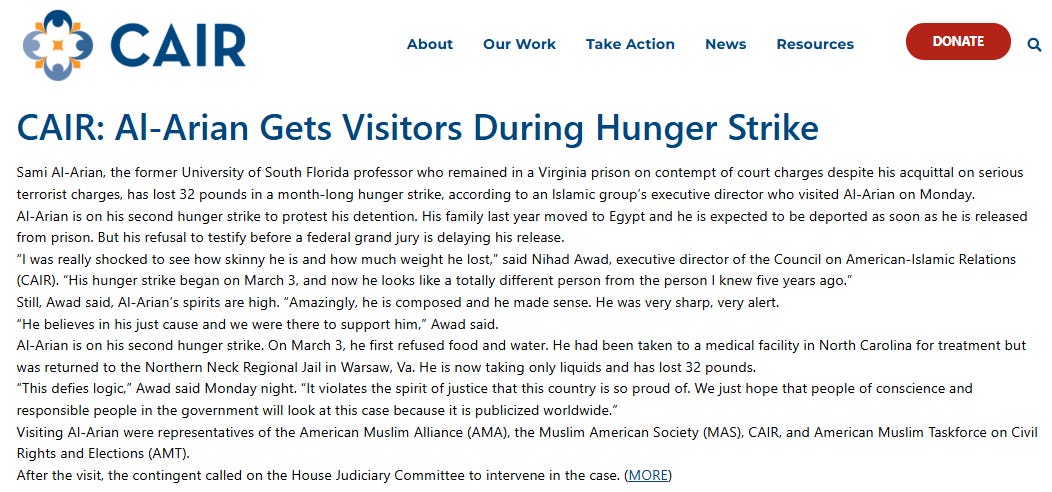
On March 31, 2008, Awad visited Sami al-Arian at the Northern Neck Regional Jail in Warsaw, Virginia, according to a news report republished on CAIR’s website the following day.
Al-Arian was then on hunger strike while being held for refusing to testify before a federal grand jury. Awad joined a delegation of Muslim organizations visiting him.
“He believes in his just cause and we were there to support him,” Awad said.
Two years earlier, al-Arian had pleaded guilty to conspiring to provide material support to Palestinian Islamic Jihad (PIJ). According to the Justice Department, he admitted his association with PIJ and acknowledged performing services for the organization after he knew it had been designated a terrorist organization.
CAIR Records and the October 7 Remarks
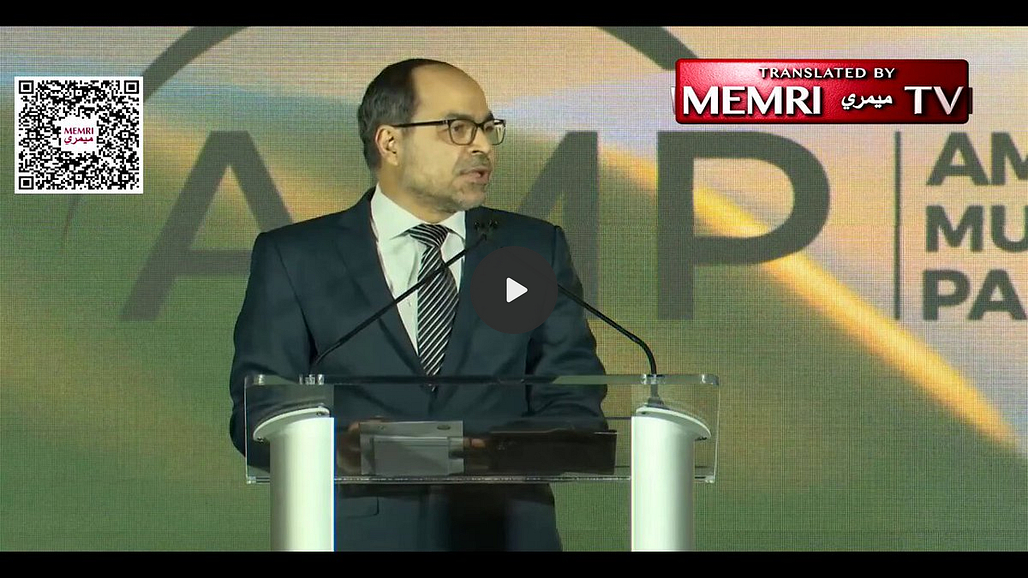
AG Rokita’s CAIR demand also focuses on November 2023 remarks by executive director Nihad Awad, including his statement that he was “happy to see people breaking the siege” on October 7. It seeks speech drafts, preparation materials, media-response communications and records of any internal action following the controversy, the Daily Signal reported.

SJP Funding and Campus Messaging
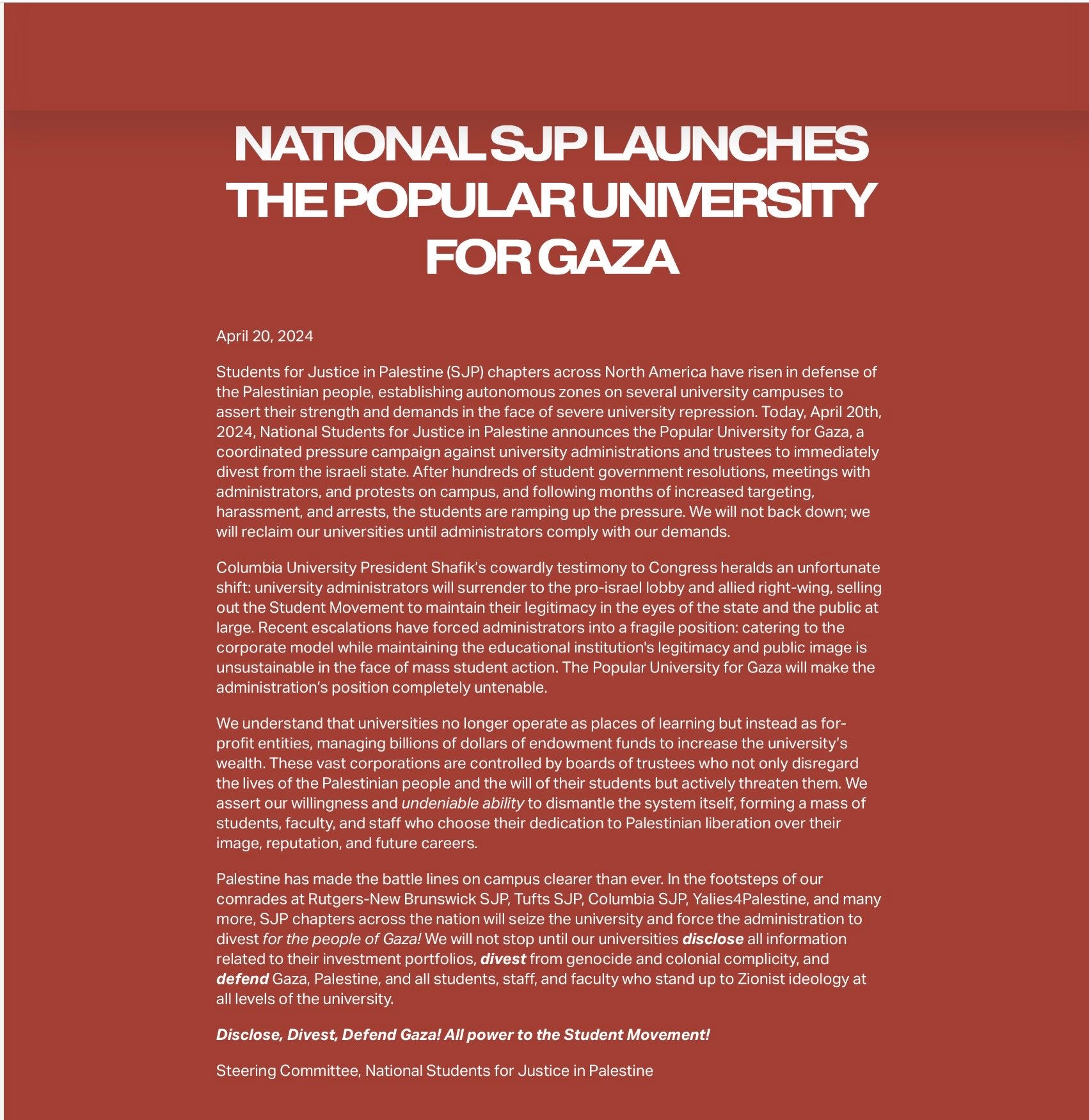
Beyond its questions about Awad and CAIR, Indiana’s investigation also targets National Students for Justice in Palestine, seeking records on its funding, relationships and campus messaging. According to the Daily Signal, the SJP demand seeks the identities of those responsible for statements calling on students to “seize the university” and endorsing “the dismantlement of the Zionist entity.”
The first phrase appears in National SJP’s April 20, 2024 statement launching its Popular University for Gaza campaign; the second appears in the editors’ letter in the January 2024 issue of The Written Resistance.
Rokita’s office said it is examining the organizations’ activities and communications after the massacre, including possible efforts to encourage anti-Israel and antisemitic sentiment in the United States. It also seeks records concerning their relationships with other groups and individuals the office described as having known terrorist connections.
What Indiana Law Allows
The investigation is being conducted under Senate Enrolled Act 256, signed in March 2026 and effective July 1. The law allows Indiana’s attorney general to demand records when there is reasonable cause to believe an organization may be affiliated with a foreign terrorist organization.
Under the law, affiliation can include acting for or at the direction of a designated terrorist organization or providing it with material support. If Rokita concludes that an organization meets that standard, it has 30 days to respond before the case goes to the governor for a final designation decision.
A designation would carry concrete consequences, including the loss of state funding, contracts and tax benefits. Public universities, school districts and other state-funded institutions would also be barred from knowingly providing financial benefits to the organization.