


Jewish Onliner is an independent publication. If you find our work valuable, please consider becoming a paid subscriber.
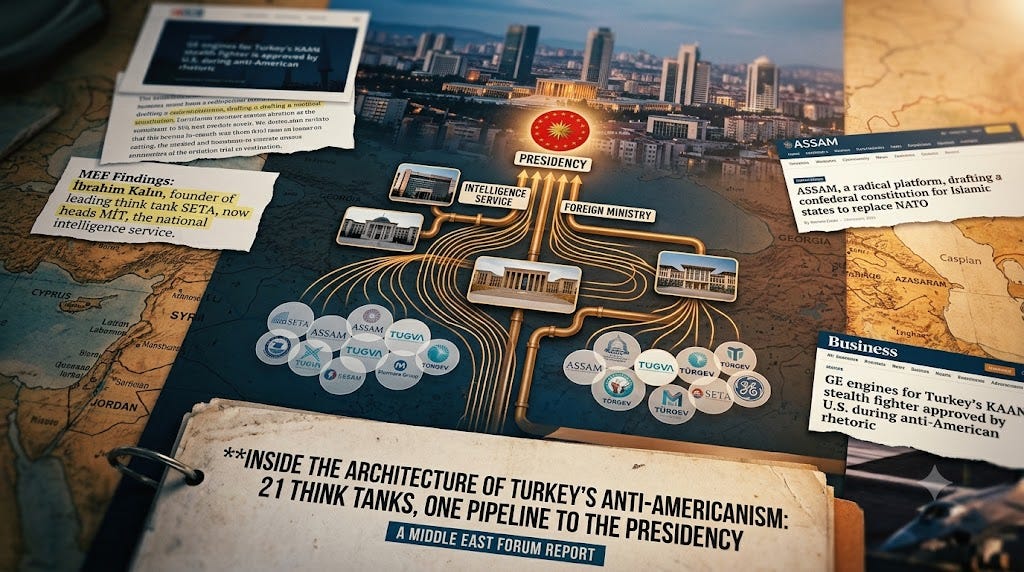
On Monday, Middle East Forum released an interactive matrix of 21 state-aligned organizations, the full architecture behind Turkey’s anti-Americanism: a network of think tanks, family foundations, and a state defense firm that manufacture hostility to Washington as doctrine and carry it directly into the presidency, the foreign ministry, and the intelligence service. Published by MEF executive director Gregg Roman, the report’s central finding is structural rather than personal — the same people who write the doctrine go on to staff the institutions that execute it.
For a NATO member using its membership to help assemble a post-American bloc with Russia, China, and the Turkic states while reshaping the Eastern Mediterranean and Caucasus, the implications reach Washington and Jerusalem alike.
The Machine
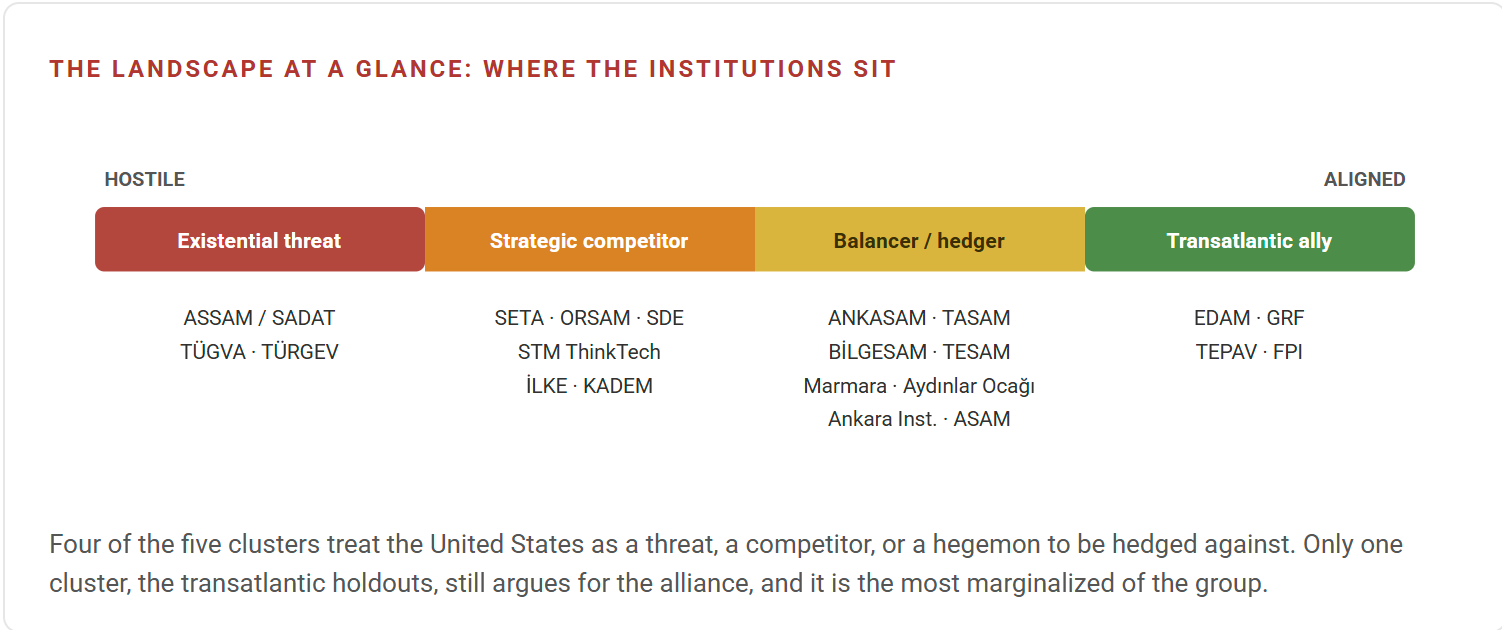
MEF’s matrix sorts the 21 organizations into five clusters, from an ideological vanguard functioning as a direct extension of state power to a marginalized handful of transatlantic holdouts still arguing for the alliance. MEF’s argument is that little of this is improvised at the podium — it is drafted and rehearsed inside that ecosystem, then carried into government by the people who wrote it.
SETA, the report’s apex think tank, was founded by İbrahim Kalın, who became Erdoğan’s spokesman and, in 2023, head of MİT, Turkey’s intelligence service; two further SETA coordinators went on to direct presidential communications, and the foundation’s board chairman simultaneously runs the conglomerate that publishes Daily Sabah.
At the radical edge sits ASSAM, founded by Erdoğan’s late former military adviser Adnan Tanrıverdi, whose private military company SADAT was reported by the UN Libya Panel and other analysts to have played a role in recruiting, training, supervising, or facilitating Syrian fighters deployed to Libya. Its congresses have spent eight years drafting a model confederal constitution for Islamic states explicitly built to replace NATO; its own platform accuses “imperialist Western states“ of waging a hybrid global war, and its founding text casts Israel itself as “the outpost of the 27th Crusade“ in the Middle East.
Family-linked foundations complete the pipeline. According to MEF, leaked materials from TÜGVA (Türkiye Gençlik Vakfı, an Istanbul-based youth foundation) allege a cadre-placement system reaching into parts of the bureaucracy, police, military academies, and judiciary. Bilal Erdoğan is linked to TÜGVA, while Erdoğan’s daughter Esra Albayrak holds a role in TÜRGEV, a non-profit organization established in 1996 by her father.
An Operating System
None of this is reducible to one man, and that is precisely the report’s point: Turkish anti-Americanism has migrated into the “operating system“ of the state, according to MEF, running on bedrock layers no election can switch off. The deepest is Sèvres Syndrome 2.0, the revived fear, rooted in the 1920 partition treaty, that the West is forever conspiring to dismember Turkey; American support for Kurdish forces in Syria and the 2016 coup attempt are read through that lens.
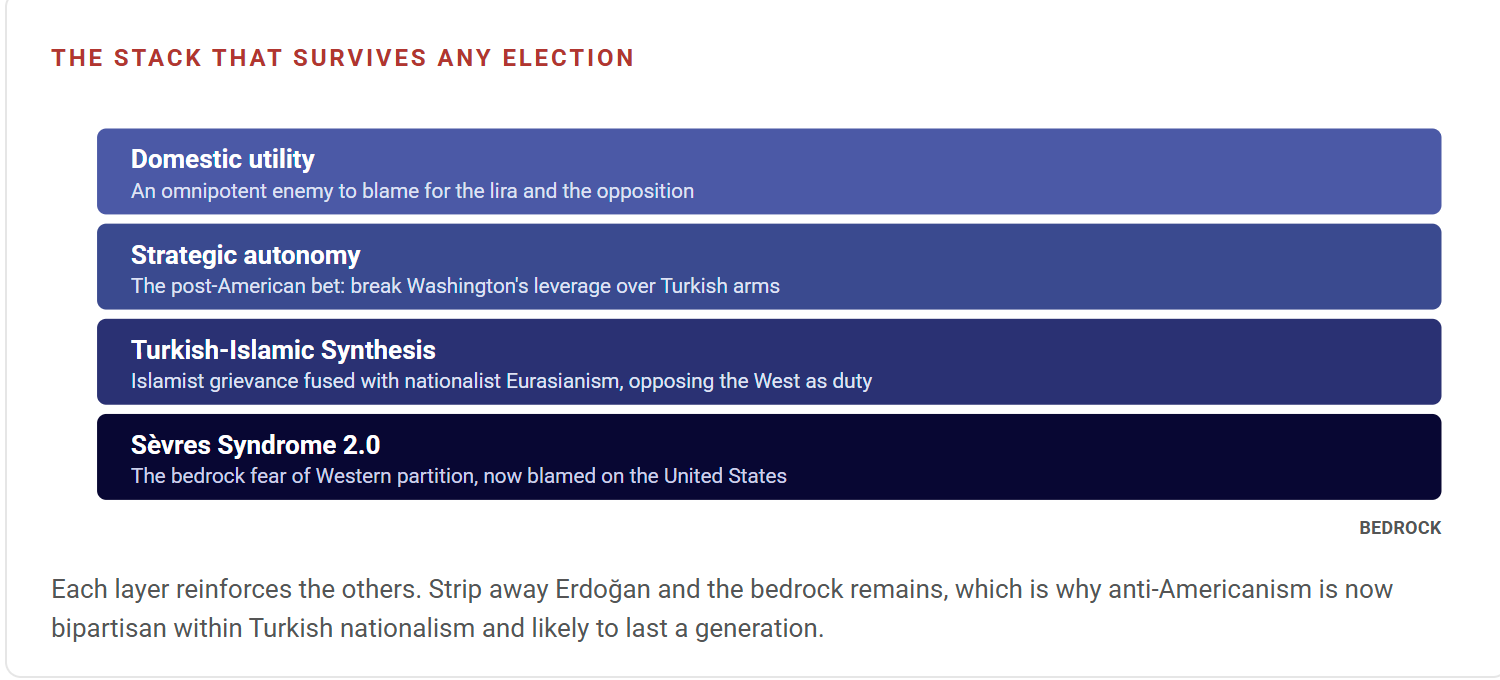
Above it sits the Turkish-Islamic Synthesis, a fusion of Islamist grievance and ultranationalism codified decades ago, which makes opposing America simultaneously a religious and a security duty. On top sits “strategic autonomy” — the judgment that the unipolar era is over — and raw domestic utility: an omnipotent Washington blamed for the lira’s collapse and the opposition’s existence alike.
How It Reaches Jerusalem Too
The danger, MEF’s analysts write, is not that Turkey leaves NATO — it is that Ankara uses the access membership confers to build the convening infrastructure of a bloc meant to replace it, deepening ties with Russia, China, and the Turkic states, while Turkey continues to possess a Russian S-400 system despite saying it is not integrated into NATO systems, and open-source analysts widely assess that U.S. B61 nuclear bombs remain stored at Incirlik.
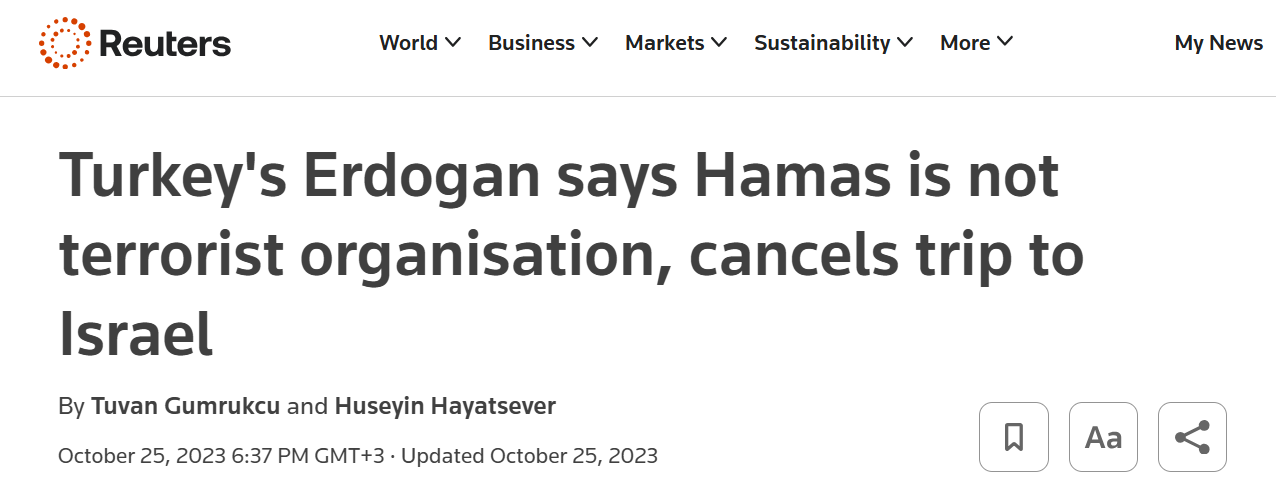
Erdoğan has called Hamas a “liberation group“ and shelters its operatives in Istanbul even as Ankara severed trade with Israel during the war, Roman wrote in a companion analysis for Ynetnews arguing Washington’s better Caucasus anchor is Azerbaijan. One of the 21 organizations MEF mapped, the Marmara Group, has anchored Ankara’s own relationship with Baku since 1998, when Azerbaijan’s then-president Heydar Aliyev became its honorary chairman. Yet the August 2025 White House process proceeded without Turkish mediation, underscoring how Washington was able to work directly with Baku and Yerevan outside Ankara’s preferred channels.
There, Presidents Aliyev and Pashinyan signed a U.S.-brokered peace framework at the White House without Turkish involvement. Baku, unlike Ankara, kept its oil flowing to Israeli refineries through the Turkish port of Ceyhan even as Erdoğan imposed his own embargo — supplying roughly 40 percent of Israel’s crude, by some 2025 estimates.
Both Sides of Erdoğan’s Mouth
None of this happens by accident, the report argues, and the clearest proof sits at its own center. Ankara routinely accuses Washington of enabling Kurdish groups Turkey designates as terrorists, while state-aligned institutions go further, branding the U.S. a patron of terrorism. Yet the same government continues to lobby for American aircraft, engines, and upgrades.
In late June, the U.S. formally notified Congress of a planned sale of more than $700 million in GE engines for KAAN, days before it hosts NATO’s Ankara summit. A state that merely disliked Washington, the report concludes, “would not manage its dependence this carefully” — only one that intends to outgrow it does.