


Jewish Onliner is an independent publication. If you find our work valuable, please consider becoming a paid subscriber.
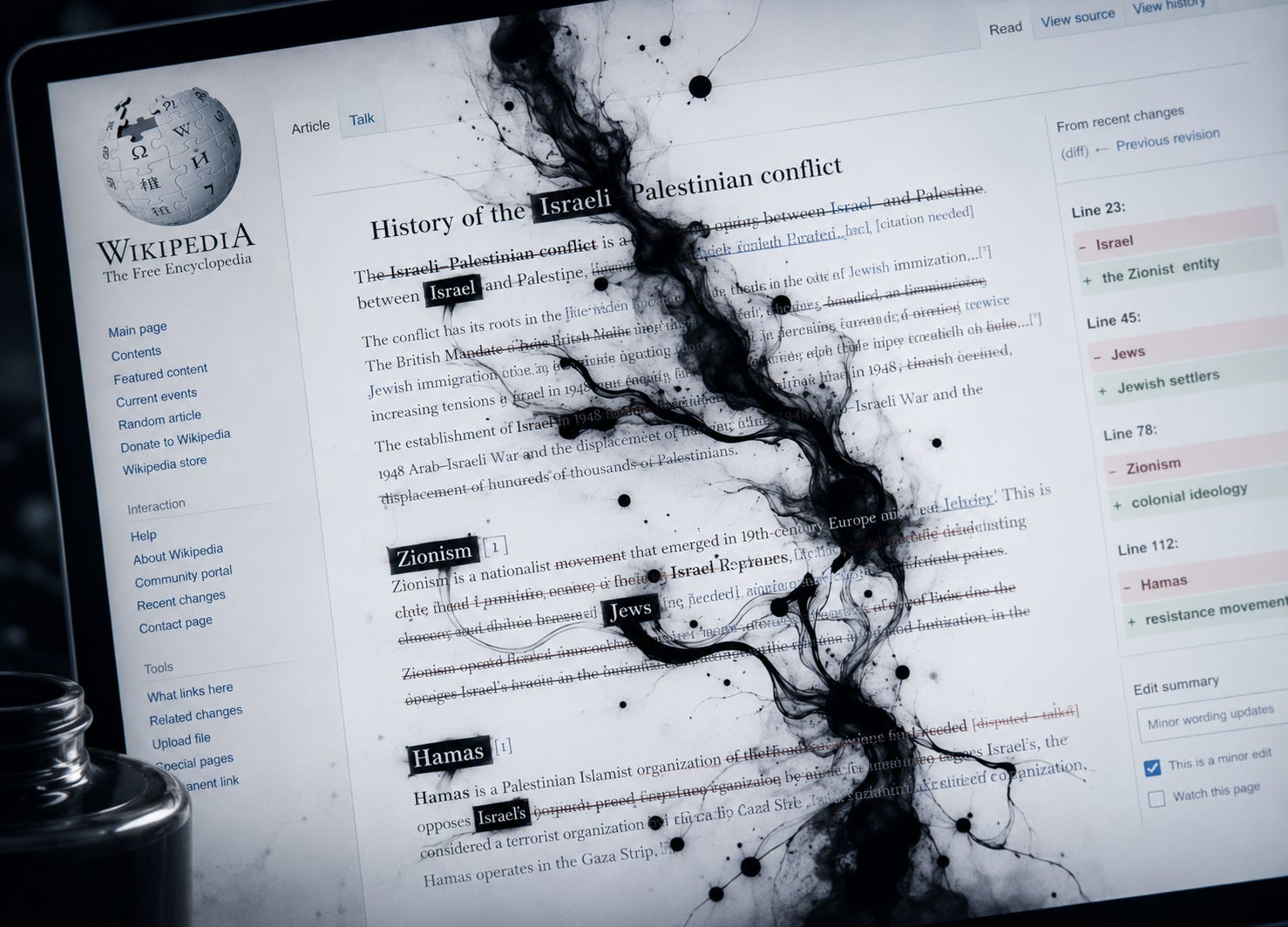
A new INSS special publication alleges that a veteran English Wikipedia editor, operating under the name Iskandar323, spent nearly 12 years making thousands of edits that systematically reframed Israel, Zionism, Jewish identity, Hamas and the October 7 attacks.
The report, written by researcher Shlomit Lir, examines 25,909 article-space edits across 7,979 unique pages and argues that the editor’s influence came not mainly through falsehoods, but through selective wording, omission, reorganization and passive phrasing. The case matters, Lir argues, because English Wikipedia functions as a major gateway to public knowledge, and many of the edits remained embedded even after the editor was sanctioned and eventually banned.
A Pattern Built Through Procedure, Not Fabrication
In the Report, Dr. Shlomit describes Iskandar323 as one of roughly 100 pseudonymous editors whose activity, in the report’s assessment, reflected a recurring anti-Israel pattern. It says his work shows how bias can be introduced through routine editorial language: “trimming,” “summarizing,” “splitting,” “reducing undue weight,” or “improving structure.”
The report’s central claim is that “knowledge poisoning” does not require fabricating facts. It can occur when accurate facts are arranged in a way that narrows interpretation, removes context, or makes one moral framework appear neutral and authoritative.
In one instance the report found that edits may look technical when it shortens a lead paragraph, but if it removes documented atrocities while retaining broader political context, it drastically changes how readers perceive the event.
The Scale: Core Pages, High Survival Rates
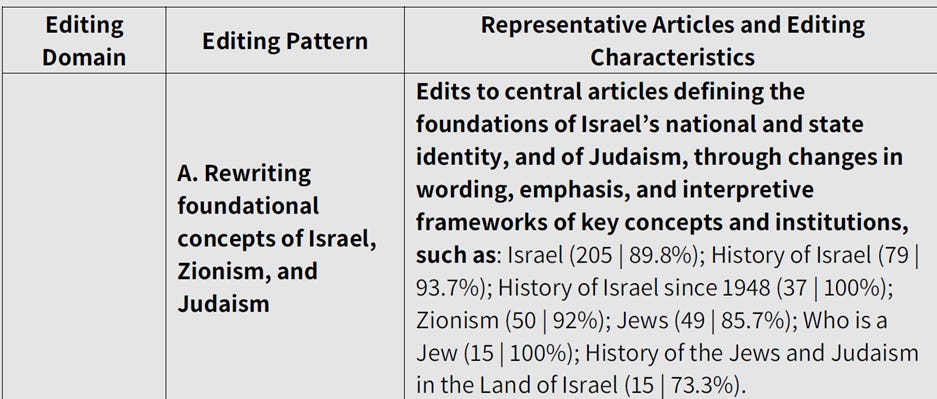
In her INSS article, Dr. Shlomit Lir identifies substantial activity on several high-profile Wikipedia pages, including 205 edits to “Israel,” 50 to “Zionism,” 49 to “Jews,” 87 to “Gaza war,” 58 to “Hamas,” and 36 to “October 7 attacks.” It also tracks what it calls the survival rate of those edits, meaning the share that was not later deleted or reverted and remained part of the article. According to the report, 89.8% of Iskandar323’s edits to “Israel” remained intact, along with 92% of his edits to “Zionism,” 85.7% to “Jews,” 86.2% to “Gaza war,” 89.7% to “Hamas,” and 97.2% to “October 7 attacks.”
The report cautions that edit counts alone do not prove significance. A single wording change can matter more than dozens of minor edits. But it argues that high survival rates can indicate lasting influence, because the wording was not merely inserted temporarily, it became embedded in the articles over time.
That matters because many of the pages at issue are gateway articles. A wording change in “Jews,” “Zionism,” “Israel,” or “Hamas” does not sit on a marginal page. It can shape the first layer of explanation encountered by readers searching for basic definitions.
October 7: Removing the Language of Atrocity
In her INSS article, Dr. Shlomit Lir argues that the most direct examples concern the October 7 attacks. In one November 2023 edit to the “October 7 attacks” article, INSS says Iskandar323 removed material stating that militants were prepared for scenarios including killing hostages, burning homes and using hostages as human shields. The report also says he removed a cited note found on a militant’s body that contained explicitly dehumanizing language.
In a later edit, the report says he removed from the lead an Associated Press description of the attack as an “atrocities-filled rampage,” along with a Physicians for Human Rights–Israel statement that the attack included widespread sexual and gender-based crimes. INSS argues that the effect was to dull the perceived cruelty, planning and ideological violence of the massacre.
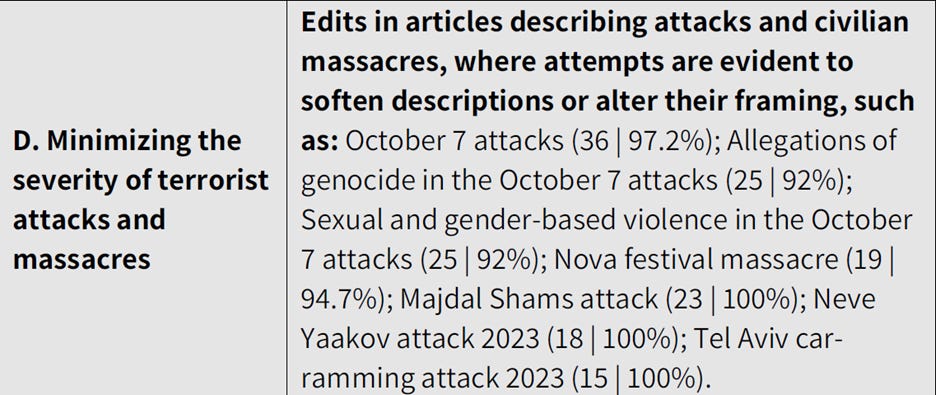
The same pattern appears in the “Gaza war” article. The report says an edit described as technical shortening removed detailed references to sexual violence, torture, victims burned alive, forensic findings and testimony shown to foreign journalists.
Jewish Identity: From Peoplehood to “Cultural Community”
The report also identifies edits that affected the foundations of Jewish identity. On September 3, 2023, according to INSS, Iskandar323 changed the “Jews” article’s short description from “ethnoreligious group and nation originating from the Levant” to “ethnoreligious group and cultural community.”
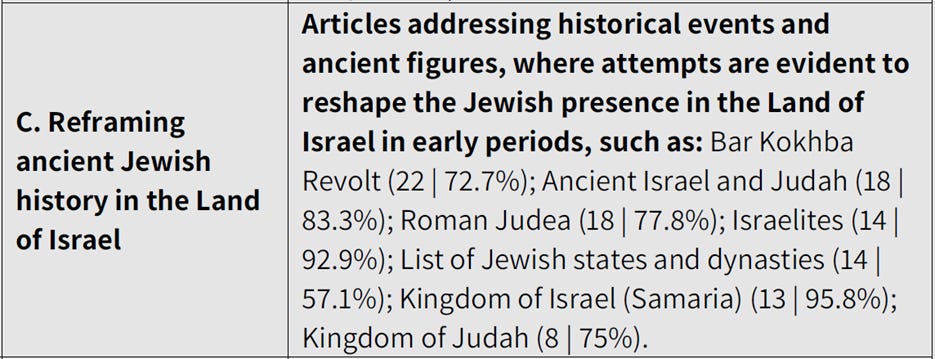
That change removed two concepts from a highly visible framing line: Jewish nationhood and geographic origin. The report says he also removed language treating “the Jewish people” as synonymous with “Jews,” and later changed wording to say Jews “claim descent from the ancient Hebrews,” a formulation INSS argues weakens historical continuity by presenting it as subjective assertion.
Example: A reader encountering “cultural community” receives a different first impression than one encountering “nation originating from the Levant.” The first suggests culture; the second signals peoplehood, history and place.
Zionism and Ancient Israel: Flattening Complexity
On the “Zionism” article, INSS says Iskandar323 removed a lead paragraph explaining that Zionism was never a uniform movement and included political, liberal, revisionist, cultural and religious streams. The report argues that the deletion weakened the historical context of Zionism as a plural movement shaped by antisemitism, Jewish self-determination and attachment to an ancestral homeland.
The report also cites numerous edits to ancient-history articles. In “Israelites,” it says he deleted a sentence stating that Israel and Judah were adjacent kingdoms with capitals in Samaria and Jerusalem. In “Ancient Israel and Judah,” it says he removed a “Language and Literature” section describing the emergence of the Paleo-Hebrew alphabet.
Together, INSS argues, those edits weakened the political, territorial and linguistic markers linking Jews to ancient Israel.
Hamas and Terror Victims: Moving, Renaming, Depersonalizing
The “Hamas” article receives similar scrutiny. According to INSS, three days after October 7, Iskandar323 moved a large portion of material on Hamas antisemitism, anti-Zionism and violent rhetoric from the main “Hamas” article into a secondary article titled “Criticism of Hamas.” The report says the moved material included explicit calls for the destruction of Jews, quotations from senior Hamas officials, references to antisemitic “blood libels,” and Hamas opposition to Holocaust education in UNRWA schools.
INSS says the edit also removed material from the main article concerning Hamas’s alleged use of human shields, rocket fire from populated areas, mosques and schools, the use of hospitals as headquarters, and Hamas’s condemnation of the killing of Osama bin Laden. In the report’s view, placing that material under “criticism” reframed core ideological and operational information as external opinion rather than central context about the organization.
The report also cites a November 20, 2023 edit in which Iskandar323 removed a photograph from the “Hamas” article showing weapons that the caption said were found in a mosque during Operation Cast Lead, according to the IDF. INSS argues that the removal erased visual evidence supporting claims that religious buildings were used for military purposes.
If Wikipedia was serious about its principles, it would revert the pages edited by those controversial 100 "editors" back to before they started their historical revisionism.
Considering how important Wikipedia is to AI algorithms, and how much financial investment is involved in AI, the AI industry has the duty and resources to implement real change and professionalism at Wiki.
There also needs to be a discussion about whether the government has a role to play here, as the integrity of databases that influence AI may well be construed as in the public interest and a matter of National Security.