


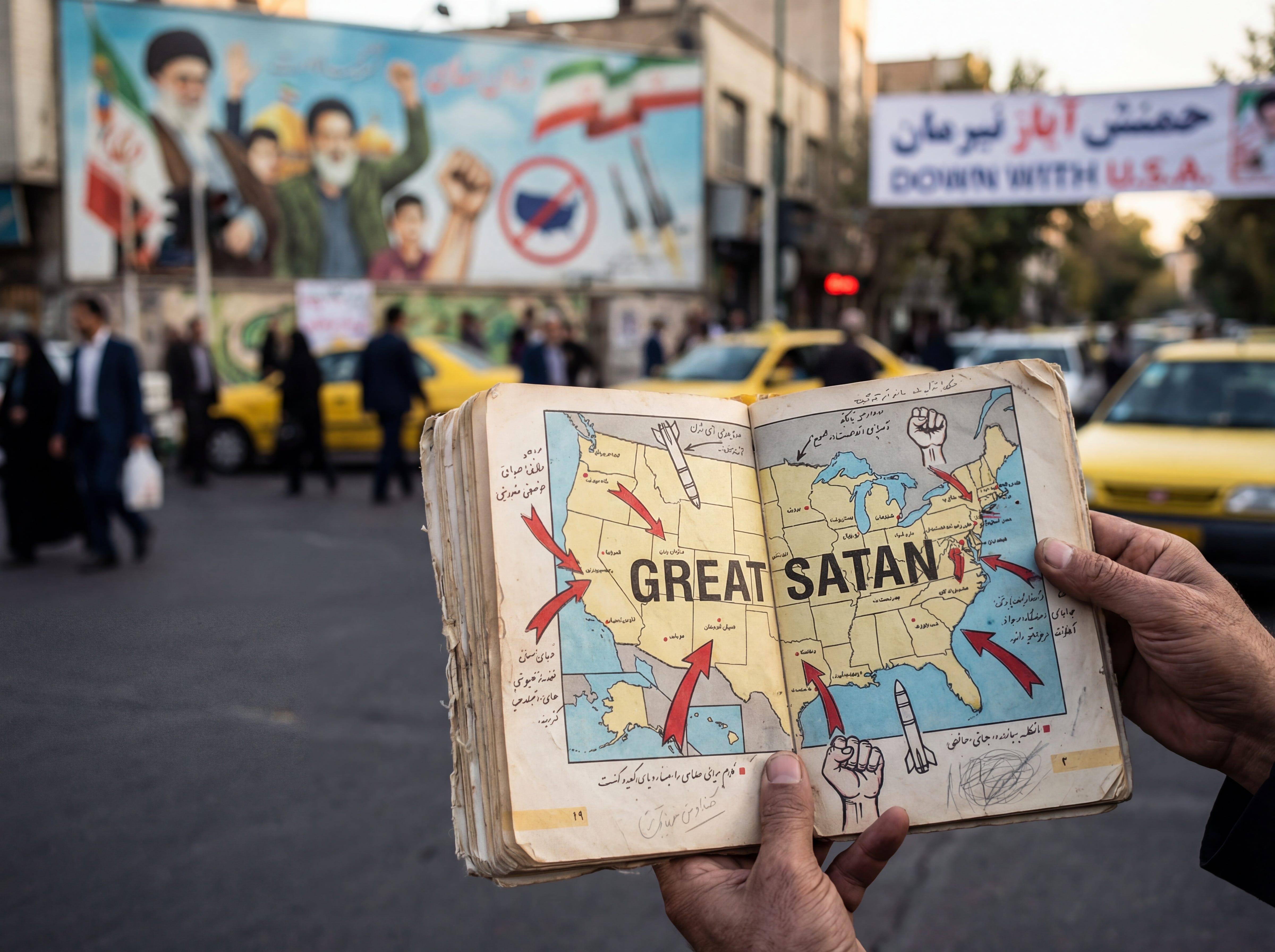
As military confrontation between the United States and Iran intensifies under Operation Epic Fury, it is worth revisiting one of the Islamic Republic’s most enduring ideological pillars: the “Great Satan” doctrine. For decades, Iran’s ruling establishment has used that framework to cast the United States not simply as a foreign adversary, but as a moral and political enemy. Far from being a relic of the 1979 revolution, the doctrine remains visible in the regime’s rhetoric, state observances, public demonstrations, and educational materials.
A Revolutionary Label That Endured
The phrase “Great Satan” became one of the defining slogans of the Islamic Republic during the revolutionary period under Ayatollah Ruhollah Khomeini. As Britannica notes, Khomeini denounced the United States as the “Great Satan” during the Iranian Revolution, helping cast America not simply as a foreign rival, but as a moral and political enemy in the regime’s founding narrative.
That language did not disappear with the revolution’s early years. It remained visible under Khomeini’s successor, Ali Khamenei. On Khamenei’s official website, the Supreme Leader referred to the United States as “the Great Satan” and described the phrase as “an excellent description.” In the same speech, he used the term in the context of rejecting negotiations with Washington, showing that it still functions as part of the regime’s present-day political language, not simply as a relic of the past.
The Doctrine in State Texts
The Islamic Republic’s core legal texts do not usually use the exact phrase “Great Satan,” but they preserve the broader ideological framework associated with it. In the full text of Iran’s constitution, Article 152 states that Iranian foreign policy is based on rejecting domination and maintaining non-alignment with “hegemonic powers,” referring to the United States. Article 154 states that the Islamic Republic supports the struggles of the oppressed against oppressors around the world.
These provisions matter because they formalize the regime’s “anti-hegemonic” — i.e. anti-U.S. — worldview within the legal structure of the state. In practice, that language has long been used to frame the United States as the central symbol of outside domination. The phrase “Great Satan” appears most clearly in speeches and propaganda, but the constitutional language shows that the doctrine behind it is reflected in official state principles.
Institutionalized Through the Calendar
The doctrine is also embedded in official state observance. Iran’s Foreign Ministry states that 13 Aban, which falls on November 4, is formally designated as the “National Day of Fight Against Global Arrogance.” The date marks the anniversary of the 1979 seizure of the U.S. embassy in Tehran, one of the foundational moments of the revolutionary state.
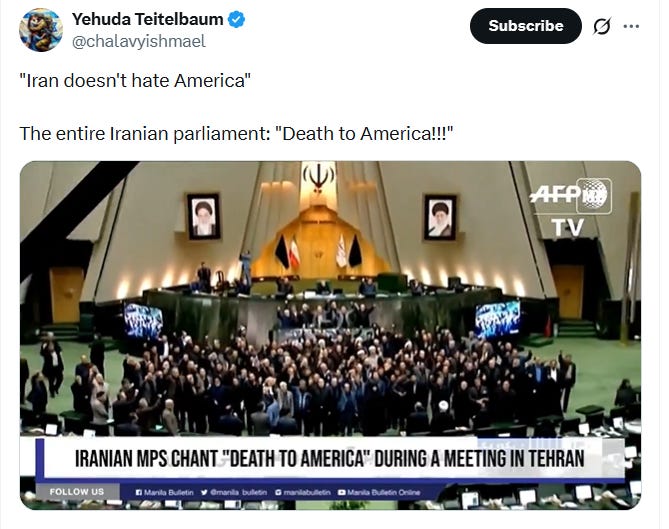
In official Iranian usage, “global arrogance” functions as a more bureaucratic version of the same ideological framework that produced the “Great Satan” label. It is the institutional vocabulary through which anti-American hostility is preserved in formal state ritual. The fact that this commemoration remains fixed on the official calendar demonstrates that the revolutionary worldview is reproduced through recurring state practice, not merely remembered as history. You can see Iranian Parliament MP’s burning the flag of the "Great Satan” shared on X by activist Eyal Yakoby:
Repeated in State-Backed Public Demonstrations
That messaging is reinforced through public political events tied to the state. In its coverage of 13 Aban commemorations, Iran’s state news agency IRNA reported that demonstrators burned American flags and repeated slogans identifying the United States as the “Great Satan.” These were not described as isolated or unofficial protests. They were part of recurring, state-recognized national observances linked to one of the Islamic Republic’s central revolutionary anniversaries.
That continuity is significant because it shows that the message is not confined to archived speeches or the revolutionary period alone. It remains visible in state-backed civic mobilization and in the public political culture the regime continues to cultivate.
The Doctrine in Education
The Great Satan doctrine has also been documented in Iranian educational materials. A review published by IMPACT-se, based on analyses of Iranian state-issued textbooks and teacher’s guides, found that the United States was presented in school materials as the “Great Satan,” the “World Devourer,” and the “Arrogant One.” The same review cites a teacher’s guide instructing that students should have a heart “overflowing of hatred” toward “Arrogance,” and notes that in one classroom exercise the guide gives the answer “America – the Great Satan.”
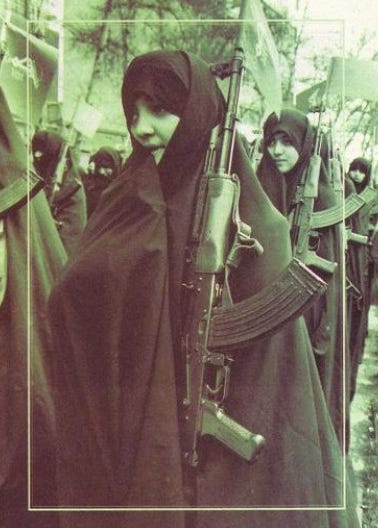
According to IMPACT-se’s review, the framing was not limited to isolated slogans. It also described textbooks portraying the United States as an imperialist power and embedding anti-American messaging within broader revolutionary themes. While this evidence comes from a secondary research organization rather than a current Iranian education ministry release, it is still relevant because it analyzes official Iranian schoolbooks and teacher’s guides. It therefore provides additional evidence that the doctrine has been transmitted not only through speeches and public ritual, but through educational materials as well.
Why It Matters During Operation Epic Fury
Taken together, the documentary record shows that the Great Satan doctrine is not just a slogan from the Islamic Republic’s early revolutionary years. It remains embedded in the regime’s institutions, official vocabulary, and political culture, shaping how the state continues to present the United States to its own public
As Operation Epic Fury unfolds, that record offers important context for understanding the ideological worldview that has long framed Iran’s posture toward Washington.