


On April 19, 2026, at 9:05 AM EDT, a photograph appeared on X showing an Israeli soldier striking a Jesus statue with a sledgehammer in southern Lebanon. Within 12 hours, it had propagated across X, Reddit, and TikTok in five languages, generating 4.7 million impressions and splitting into three competing narratives- each targeting different audiences with surgical precision. What makes this case extraordinary is not just the incident itself, which the IDF confirmed as authentic, but how a former intelligence analyst documented the entire operation as it unfolded, exposing the mechanics of modern information warfare.
Travis Hawley, a former NSA and US Air Force analyst who teaches open-source intelligence to DHS, captured what he describes as “a precision instrument against the Christian-Zionist political relationship”- a fracture line that underpins America’s support for Israel. His analysis reveals something more disturbing than disinformation: how authenticated events become weaponized as psychological operations through coordinated amplification, strategic framing, and the exploitation of existing political fault lines- even as Israeli leadership venehemently denounced the incident
The Incident: What Actually Happened
The photograph was posted by Younis Tirawi, a Palestinian reporter with 237,000 followers who has previously shared images of alleged IDF misconduct. It showed an IDF soldier in uniform using what appeared to be a sledgehammer or axe to strike the head of a crucifix statue in the Christian village of Debel, southern Lebanon- one of the few communities where residents remained during Israeli operations against Hezbollah.


Reuters independently verified the location. Father Fadi Flaifel, the head of Debel’s congregation, confirmed the statue belonged to a family shrine in a garden on the village edge. The IDF’s response evolved throughout the day: initially describing the image as “under examination for reliability,” the military later confirmed its authenticity, located the soldier involved, and promised disciplinary action.
Prime Minister Benjamin Netanyahu condemned the act “in the strongest terms.” Foreign Minister Gideon Sa’ar apologized to Christians worldwide. US Ambassador Mike Huckabee demanded “swift, severe, & public consequences.”
By the Numbers: Anatomy of 12-Hour Amplification
Hawley’s team tracked 402 posts across platforms in the first 12 hours: 373 on X, 19 on Reddit, and 10 on TikTok. The top 49 X posts plus adjacent TikTok content generated an estimated 4.7 million impressions. Tirawi’s original post alone reached 3.41 million views.
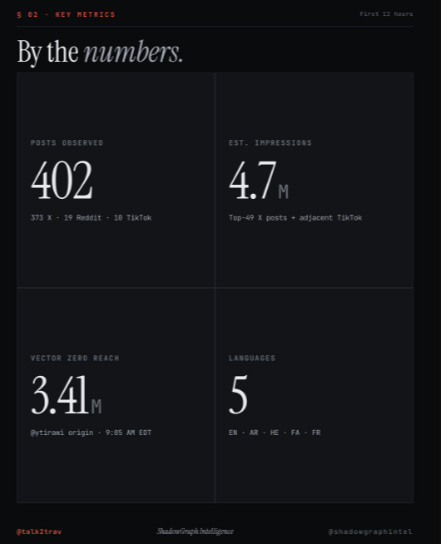
The content spread in five languages: English, Arabic, Hebrew, Farsi, and French. It appeared in 19 Reddit communities, accumulating 5,748 upvotes and 728 comments. On TikTok, 18 accounts generated an estimated 18 million combined plays, with the largest single post reaching 534,900 views.
But raw metrics don’t tell the full story. What Hawley documented was narrative divergence, the same authenticated image splitting into three distinct storylines, each calibrated for different audiences in order to amplify the narrative.
The Amplification Network: How It Spread
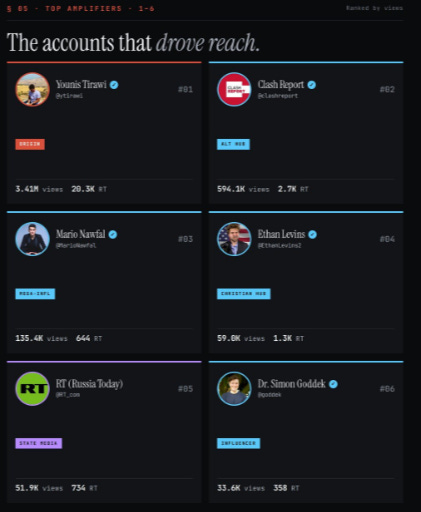
Hawley’s network analysis identified Tirawi as “Vector Zero”—the hub from which all amplification radiated. The top six amplifiers were:
Younis Tirawi (@ytirawi) - Origin: 3.41M views, 20,300 retweets
Clash Report (@clashreport) - Alt-media: 594,100 views, 2,700 retweets
Mario Nawfal (@MarioNawfal) - Web3/news: 135,400 views, 644 retweets
Ethan Levins (@EthanLevins2) - Christian hub: 59,000 views, 1,300 retweets
RT (Russia Today) - State media: 51,900 views, 734 retweets
Dr. Simon Goddek - Influencer: 33,600 views, 358 retweets
Regional hubs included advocacy accounts Israel Exposed (12,500 views), Palestinian-focused Quds News Network (2,900 views), and state outlets like IRNA. The ecosystem combined alternative media, state broadcasters, Christian networks, and individual influencers each adding their own framing while maintaining the core image.
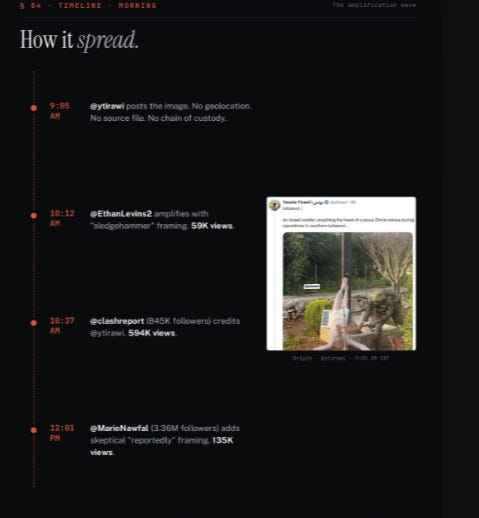
Timeline analysis showed strategic pacing:
9:05 AM: Tirawi posts with no geolocation, no source file, no chain of custody
10:12 AM: Ethan Levins amplifies with “sledgehammer” framing (59K views)
10:37 AM: Clash Report credits Tirawi (594K views)
12:01 PM: Mario Nawfal adds skeptical “reportedly” framing (135K views)
Beyond X: Multi-Platform Saturation
Reddit provided narrative resilience. The image appeared in 19 subreddits, with r/conspiracy leading at 1,282 upvotes, followed by r/suppressed_news (1,223 upvotes) and r/UnderReportedNews (887 upvotes). These communities provided ideological diversity- from anti-establishment skeptics to Middle East-focused forums like r/Lebanon (342 upvotes).
TikTok offered geographic and linguistic reach. The account @eastern.christians generated 534,900 plays, while @middleeastmonitor reached 429,800. Crucially, a French-language post by @rudyactu2 provided what Hawley identified as “the clearest verification chain confirms statue located in Debel (South Jabi district).”.
The Hypocrisy Dimension: Selective Outrage Quantified
Hawley’s analysis included a devastating comparison that exposes global media bias. On Palm Sunday weekend, April 13, 2025, Islamic Fulani extremists massacred 54 Christians in the village of Zikke near Jos, Nigeria. Eyewitnesses described an attack lasting over an hour that destroyed 103 households and displaced the entire village. Local leaders called it “a targeted act of genocide against the Christian community.”


Hawley’s team tracked comparative coverage:
Nigeria Palm Sunday massacre (54 killed):
393 X posts
Zero major-network coverage
Israel blocking Mass at Holy Sepulchre (same day, zero casualties):
855 posts
Global coverage
IDF soldier/Jesus statue (April 19, zero casualties):
817 posts
Global coverage
The disparity is stark. Thousands of Christians murdered in Nigeria generated less than half the social media engagement of a symbolic act by one Israeli soldier. Zero deaths in either Israel story. Fifty-four deaths in Nigeria produced near-total media silence.
From December 2023 to February 2024, more than 1,300 people were killed in Plateau State, Nigeria, alone; including over 500 women and 260 children. Nearly 30,000 people have been displaced. Plateau State Governor Caleb Manasseh Mutfwang described the violence as “coordinated acts of terror” aimed at ethnic cleansing and “a calculated campaign of genocide.”
Yet global attention remains fixed on Israel. Hawley quantified what observers have long suspected: the disproportionate focus on Israeli actions, regardless of scale or lethality, compared to actual mass violence against Christians elsewhere.
The Discipline: Evidence vs. Noise
Hawley concludes his analysis with a methodological note: “The information environment surrounding it is still saturated with amplification that predates verification, bad-faith framing, and recycled footage. The discipline remains the same: map the narrative, trace the vectors, assess what is evidence and what is noise.”
This case study demonstrates why that discipline matters. The authenticated event, one soldier destroying one statue, became a multi-million-impression information operation within 12 hours. It split into three targeting distinct audiences. It received more global attention than the massacre of 54 Nigerian Christians. It struck at a critical political alliance underpinning US foreign policy.
Hawley’s work provides a template for understanding how single images become precision instruments in information warfare. The question facing those targeted is not whether events are real, but whether they can maintain narrative control of authentic incidents before millions have already formed their conclusions.
altho, a bit personnel, ‘yhis’ is just a share that:
i was just wishing, i had been ‘able,’ to read: the last, text; which ‘like’-‘This’ one- just appeared(as a notification,?) on my phone, screen.
I, was disallowed, from viewing it; in that immediately, i received 2 different ‘phone missives (?) & have felt, very much; saddened, ‘Although, i almost, immediately, tried-that i could; neither see, nor find-just ‘where/what’ happened to-it?
Ido, the text writer, is my first; of Whom, i hope to have ‘many’-
‘new’ Jewish,’ friends-soon.
This, ‘question’ -‘may’ sound like a joke, but believe, me; Please:
(i don’t intend for it ‘to’ be, or even ‘sound,’ -‘irreverent’)
But, “Can an ‘IPhone’- be anti-semitic?”
Mary W/N