


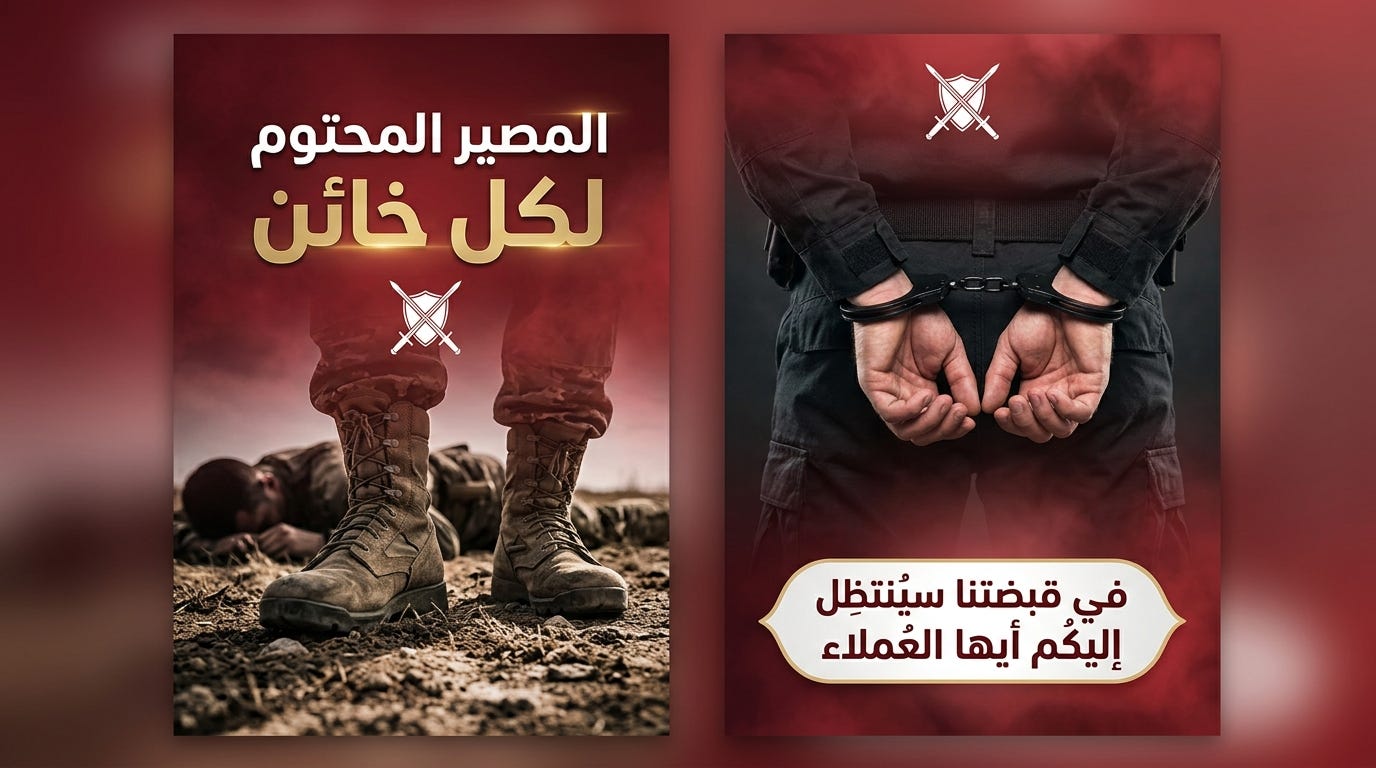
Hamas has launched a sophisticated psychological warfare campaign to eliminate rival militias threatening its control of Gaza, according to a new new paper published by Israel’s International Institute for Counter-Terrorism (ICT). The campaign combines execution squads, Telegram propaganda channels, and coercion of Gaza’s tribal clan structures to delegitimize armed groups that emerged after Israeli operations weakened the terror organization’s grip on the enclave.
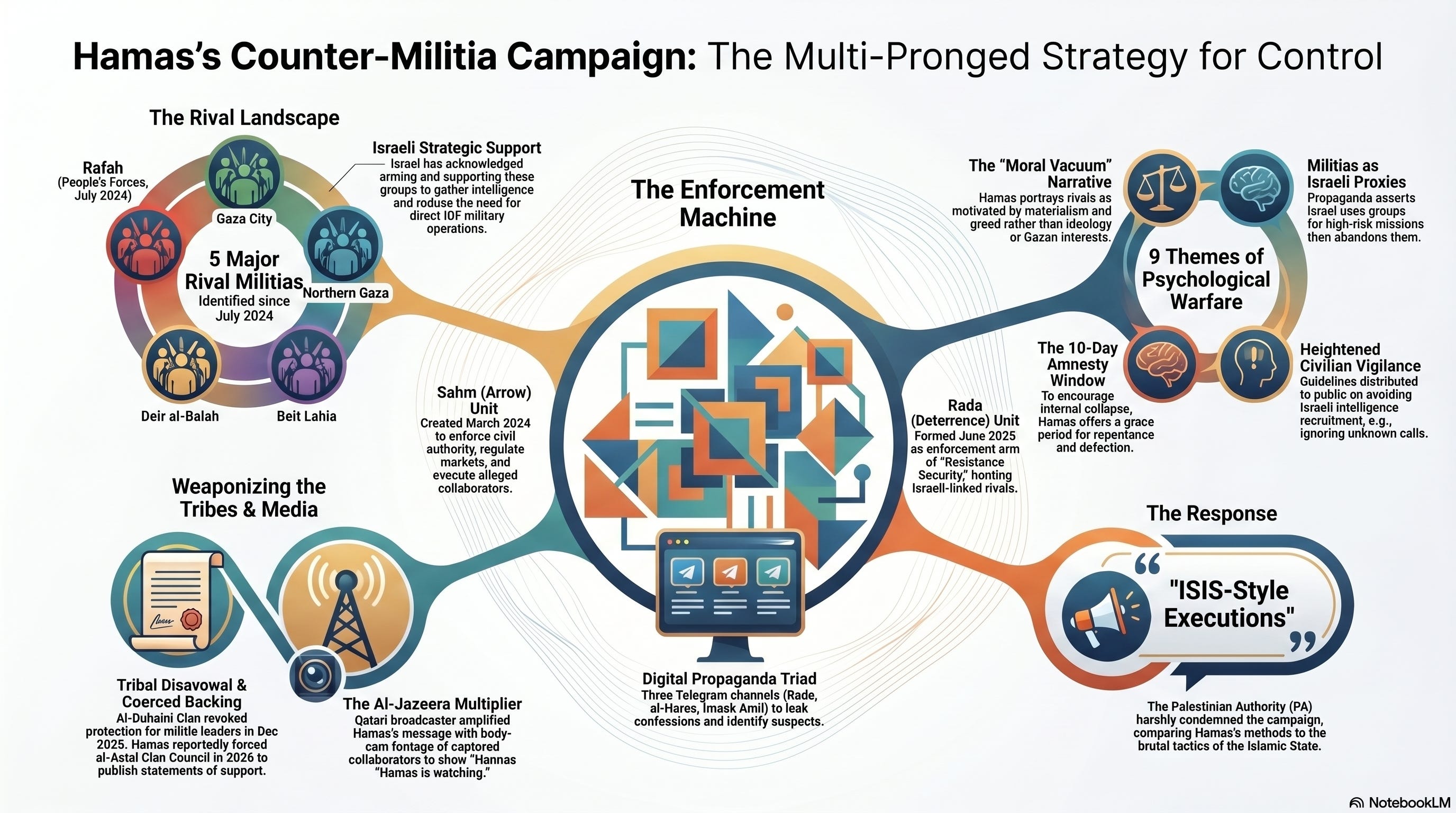
The paper documents how Hamas established two enforcement units—Sahm and Rada—and intensified operations following the October 10, 2025 ceasefire, targeting militias operating across Gaza City, Rafah, Deir al-Balah, and northern Gaza. Researchers found that Hamas isn’t just fighting militarily: the group is weaponizing Gaza’s clan structures and Qatari media outlets to frame rivals as traitors destined for death, while simultaneously offering ten-day amnesty windows to encourage defections.
The Rivals Threatening Hamas
The paper identifies five militia groups now operating in Gaza. The “People’s Forces,” established in July 2024 by Yasser Abu Shabab, operates in eastern Rafah. Israel acknowledged on June 5, 2025 that it was arming the group.
Other militias include Shouki Abu Nazira’s forces in Deir al-Balah (November 2024), Rami Helles’s militia in Gaza City (May 2025), the al-Astal militia in northern Gaza (July 2025), and the People’s Forces of Beit Lahia (September 2025), which coordinates closely with the original People’s Forces. Israel supports these groups to destabilize Hamas, gather intelligence, and reduce the need for direct military operations.
The Enforcement Machine
Hamas created the Sahm (Arrow) unit in March 2024, five months after the war began. The unit’s mandate is to enforce authority over civilians, regulate market prices, and execute alleged collaborators. In June 2025, Hamas formed Rada (Deterrence) as the enforcement arm of “Resistance Security,” specifically targeting Israeli collaborators.


Following the October 10 ceasefire, Hamas moved beyond assassinations to psychological operations. The organization operates three primary Telegram channels—Rada, al-Hares, and Imsak Amil—to disseminate propaganda, alleged confessions, and photos of suspected collaborators.
Nine Psychological Warfare Themes
The ICT paper identified nine core propaganda themes Hamas employs:
The Archetype of the Gazan Traitor: Hamas portrays militia members as motivated by materialism and personal vendettas, emphasizing a “moral vacuum.”
Crimes Against Gazans: Hamas accuses militias of burning agricultural lands with Israeli backing.
The Inevitable Death of Collaborators: The group claims Israel exploits militias then abandons them. Hamas cited Yasser Abu Shabab’s death—allegedly by one of his own associates—as proof Israel won’t protect collaborators.
Internal Fractures: Hamas emphasizes tensions within militia ranks, citing incidents of attempted executions of defectors.
Repentance Offers: The organization announced a ten-day grace period, urging militia members to defect in exchange for formal amnesty.
Militias as Israeli Proxies: Hamas asserts Israel uses these groups to reduce IDF casualties, gather intelligence, and conduct high-risk missions including assassinations and weapons cache locations.
Intelligence Penetration: On February 18, 2026, Hamas announced exposing a female Gazan agent recruited by Israel in February 2024 to collect intelligence by entering tents under the pretext of seeking aid.
Encouraging Surrender: The Imsak Amil (“Catch a Collaborator”) channel disseminates photographs of suspected collaborators, calling on clans and civilians to apprehend them.
Heightening Vigilance: Hamas distributes guidelines on avoiding disclosure of intelligence to Israel, such as not returning calls from unidentified numbers.
Weaponizing the Tribes
Hamas’s most effective tactic may be exploiting Gaza’s clan structures. On December 9, 2025, the al-Duhaini clan in Jordan and Palestinian territories issued a statement disavowing four members leading militias, revoking their tribal protection, and expelling them from the clan.
Ala’ al-Din al-Aklouk, head of Hamas’s “General Administration for Clan Affairs and Social Reconciliation,” described militia members as “traitors and mercenaries” in a February 2024 Al-Jazeera interview. He claimed these groups lack genuine social foundation, evidenced by social ostracism from their own families.
A former Fatah intelligence officer revealed that Hamas coerced the re-establishment of the “al-Astal Clan Council” in April 2026 to publish statements aligned with Hamas’s interests, creating a false impression of authentic tribal backing.
Qatar’s Role
Al-Jazeera, the Qatari state broadcaster, has amplified Hamas’s messaging. On February 6, 2026, the network broadcast exclusive footage from body cameras worn by Gazan collaborators during missions, provided by Hamas. The message: Hamas knows collaborators’ identities and can construct comprehensive intelligence pictures.
The network portrayed Israel as opportunistic, showing a collaborator in distress captured by Hamas without Israeli intervention. Collaborators were depicted as individuals “lured by food, cigarettes, and false promises.”
Palestinian Authority Response
The Palestinian Authority issued harsh condemnation. Mahmoud Abbas’s office called Hamas’s executions “a crime and a blatant violation of human rights” that reflects the movement’s “persistence in imposing its authority through force and terror.”
The PA-affiliated daily Al-Hayat al-Jadida compared Hamas’s executions to ISIS, stating: “Hamas militias have carried out a new massacre through ISIS-style executions.”
Hamas’ Emphasis on “Social Legitimacy”
The ICT paper concludes that Hamas’s political survival depends on social legitimacy as much as firepower. By framing militias as “unprincipled entities driven by material interests,” Hamas maintains the narrative of “pure resistance” versus “ignoble treason.” Any alternative governing authority in Gaza will confront not only Hamas’s military branches but a deeply rooted ideological and tribal apparatus that denounces cooperation with Israel as moral deviation.