


A Gaza-born Palestinian-American analyst has alleged that Hamas security forces used Al-Ahli Arab Hospital in Gaza City to interrogate and threaten Palestinians suspected of supporting the June 26 protest movement against Hamas rule. Ahmed Fouad Alkhatib, a resident senior fellow at the Atlantic Council and director of Realign for Palestine, said friends in Gaza were summoned, threatened with execution under “revolutionary conditions,” and placed under house arrest after warnings from Hamas police, internal security officers, and al-Qassam Brigades operatives.
The claim has not been independently confirmed by Jewish Onliner, but it echoes recent accounts of Hamas reasserting control through hospitals, schools, and other civilian facilities. Its significance is twofold: Gaza’s medical system remains one of the territory’s most vulnerable lifelines, and Hamas’s alleged use of it for repression places Palestinian civilians between Israeli strikes, militant rule, and a shrinking space for dissent.
The Allegation
Alkhatib wrote that Hamas’s “intelligence and internal security services” were “beating, interrogating, and threatening” people suspected of supporting the June 26 protests. He said some of those interrogations took place inside Al-Ahli Arab Hospital, also known as Ma’amadani or the Baptist Hospital, in Gaza City’s Zeitoun neighborhood.
According to Alkhatib, the threatened Palestinians were told that posting support for the protests on Facebook or assisting protesters could lead to execution as alleged collaborators with Israel. He called the hospital’s alleged use as an intelligence and internal-security hub “criminal on every level” and urged the World Health Organization, UNICEF, UNRWA, the United Nations, Doctors Without Borders, the International Committee of the Red Cross, and other aid groups to confront Hamas’s presence in medical facilities.


Al-Ahli is not an obscure site. The American Friends of the Episcopal Diocese of Jerusalem describes it as Gaza’s oldest hospital, founded in 1882, and says more than 45,000 Gazans receive care there each year. The same page describes the hospital as a “safe haven of peace and compassion,” underscoring the seriousness of any claim that armed factions are using it for coercive security activity.
June 26 Protests Under Pressure
The allegations came as activists were calling for a “June 26 movement” across Gaza, which ended up occuring throughout the strip. +972 Magazine reported that organizers planned demonstrations in more than a dozen locations around demands for “life, dignity, and freedom,” while some activists explicitly criticized Hamas rule.

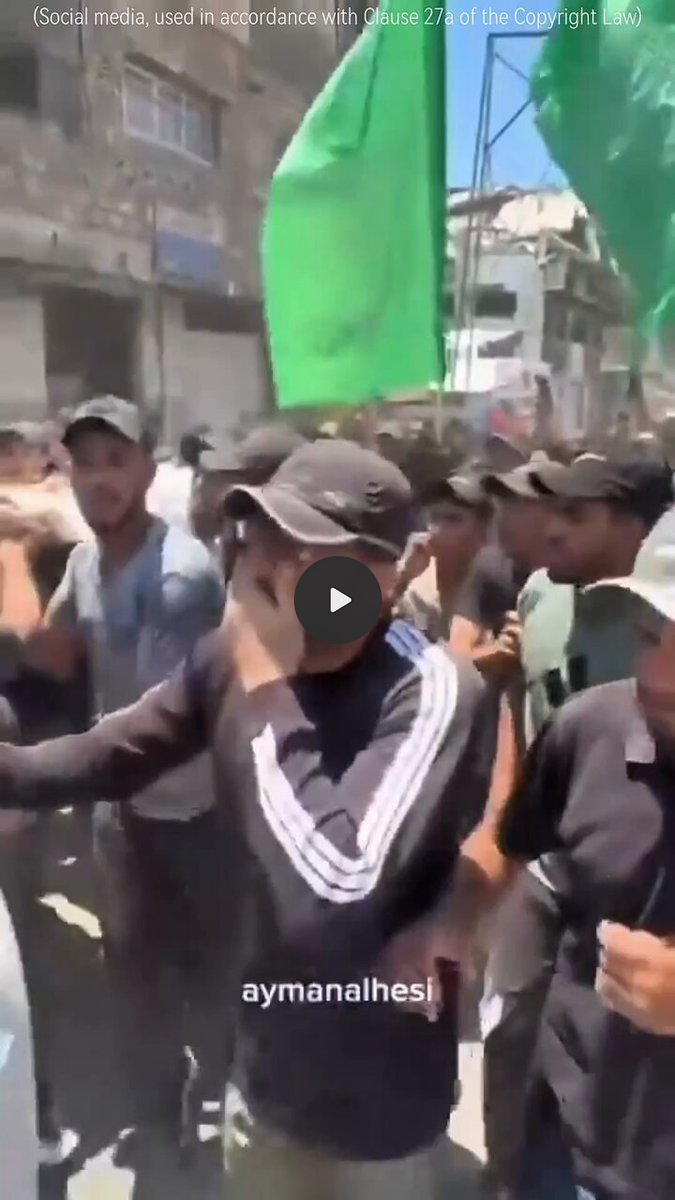
The Times of Israel reported that hundreds of Palestinians appeared to protest Hamas on June 26, with signs including “Hamas out,” “We are not pawns,” and “We want to live.” The outlet also reported that Hamas operatives issued threats ahead of the demonstrations, that armed masked men appeared in the streets, and that Gaza journalists had been warned not to cover the protests.
The Jerusalem Post, citing Hebrew media and Gaza sources, reported that Hamas deployed armed men near potential gathering points, restricted movement, confiscated phones in some cases, and accused protesters of treason. One reported organizer told Kan News: “They threaten anyone who opposes Hamas. All of us are in danger, but we still believe we deserve to live without a terrorist organization.”

A Documented Pattern of Suppressing Dissent
This was not the first wave of anti-Hamas dissent in Gaza. On March 26, 2025, the Associated Press reported that thousands of Palestinians marched in northern Gaza, many chanting against Hamas in a rare public display of anger against the group that has ruled the territory since 2007.
Amnesty International later documented what it called a “disturbing pattern” of threats, intimidation, harassment, interrogations, and beatings by Hamas-run security forces against Palestinians exercising their right to protest. Amnesty said demonstrators had criticized both Israel’s military campaign and Hamas-led authorities, with some calling for an end to Hamas’s rule.
A June 2026 UN Commission of Inquiry press release said Palestinian civilians were “victims of all sides” and trapped between mass atrocities, while Le Monde reported that the inquiry documented Hamas abuses against Palestinians, including public executions, torture, humiliation, and violence by armed factions targeting alleged collaborators and political opponents.
Hospitals As Contested Civilian Space
The hospital-specific allegation is the most sensitive part of Alkhatib’s post. The Washington Free Beacon reported earlier in June that Gazan witnesses and documents described Hamas using hospitals and schools as interrogation and detention sites, including al-Shifa, al-Aqsa Martyrs Hospital, Nasser Hospital, and al-Ma’amadani Hospital. The report said summons letters from Hamas-run internal security directed civilians to appear at hospital-based investigation offices, though the witnesses remained anonymous due to fear of retaliation.
Al-Ahli has also been a recurring flashpoint in the war. Reuters reported that UN Secretary-General António Guterres was “deeply alarmed” after an April 2025 Israeli strike damaged the hospital’s emergency department. Israel said it targeted Hamas militants using the hospital area for cover; Hamas denied the allegation.
That dual reality is what makes the latest claim so consequential. Hospitals are protected civilian institutions under international humanitarian law. If Hamas is using them for internal repression, it endangers patients and staff while exploiting the very protections meant to preserve civilian life. If Israel targets them without adequate evidence, proportionality, or precautions, civilians pay the price.

The Broader Significance
Alkhatib’s testimony sits within a larger, increasingly documented pattern: Hamas has repeatedly suppressed Palestinian dissent, and multiple reports now allege that its security apparatus has operated from civilian sites.
For Gaza’s anti-Hamas protesters, the message is clear. Public dissent risks arrest, torture, accusation of collaboration, or worse. For international agencies operating in Gaza, the question is harder to avoid: whether hospitals they support are being kept neutral, or whether armed actors are turning them into instruments of control.
The June 26 protests did not topple Hamas. But the threats surrounding them revealed something equally important: even after years of war, ruin, and ceasefire politics, Hamas still appears willing to treat Palestinian dissent as an existential threat.
We can only hope this will open people’s eyes to the true colors of this terrorist organization funded by Iran and the Muslim Brotherhood!