


Jewish Onliner is an independent publication. If you find our work valuable, please consider becoming a paid subscriber.
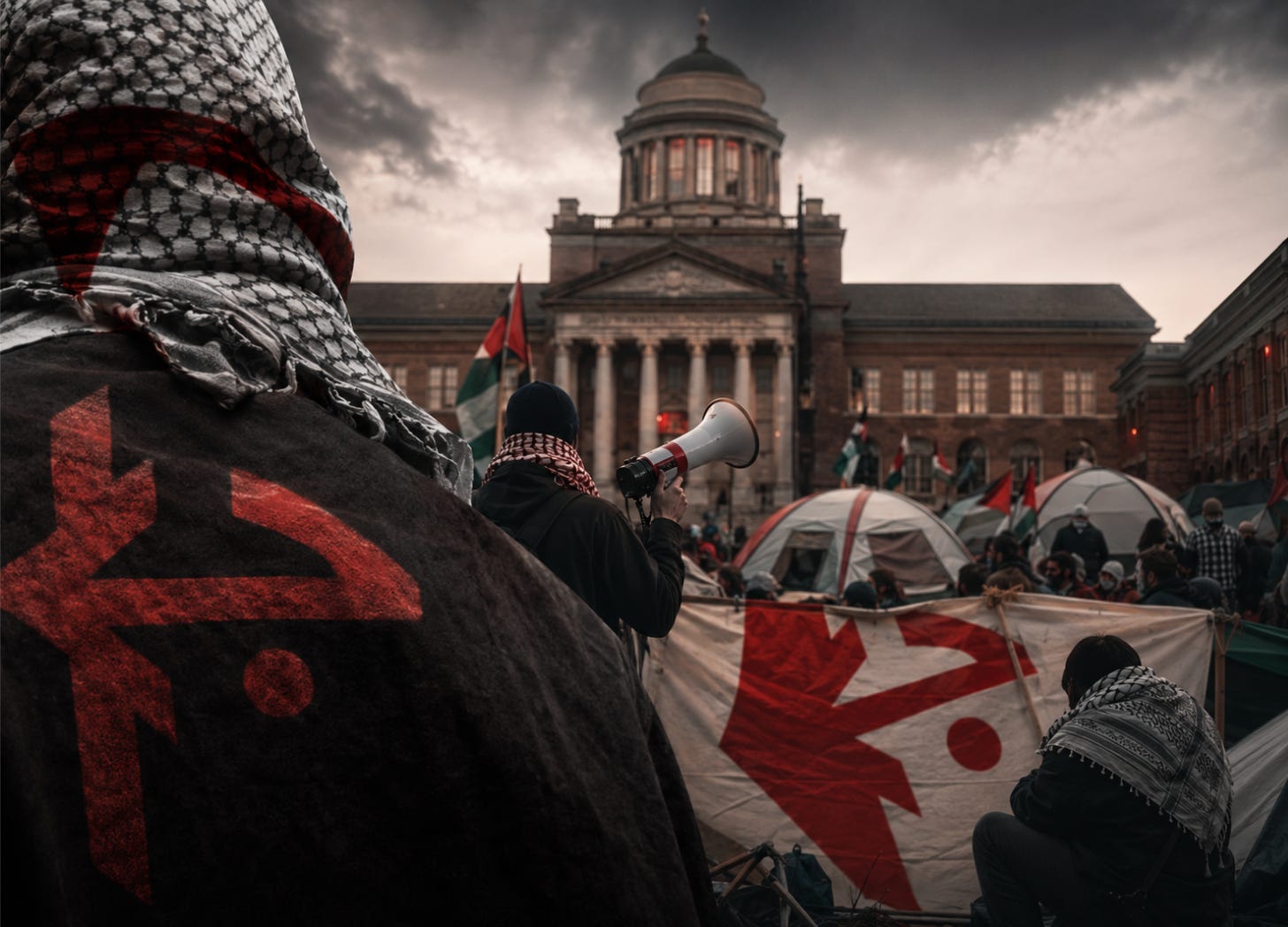
A detailed report from George Washington University’s Program on Extremism reveals how the Popular Front for the Liberation of Palestine (PFLP)—the group infamous for airline hijackings in the 1970s—has rebuilt a significant support and influence network in the United States, not through spectacular attacks, but through a sophisticated web of prisoner solidarity campaigns, campus activism, and international fundraising that has grown largely unmonitored for over a decade.
The July 2026 report, titled “The Forgotten Threat: The PFLP’s Return with a Proven Playbook“ authored by Lara Burns, Leonel Caraciki, Zeynep Ozharat, Asher Stern, and Samantha Wampold, documents how the PFLP established what the U.S. government now describes as an “external support infrastructure” centered on Samidoun: Palestinian Prisoner Solidarity Network, an organization sanctioned by the United States as a Specially Designated Global Terrorist, listed as a terrorist entity by Canada, and designated as a terrorist organization by Israel.


A Terrorist Group That Went Unnoticed
Despite being designated as a Foreign Terrorist Organization by the U.S. State Department in 1997 and as a Specially Designated Global Terrorist in 2001, the PFLP largely faded from American counter-terrorism focus after 9/11. As the authors detail in their research, law enforcement and intelligence agencies prioritized Hamas and Palestinian Islamic Jihad, leaving the PFLP’s propaganda and support infrastructure to operate “with impunity” on U.S. soil by the mid-2010s.
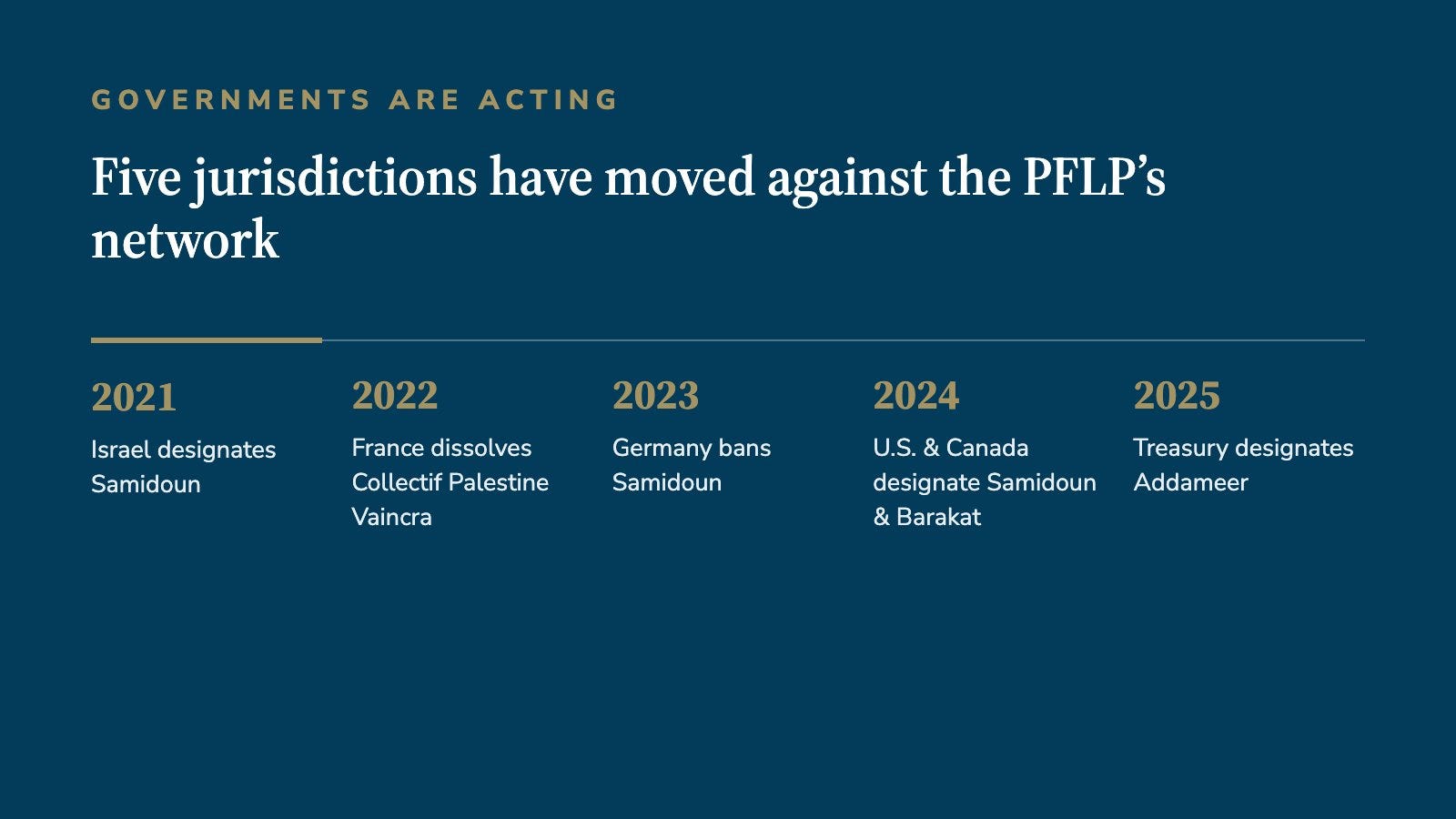
That changed in October 2024 when the U.S. Department of Treasury and Canada jointly designated Samidoun as a “sham charity” serving as an international fundraiser for the PFLP. The same action targeted Khaled Barakat, a Canadian citizen identified as part of the PFLP’s leadership abroad, for his role in fundraising and recruitment.
The GWU researchers trace how this blind spot occurred: “After the 2008 conviction of the Holy Land Foundation and its officers for material support to Hamas, the U.S. government largely looked away from Palestinian terror organizations and their propaganda apparatuses. But by the mid-2010s, those propaganda apparatuses were operating on U.S. soil with impunity.”
The Samidoun Network: Prisoner Solidarity as Cover
The report demonstrates that Samidoun’s public identity as a prisoner solidarity organization masks its operational function as a PFLP fundraising and recruitment platform. Israel’s National Bureau for Counter Terror Financing made this assessment explicit in February 2021, stating that Samidoun’s formal prisoner-support work operated “in practice as a PFLP front abroad” and supported “the PFLP’s propaganda, fundraising, and recruitment activity.”
U.S. enforcement actions have continued tracking this network since the initial October 2024 designations. In June 2025, Treasury designated Addameer Prisoner Support and Human Rights Association, a West Bank-based organization, for being “owned, controlled, directed by, or acting for or on behalf of the PFLP.” The designation record noted that Barakat coordinated with the PFLP to send funds to Addameer and arrange meetings between Addameer and Samidoun.
In May 2026, the same pattern appeared again when Treasury designated Mohammed Khatib and Jaldia Abubakra Aueda as leaders of Samidoun’s European operations, further demonstrating the organization’s transnational structure.


Icons as Organizing Tools
The authors document a sophisticated strategy: Samidoun and allied activist organizations repackaged historical PFLP figures—Leila Khaled, Ghassan Kanafani, Ahmad Sa’adat, and Rasmea Odeh—as symbols of resistance, women’s liberation, and political imprisonment within U.S. activist spaces.
Rasmea Odeh exemplifies this approach. According to U.S. prosecutors, Odeh was convicted in Israel for participating in PFLP bombings in Jerusalem in 1969, including the Supersol supermarket bombing that killed two people, and the bombing of the British Consulate. She served over 10 years in Israeli prison before being released in a prisoner exchange. After entering the United States without disclosing her terrorism convictions, she became active in Chicago’s Palestinian community and was eventually deported after admitting in court that she had falsely denied her Israeli convictions on immigration forms.
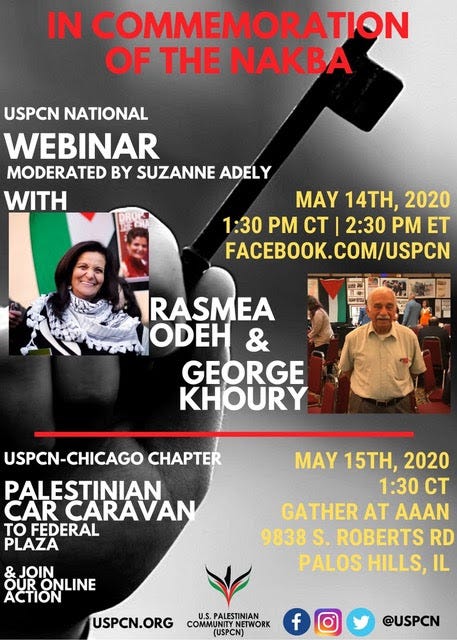
Despite this documented history, the U.S. Palestinian Community Network (USPCN) promoted Odeh as a movement elder, “living legend,” and “community icon.” Jewish Voice for Peace (JVP) invited her to speak at its 2017 national membership meeting, while Northwestern University’s chapter of Students for Justice in Palestine (SJP) hosted her during Israeli Apartheid Week. Samidoun and PYM circulated statements supporting her, and USPCN featured her in a 2020 Nakba Day webinar.
“The repackaging happened inside ordinary U.S. activist settings: conferences, campus events, legal-defense campaigns, webinars, and community organizations,” the authors write.
Similarly, Leila Khaled—who participated in the 1969 hijacking of TWA Flight 840 and the attempted hijacking of El Al Flight 219 in 1970—was rebranded in 2020 by Jewish Voice for Peace as a “Palestinian resistance icon.” And Ghassan Kanafani, a PFLP spokesman killed in 1972, was presented through a Resistance Arts Scholarship run by the Palestinian Youth Movement without foregrounding his PFLP affiliation.
The Alliance Structure: Campus to Community
The report maps a recurring pattern of collaboration among U.S. organizations: the Palestinian Youth Movement (PYM), U.S. Palestinian Community Network (USPCN), Students for Justice in Palestine (SJP), Within Our Lifetime (WOL), and others appearing repeatedly in prisoner campaigns, campus activism, protest coalitions, and fundraising efforts alongside the designated Samidoun network.
These relationships are not necessarily formal alliances, the authors explain, but rather coordinated activity centered on “anti-Western themes, conferences, prisoner support, protest campaigns, campus activism, fiscal sponsors, calls for ‘resistance,’ and donation platforms.”
PYM appears particularly central. The Palestinian Youth Movement, which describes itself as a grassroots organization of young Palestinians in exile, co-sponsored at least 450 anti-Israel rallies since October 7, 2023, according to the Anti-Defamation League. The organization has co-hosted prisoner release campaigns with Samidoun, and supplied students with “political, strategic, and logistical support.”
USPCN, founded in 2006, similarly bridges community and campus organizing. Its Student Committee, created in 2010 after the Second U.S. Palestinian Popular Conference in Chicago, was explicitly designed to function as a liaison between USPCN’s coordinating committee and the SJP student movement across the United States. In 2011, USPCN encouraged its members to attend American Muslims for Palestine’s national conference, placing the organizations in the same ecosystem.
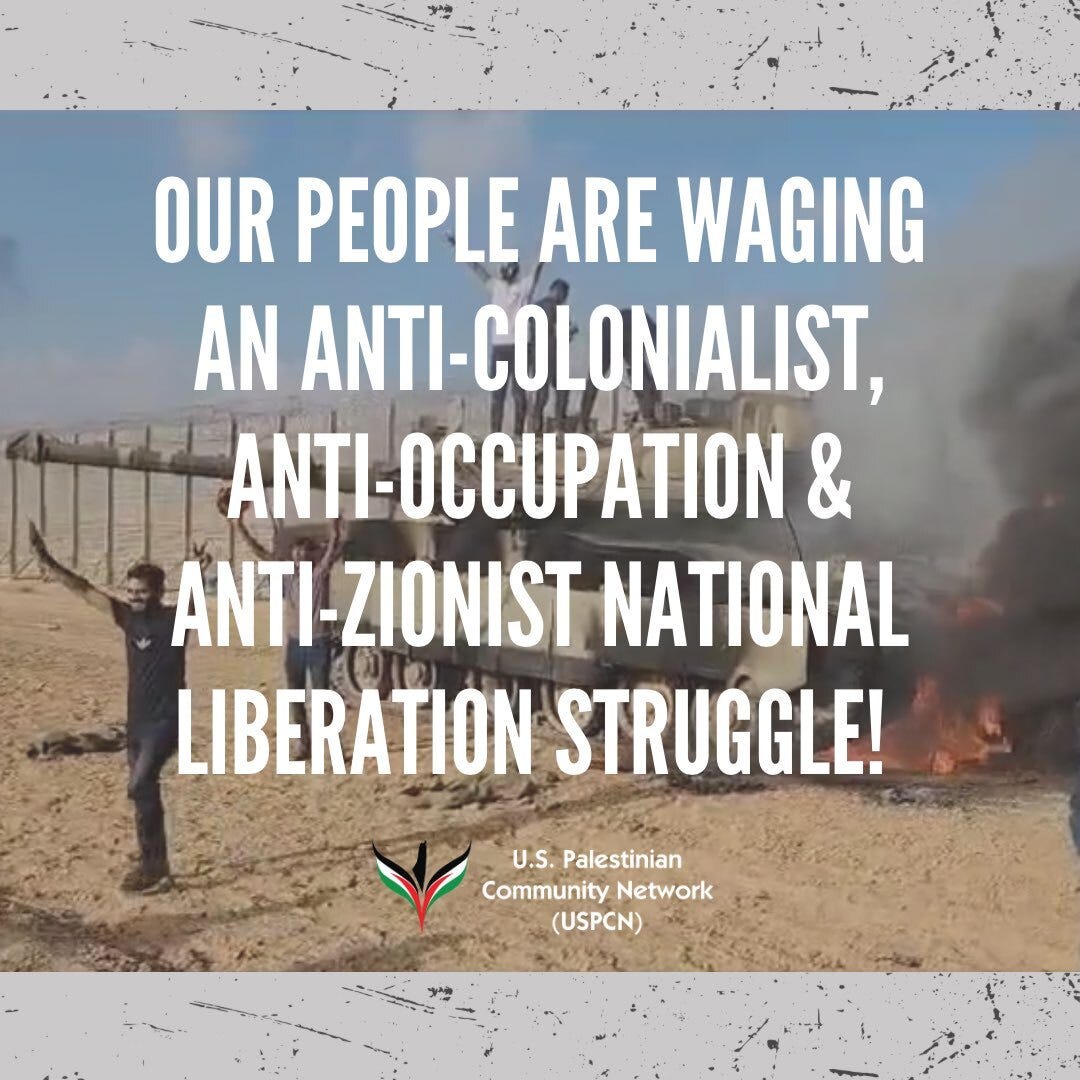
After October 7, 2023, USPCN’s messaging escalated. Its statement described the Hamas-led attack—which killed over 1,200 people and involved mass rape, torture, and hostage-taking—as “self-defense operations” by the “unified Palestinian Resistance.” USPCN’s national chair, Hatem Abudayyeh, cast the attacks as a legitimate response to Israeli violence. By April 2024, USPCN stated it “unequivocally supports” SJP and other student groups building campus encampments.
“Resistance 101” and Legitimizing Violence
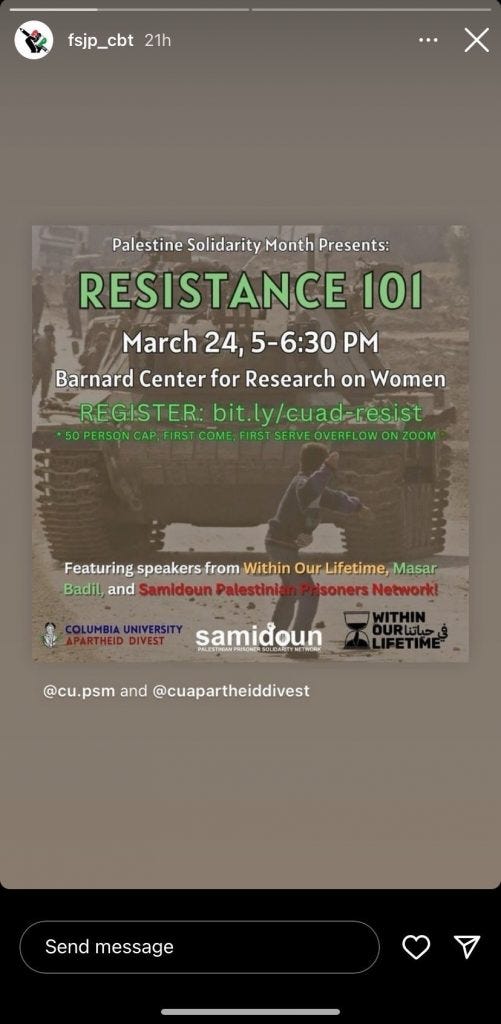
A March 2024 Columbia University event crystallized how these networks operationalize PFLP ideology. Khaled Barakat and his wife Charlotte Kates, Samidoun’s international coordinator, held an online conference titled “Resistance 101” where the October 7 attack was explicitly lauded as resistance and attendees were encouraged to serve “the resistance movements.”
Barakat praised “friends and brothers in Hamas, Islamic Jihad, the PFLP” and referenced the PFLP’s hijackings approvingly. WOL founder Nirdeen Kiswani spoke about destroying the country of Israel. Faculty and Staff for Justice in Palestine promoted the event.
Kates, for her work in this arena, received the Islamic Human Rights and Human Dignity Award from the Iranian regime, reportedly attending the official ceremony in Iran—a nation that has long-term alliances with Hamas, Palestinian Islamic Jihad, and the PFLP.
Donation Infrastructure and Fiscal Sponsorship
The authors document how these organizations obscure their financing through fiscal sponsorship arrangements. Samidoun lacks its own 501(c)(3) status and was described by the House Ways and Means Committee in 2024 as a fiscally sponsored project of Alliance for Global Justice (AFGJ). Canada’s corporate records list Samidoun’s Canadian not-for-profit corporation as dissolved for non-compliance as of March 27, 2026.
Following its designation, Samidoun’s donation page now accepts cryptocurrency, listing Bitcoin, Ethereum, USDT, and Monero options after U.S. sanctions restricted its access to international banking systems and payment processors.
PYM routes donations through GoodBricks and previously through WESPAC Foundation and Honor the Earth. The researchers note that Nadya Tannous sits on PYM’s national executive board while serving as deputy director of Honor the Earth, and that PYM lead organizer Lenna Zahran Nasr sits on Honor the Earth’s board of directors. USPCN accepts donations only through Zeffy via a fiscal sponsor called “IT IS APARTHEID INC.”
International Enforcement Context
Beyond U.S. action, the authors document parallel enforcement in Europe. Germany banned both Hamas and Samidoun in November 2023, with the German Interior Ministry stating that Samidoun “operated internationally under the cover of prisoner solidarity while spreading anti-Israel and anti-Jewish propaganda.”
France dissolved Collectif Palestine Vaincra, a French pro-Palestinian group that Samidoun itself identified as a network member, in March 2022. In February 2025, France’s Conseil d’État upheld the dissolution, finding that the group’s social media activity generated “especially aggressive and hateful comments targeting Jewish Israeli citizens, including comments that were explicitly antisemitic,” and that the group had not sufficiently moderated them.
The Armed Connection
The report also documents how the ideological alliance between Islamist and Marxist Palestinian factions extends to the military sphere. An October 2025 federal complaint describes the Joint Operations Room, a Gaza-based coordination mechanism established by Hamas around 2018 to unite Hamas, PFLP, DFLP, and Palestinian Islamic Jihad.
The complaint against Mahmoud Amin Ya’qub Al-Muhtadi, a Gaza native arrested in Louisiana for alleged involvement in the October 7 attack, cited a June 2023 interview describing how these groups coordinated “communications, operational and intelligence assessments, logistical support, armaments, and annual joint training exercises.”
While the authors do not allege that U.S. organizations are directed by this command structure, they note the significance: “What has manifested in the U.S. is a support network where Islamist-aligned, secular-left, student, prisoner-solidarity, and community actors appear in the same campaigns driving the same pro-terror, anti-imperialist, anti-Western narratives.”
Adaptation Not Decline
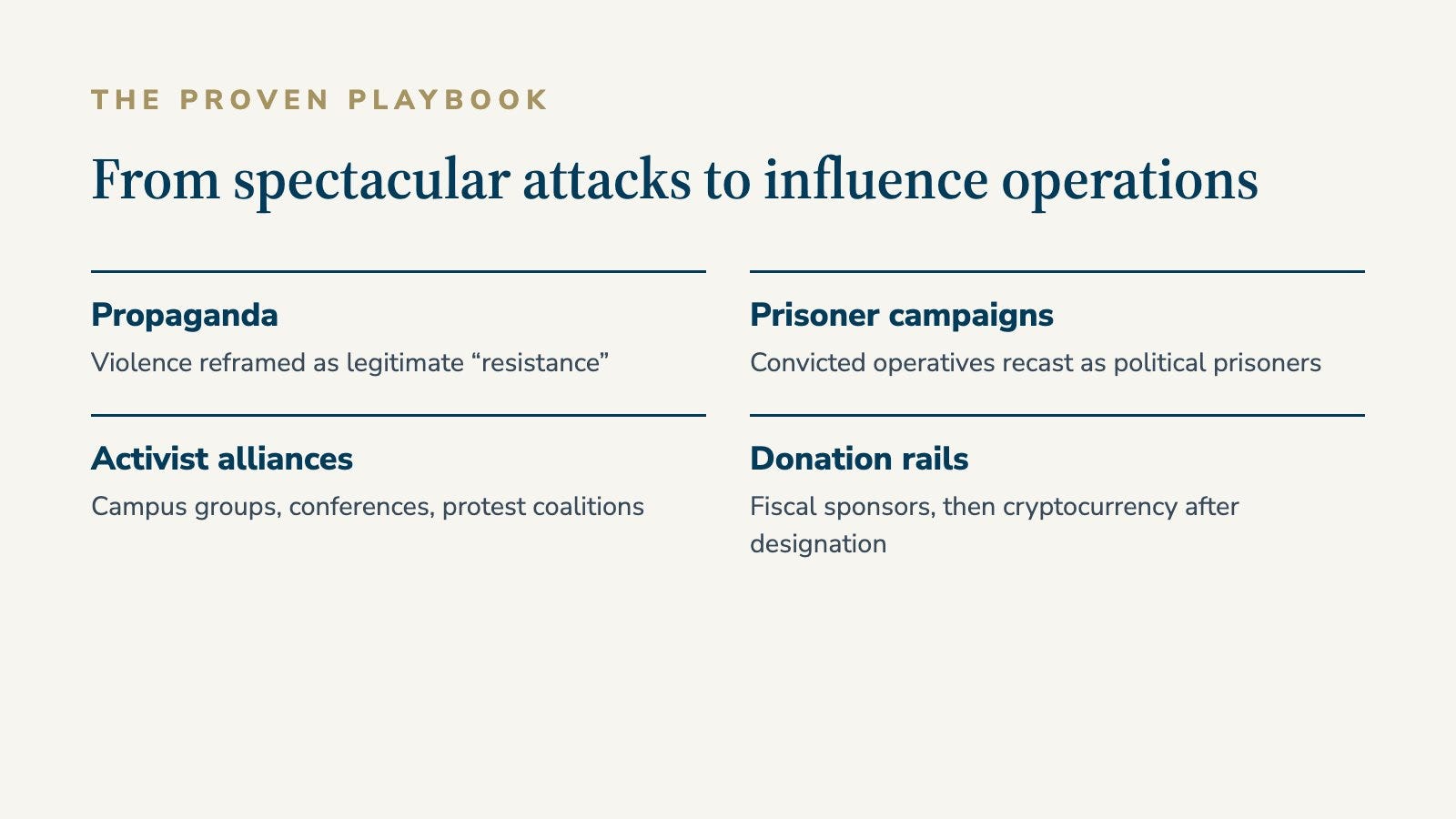
The GWU researchers conclude that the PFLP represents not a relic of the 1970s but a group that has successfully adapted its operational model. Rather than pursuing spectacular attacks, the PFLP shifted emphasis “from spectacular terrorist attacks to influence operations built around propaganda, prisoner campaigns, activist alliances, and transnational support networks.”
They note that recent U.S., Canadian, and European enforcement actions “suggest governments are increasingly recognizing these networks as part of the broader infrastructure that sustains and legitimizes designated terrorist organizations.”