


Jewish Onliner is an independent publication. If you find our work valuable, please consider becoming a paid subscriber. You can also subscribe to us on WhatsApp and Telegram. Follow us on YouTube, TikTok, Instagram, Discord, and X.
The third article in Jewish Onliner’s series on the Gaza GenoLIE campaign, launched by 40 legal and civil society organizations, examines the campaign’s section on the distortion of genocide’s legal definition. The section explains that genocide is not a synonym for mass killing or a war involving heavy civilian losses. It is a specific international crime requiring proof that prohibited acts were committed with the intent to destroy a protected group, in whole or in part.
The section applies that test to Gaza, arguing that Israel’s war aims, Hamas’s conduct and Israel’s measures to reduce civilian casualties provide a reasonable explanation other than genocidal intent. Under the International Court of Justice’s test for inferring intent from a pattern of conduct, the campaign says that competing explanation defeats the genocide allegation.
Genocide Has a Narrow Legal Definition
The United Nations states that the popular understanding of genocide is broader than the definition established under international law. The crime was codified in the 1948 Genocide Convention, drafted following the Holocaust and adopted by the UN General Assembly on Dec. 9, 1948.
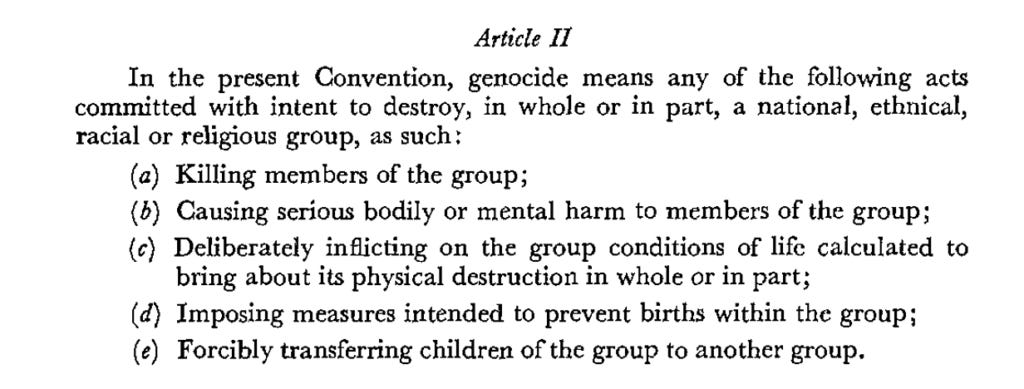
Under Article II, genocide consists of specified acts committed “with intent to destroy, in whole or in part, a national, ethnical, racial or religious group, as such.” The acts include killing members of the group, causing serious bodily or mental harm and deliberately imposing conditions of life calculated to bring about the group’s physical destruction. The Convention also covers measures intended to prevent births and the forcible transfer of children.
The decisive element is intent. The existence of civilian deaths, including deaths on a large scale, does not establish genocide without proof that the perpetrator acted with the specific purpose of destroying the protected group because of its identity.
The UN calls intent the most difficult element to determine. Its guidance states that the required purpose is the group’s physical destruction. An intention to disperse a population or erase its culture does not by itself satisfy the definition. The Convention’s drafting history also indicates that delegates did not consider heavy civilian losses during wartime to constitute genocide as a general rule, according to historian Norman J.W. Goda’s review of the preparatory records.
International Courts Require Specific Intent
The campaign points to two ICJ judgments demonstrating the difficulty of proving genocide. In Bosnia v. Serbia, the court confirmed that the murder of approximately 8,000 Bosniak men and boys at Srebrenica constituted genocide. It did not hold Serbia responsible for committing the genocide or being complicit in it. The court instead found that Serbia failed to prevent the genocide and violated its obligations concerning the punishment of its perpetrators.
In Croatia v. Serbia, the court dismissed genocide claims brought by both countries because neither established the required specific intent. The court held that when genocidal intent is inferred from a pattern of conduct, it must be the only reasonable inference that can be drawn from the acts.
The campaign presents the consequence of that standard in direct terms: if another reasonable explanation exists for the conduct from which genocidal intent is being inferred, the genocide allegation fails as a matter of law.
Rewriting Genocide Law to Fit the Accusation
Several organizations presented the genocide accusation against Israel as a legal conclusion, then challenged, supplemented or broadened the framework needed to reach it. The sequence exposes the central inconsistency: instead of allowing the Genocide Convention’s demanding standard to determine the conclusion, the reports reworked the analysis until the accusation could be made to fit. Amnesty challenged the ICJ’s application of the intent test, B’Tselem expressly adopted a broader framework and Human Rights Watch used the language of genocide while stopping short of establishing the specific intent the crime requires.
Amnesty International’s December 2024 report illustrates the maneuver. Amnesty acknowledged that the ICJ requires genocidal intent to be the only reasonable inference drawn from a pattern of conduct. It then criticized a narrow reading of the court’s rulings as an “overly cramped interpretation” of international jurisprudence. Amnesty maintained that genocidal intent could coexist with, or serve as a means of achieving, a military objective. That move neutralized a central competing explanation for Israel’s conduct by recasting the stated objective of defeating Hamas as something that could operate alongside the genocidal intent Amnesty sought to establish.
B’Tselem made the expansion explicit in its July 2025 report. It acknowledged that genocide’s legal definition is narrow and that the prevailing legal standard imposes a high threshold. It nevertheless stated that, while relying on the Convention, it was adopting “a broader analytical framework” drawn from Raphael Lemkin’s original conception and historical and sociological research. B’Tselem then incorporated social, cultural and political destruction into what it called a coordinated attack on the foundations of Palestinian society. The report invoked the authority of genocide law while expanding its analysis beyond the legal definition it purported to apply.
That methodological admission is not a minor academic distinction. UN guidance states that genocide requires an intent to physically destroy a protected group. Cultural destruction or an intention to disperse a population does not satisfy the legal definition. Evidence that supports a broader historical or sociological account of societal damage cannot be substituted for the Convention’s specific-intent requirement and then presented to the public as a definitive legal finding of genocide.
Human Rights Watch’s December 2024 report used a different form of legal slippage. Its headline foregrounded “acts of genocide,” but the report described genocidal intent only as something that “may be inferred” and concluded that the conduct “may amount” to genocide. HRW therefore did not establish the completed crime it placed at the center of its presentation. An act listed in Article II becomes genocide only when the required specific intent is established.
Taken together, the reports reveal a result-driven approach. Amnesty rejected the restrictive effect of the ICJ test, B’Tselem supplemented the Convention with a broader framework, and HRW foregrounded genocidal acts while conceding that the decisive intent element remained inferential. The legal standard was not simply applied to the evidence. It was challenged, expanded or blurred where necessary to sustain the accusation against Israel.
The Campaign Applies the Test to Gaza
The Gaza GenoLIE campaign identifies a competing explanation for Israel’s conduct. Israel launched the war after Hamas attacked Israeli communities on Oct. 7, 2023, with the declared objectives of dismantling Hamas and obtaining the release of the hostages. The campaign describes the civilian death toll as a consequence of dense urban combat against an enemy that deliberately embeds its fighters and infrastructure within the civilian population.
It also points to measures Israel used to reduce civilian casualties, including advance warnings and rules of engagement intended to limit harm to noncombatants, even when those measures increased risks to Israeli soldiers or civilians. The campaign concludes that those actions are inconsistent with an intent to destroy Palestinians as a group.


On the campaign’s analysis, Israel’s stated war objectives, Hamas’s use of civilian areas and Israel’s civilian-protection measures provide a reasonable explanation for the wartime conduct. Genocidal intent therefore cannot be the only reasonable inference drawn from that conduct, meaning the accusation does not satisfy the ICJ test.


The ICJ Did Not Validate the Genocide Charge
The campaign also addresses claims that the ICJ validated the accusation against Israel. In its January 2024 order, the court found that at least some of the rights South Africa sought to protect were plausible and imposed provisional measures while the case proceeded.
That was not a finding that Israel was committing genocide. The plausibility determination concerned the right of Palestinians in Gaza to be protected from acts prohibited by the Genocide Convention and South Africa’s right to seek Israel’s compliance with the treaty. An analysis published by EJIL: Talk! similarly distinguished the plausibility of asserted rights from a finding on the underlying genocide allegation.
Judge Georg Nolte’s declaration appended to the order further emphasized that the threshold applied during provisional-measures proceedings is different from the demanding evidentiary standard required for a final finding of genocidal intent. The preliminary order preserved asserted rights while the case continued. It did not decide the merits of South Africa’s accusation.
Describing the ICJ order as confirmation of genocide replaces a preliminary procedural ruling with a verdict the court never delivered. The “Gaza genocide” allegation is one of the largest falsehoods of the 21st century, generated and promoted after Oct. 7 by anti-Zionist and antisemitic networks seeking to impede Israel’s efforts to free the hostages, delegitimize the Jewish state and fuel antisemitism worldwide.
Pat Johnson on substack summarizes it nicely:
“The perpetrators of the “Gaza Genocide” hoax may or may not believe a genocide is actually happening. If they do believe it, they are ignorant of either the definition of the term or what is happening in Gaza, or both. If they don’t believe it but use it as a weapon, they are sadists, not human rights activists.”