


Jewish Onliner is an independent publication. If you find our work valuable, please consider becoming a paid subscriber. You can also subscribe to us on WhatsApp and Telegram. Follow us on Instagram, Discord, and X.
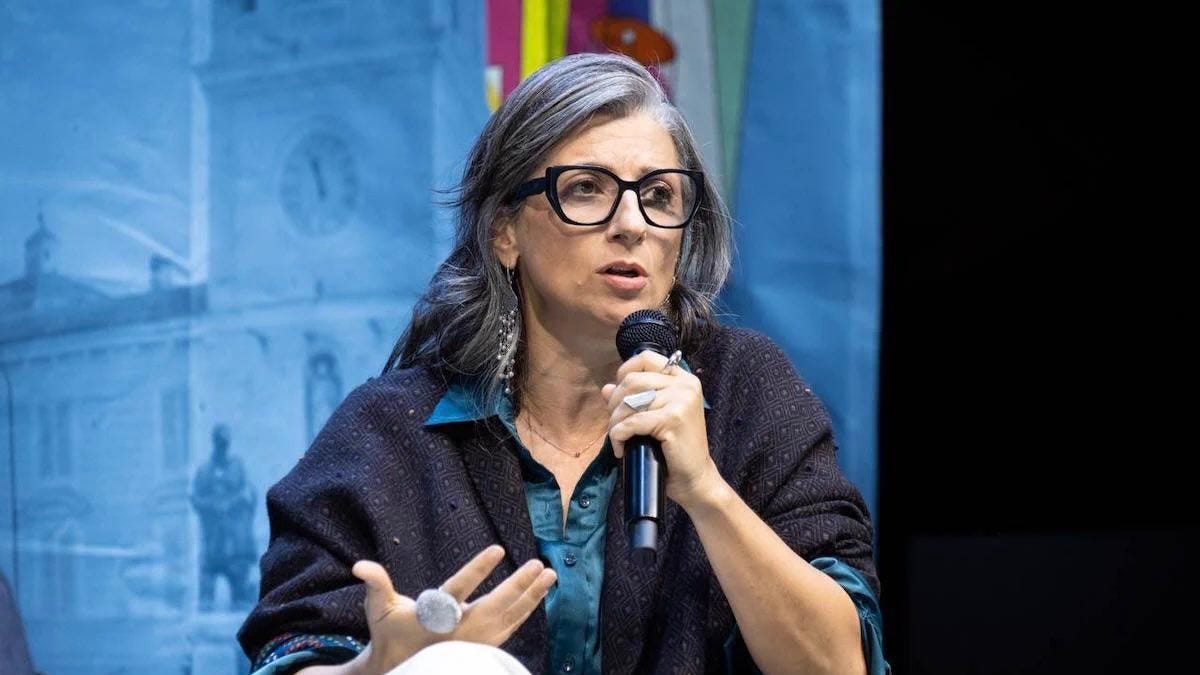
On September 19 in Parma, Italy, UN Special Rapporteur Francesca Albanese called for an end to weapons deliveries to Ukraine and alleged that NATO is helping perpetuate the war. Albanese acknowledged that “Russia invaded Ukraine,” but added that “there are a number of reasons that led to that war” before directing her criticism toward NATO and the United States.
The remarks prompted UN Watch to send a formal complaint to UN Secretary-General António Guterres on Tuesday, accusing Albanese of using her UN position to advance political views on a conflict outside her mandate.
Albanese went beyond opposing arms shipments. She said Ukraine was being “instrumentalized” to promote what she called the “horrible narrative” that Europe is already engaged in a hybrid war. She then said governments should stop sending weapons to Ukraine and move the conflict back into the political sphere.
Asked what should happen instead, Albanese acknowledged the limits of her expertise. “I don’t have the solution because I’m not an expert,” she said.
Amplified by Russian Media
Albanese’s Ukraine comments were subsequently promoted by Russia Direct, which UN Watch described as a Russian propaganda account. The account highlighted her UN position while circulating her demand to stop sending weapons to Ukraine.


The amplification came just nine days after Albanese appeared in an exclusive interview with RT, the Russian state-controlled broadcaster, on September 10. In that interview, she discussed Gaza, accused Western governments and companies of complicity in supposed Israeli wrongdoing, and criticized what she described as the repression of pro-Palestinian activism in Europe.


Outside Her UN Mandate
Albanese’s official UN mandate covers “the situation of human rights in the Palestinian territory occupied since 1967.” Ukraine, Russia and NATO fall outside that geographic remit.
In its September 22 letter, UN Watch cited three provisions of the Human Rights Council’s Code of Conduct. Article 3(d) requires mandate holders to focus on implementing their mandate, Article 7 requires “strict observance” of its terms, and Article 12 requires experts to ensure personal political opinions do not prejudice their work and to exercise “restraint, moderation and discretion.”


The Iran Contrast
UN Watch also pointed to Albanese’s response when she was pressed to address Iran earlier this year.
On January 12, amid criticism over her silence on the Iranian government’s repression of protesters, Albanese said she was the UN rapporteur for the occupied Palestinian territory and that she devoted herself “rigorously” to the mandate assigned to her, directing attention instead to the UN rapporteur responsible for Iran.


Yet Albanese has repeatedly stepped beyond her Palestine mandate to weigh in on the Iran conflict. In June 2025, she accused Israel of launching an “unprovoked” attack on Iran and of carrying out “psychological & political terror.” In March 2026, she described Iran’s government as “illiberal and brutal,” but still declared that neither the United States nor Israel had the right to bomb Iran.

UN Watch cited that record in arguing that Albanese applies the geographic limits of her mandate inconsistently. Its September 22 complaint asks UN leadership to formally address her intervention on Ukraine and NATO.