


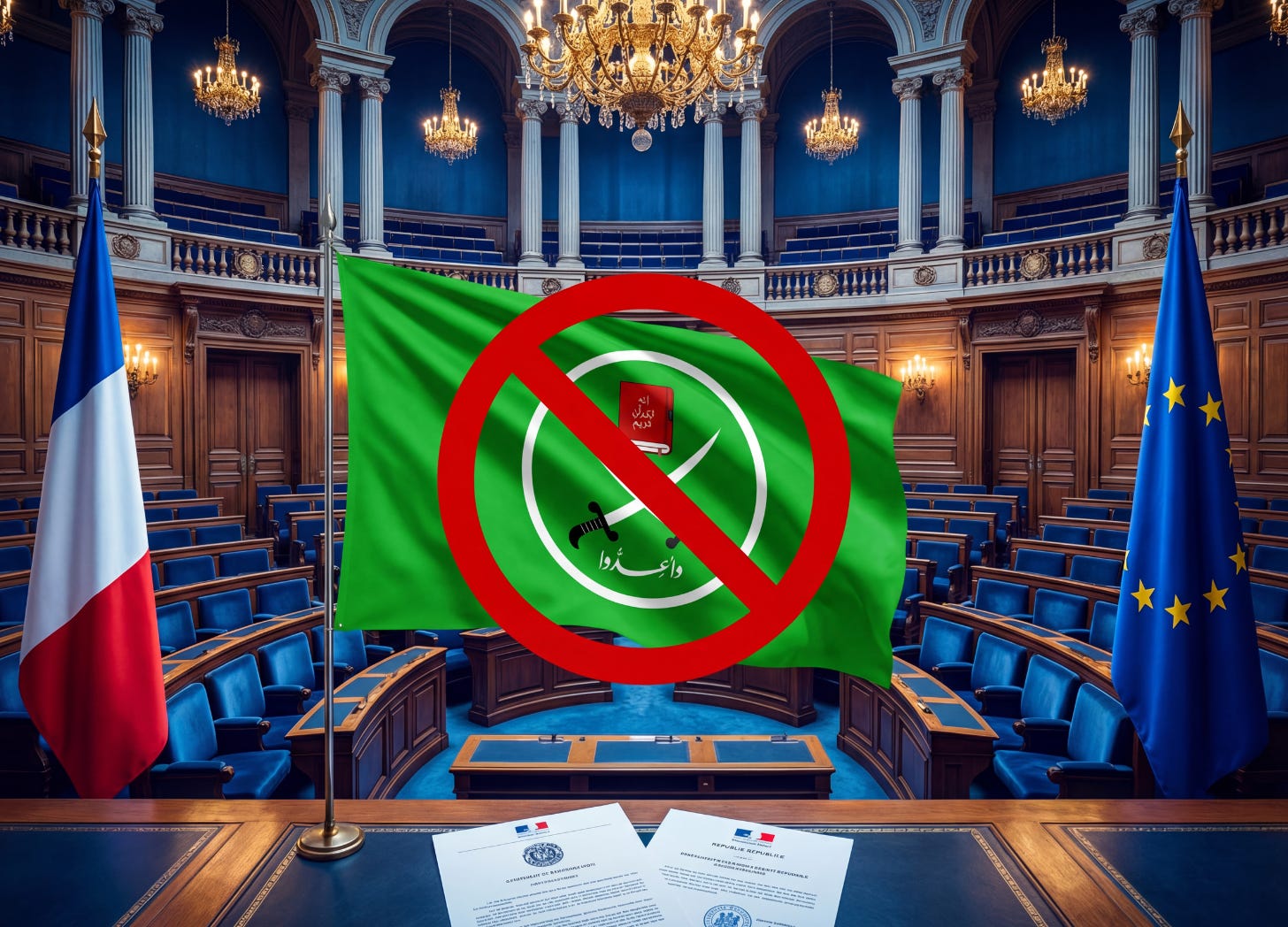
France’s National Assembly voted 157-101 on January 22nd to call for the Muslim Brotherhood to be added to the European Union’s list of terrorist organizations, marking the first time a major EU nation has formally pushed for such a designation.
The resolution, adopted after nearly five hours of contentious debate, instructs the French government to press the European Commission and Council to conduct a comprehensive legal evaluation of the transnational Islamist movement and its networks across Europe. If ultimately approved at the EU level, the designation would trigger asset freezes, funding prohibitions, and enhanced intelligence cooperation among member states.
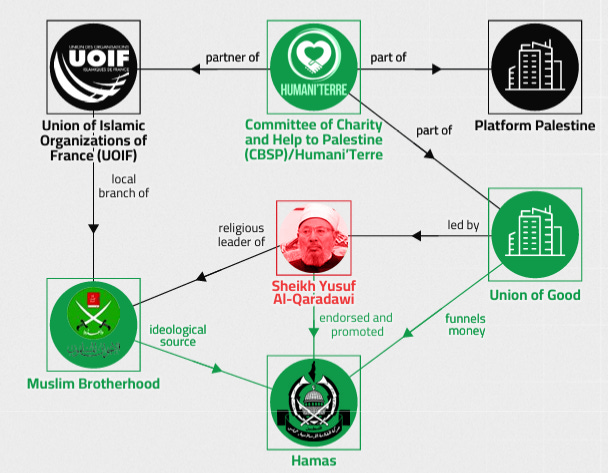
Deputies repeatedly cited the Muslim Brotherhood’s direct connection to Hamas—already on the EU terror list—pointing to the October 7, 2023 massacre that killed over 1,200 Israelis as evidence of the Brotherhood’s ideological offspring.
The “Entrisme” Strategy
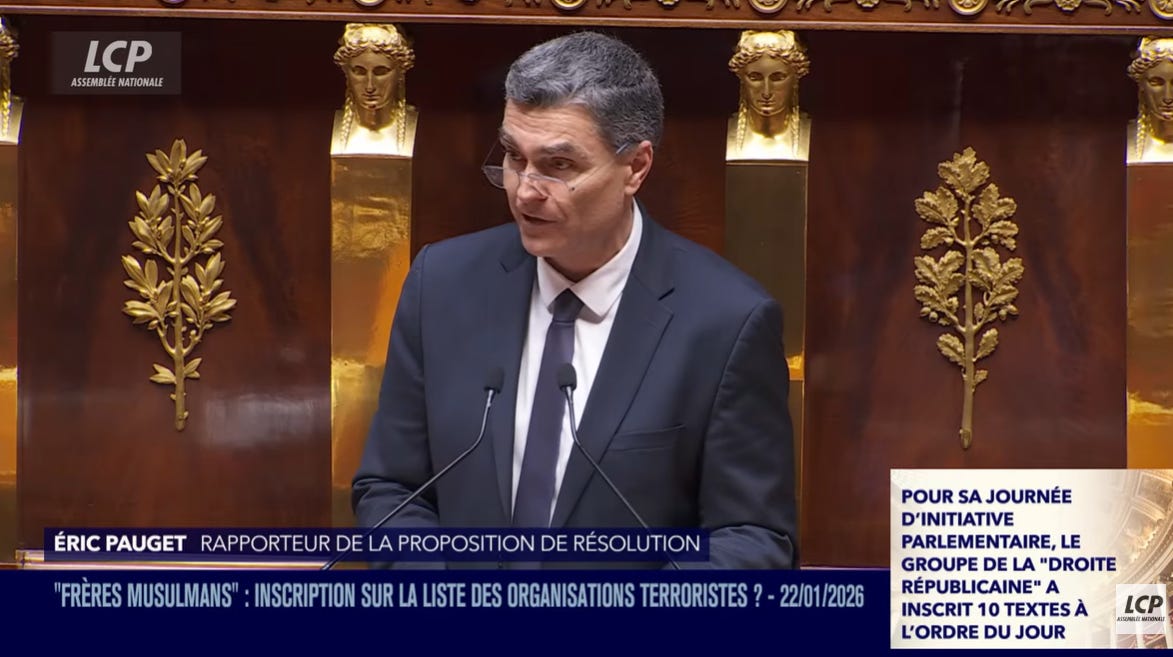
"Their project is clear: to make sharia triumph over the law of the Republic," declared rapporteur Éric Pauget, author of the resolution and member of the Republican Right party, summarizing what he called the ultimate goal behind the Muslim Brotherhood's decades-long strategy in France.
“The Republic does not combat a religion, it combats a strategy… We combat the political Islamism of the Muslim Brotherhood, which serves as a gateway to radicalization and prepares the ground for terrorism.”
Pauget emphasized the movement’s “entrisme” strategy—patient infiltration of democratic institutions rather than direct confrontation—which he said exploits European freedoms to subvert them from within. A May 2025 French government report documented Brotherhood networks across 55 departments, involving 280 associations and 139 places of worship.
The Brotherhood operates as what deputies called a “nébuleuse”—a nebulous network that reconstitutes under new names when dissolved. When French authorities disbanded the Collectif contre l’islamophobie en France (CCIF) in 2020, it immediately re-emerged as the Collectif contre l’islamophobie en Europe (CCIE), circumventing national sanctions by crossing borders.
A Movement Doubling in Size
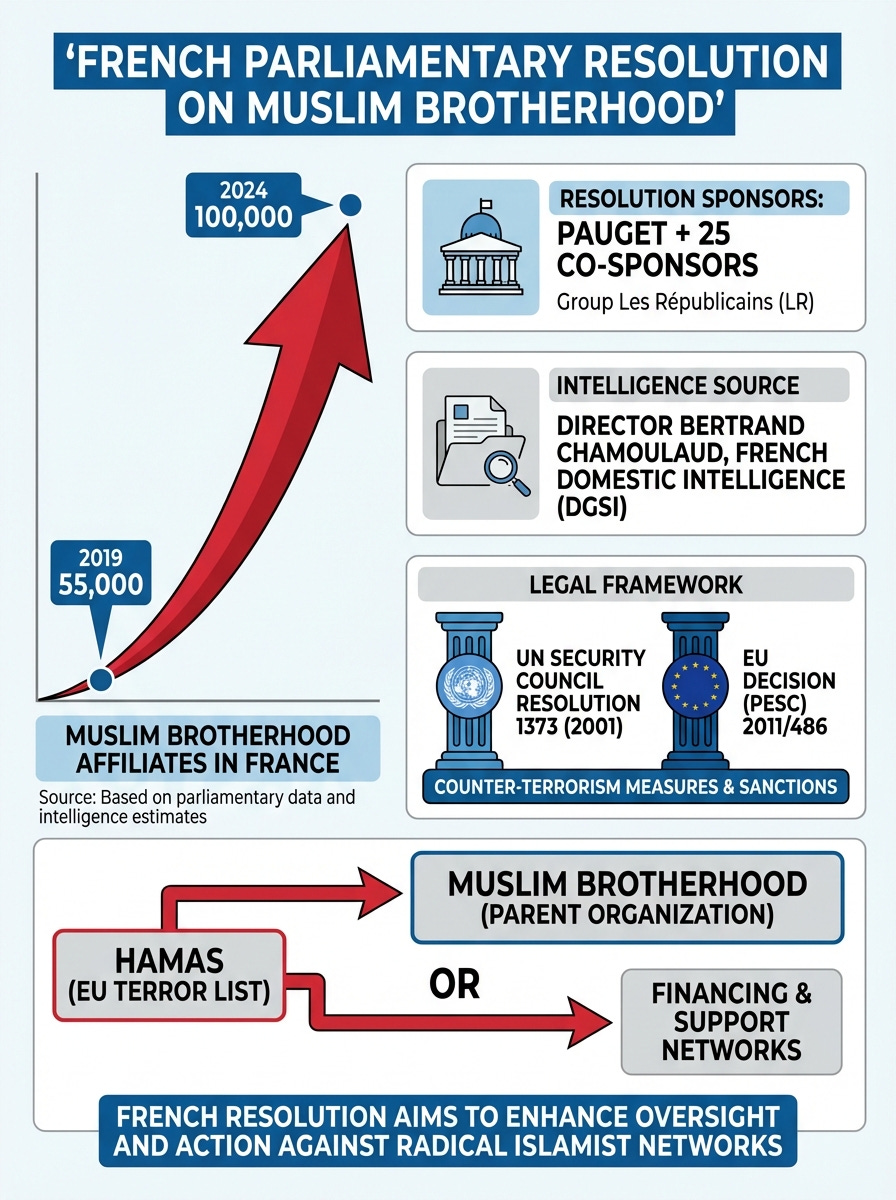
The formal resolution presented by Pauget and 25 co-sponsors cites stark intelligence warnings that drove the parliamentary action. French domestic intelligence director Bertrand Chamoulaud reported that Brotherhood affiliates in France doubled from an estimated 55,000 individuals in 2019 to over 100,000 in 2024, a silent expansion that occurred in the greatest discretion.
The document invokes UN Security Council Resolution 1373 and EU legal framework Decision (PESC) 2011/486, which permits designating entities when there exists “sufficiently precise, factual, and recent elements” demonstrating involvement in or support for terrorist acts. Notably, the resolution emphasizes that Hamas, already on the EU terror list, originated as the Palestinian branch of the Muslim Brotherhood, making the parent organization’s exclusion a logical inconsistency.
The Legal Loophole: Why the Brotherhood Evades Terrorism Designation
The Muslim Brotherhood presents a unique legal challenge: its primary weapons are ideological, not violent. Government Minister Eléonore Caroit explained that the Brotherhood’s core tactics—”separatism and entrism,” the gradual infiltration and reshaping of democratic institutions from within—fall outside the EU’s strict legal definition of terrorism, which requires demonstrable links to violent acts.
This distinction creates what critics call a strategic blind spot. The Brotherhood operates through a decentralized web of affiliated associations, mosques, and NGOs that share an ideology rather than a formal command structure, making it difficult to prove organizational responsibility for terrorist acts committed by offshoots. The fragmented approach allows the network to persist: when one branch is sanctioned, others continue operating under the same ideological umbrella.
A Long Road to EU-Wide Action
The vote positions France alongside Austria as the only EU nations actively pursuing Brotherhood restrictions, though several Muslim-majority countries including Egypt, Saudi Arabia, the UAE, and Jordan have already banned the organization. The resolution now requires French government action at the EU level, where unanimous Council approval would be needed, a process experts say could take 12 to 24 months and face significant legal challenges.
The designation effort reflects Europe’s broader reckoning with political Islamism’s infrastructure, particularly its role in fostering antisemitism and delegitimizing Israel through networks that operate under the cover of civil society organizations.
France's parliamentary action comes alongside parallel moves across the Atlantic. In January 2026, the Trump administration designated three chapters of the Muslim Brotherhood as foreign terrorist organizations, marking a significant shift in U.S. policy after years of debate over the group's status.