


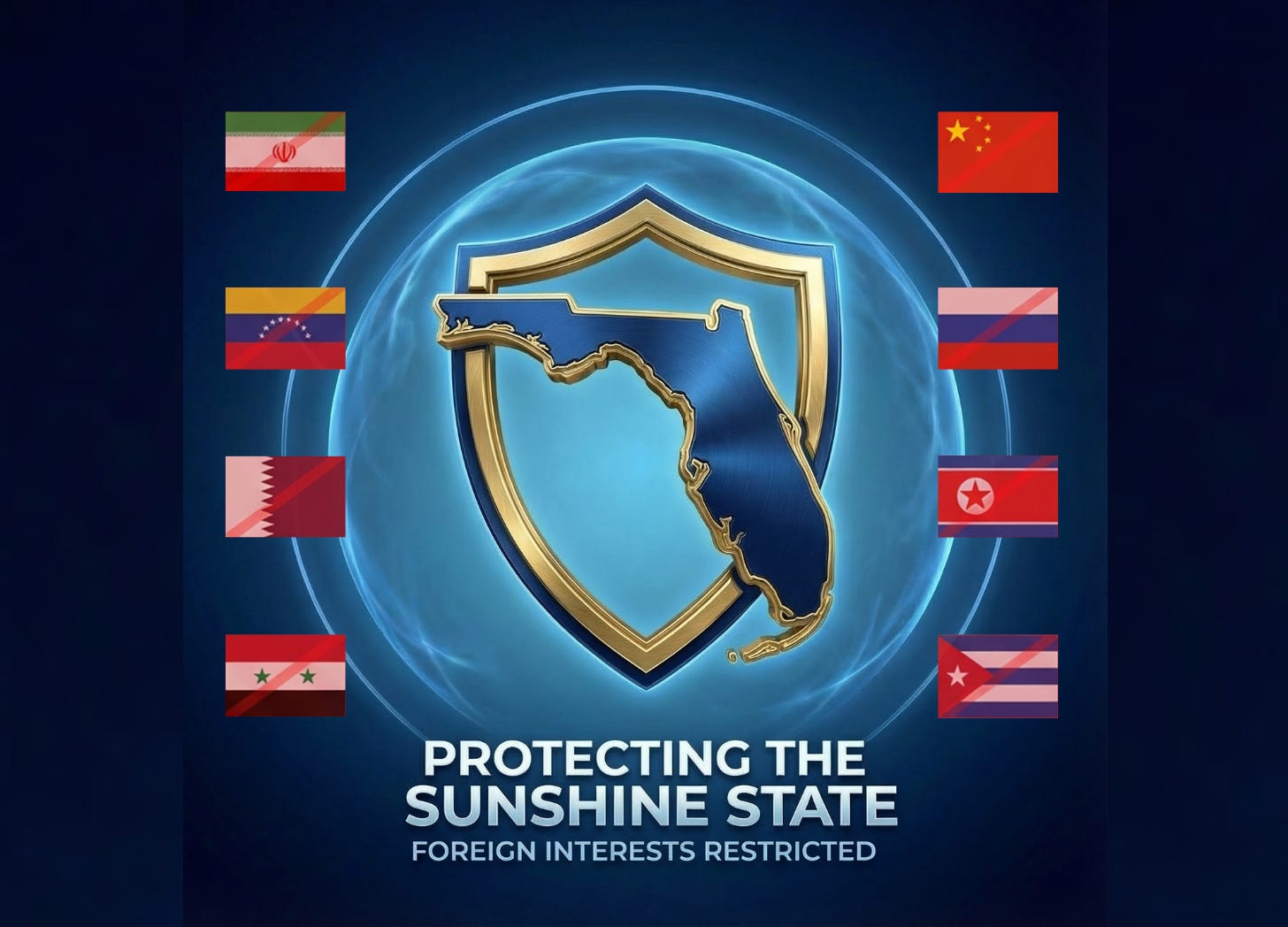
Florida State Representative Jenna Persons-Mulicka has filed legislation that would impose strict foreign influence barriers, targeting eight countries deemed threats to state security. House Bill 905, dubbed the “Foreign Interference Restriction and Enforcement Act,” was filed on December 23, 2025, and would take effect July 1, 2026, if passed.
What the Bill Stipulates
The bill specifically designates China, Russia, Iran, North Korea, Cuba, Venezuela, Qatar, and Syria as “foreign countries of concern.” Under the legislation, any person acting as an agent for these nations would be required to register with Florida’s Division of Elections within 10 days, disclose all payments received, and update their information every 90 days. Violations could result in fines up to $2,000 per offense for willful or repeated infractions.
The proposed law would also prohibit Florida’s public officials, government employees, and political candidates from accepting anything of value—including gifts, travel reimbursements, or loans—from these designated countries or foreign terrorist organizations. This represents a significant expansion of existing ethics rules, closing loopholes that currently allow some forms of foreign engagement.

Government contracting would face new restrictions as well. State and local agencies could not enter into contracts for information technology services with entities owned or controlled by foreign sources of concern, particularly when those contracts involve access to personal identifying information. The bill further mandates that entities with access to critical infrastructure facilities, such as power plants and water systems, cannot contract with these foreign sources. Violations would carry civil penalties of $1,000 per day and potential criminal charges.
The legislation takes aim at cultural and educational ties as well. It removes the Florida-China Institute from the state’s list of authorized international linkage institutes and prohibits all such institutes from entering agreements with countries of concern. Existing agreements, including sister city partnerships with Chinese or Russian municipalities, must be terminated by July 1, 2026. The Department of Commerce would be required to publish quarterly updates listing all foreign consulate offices and sister city affiliations.
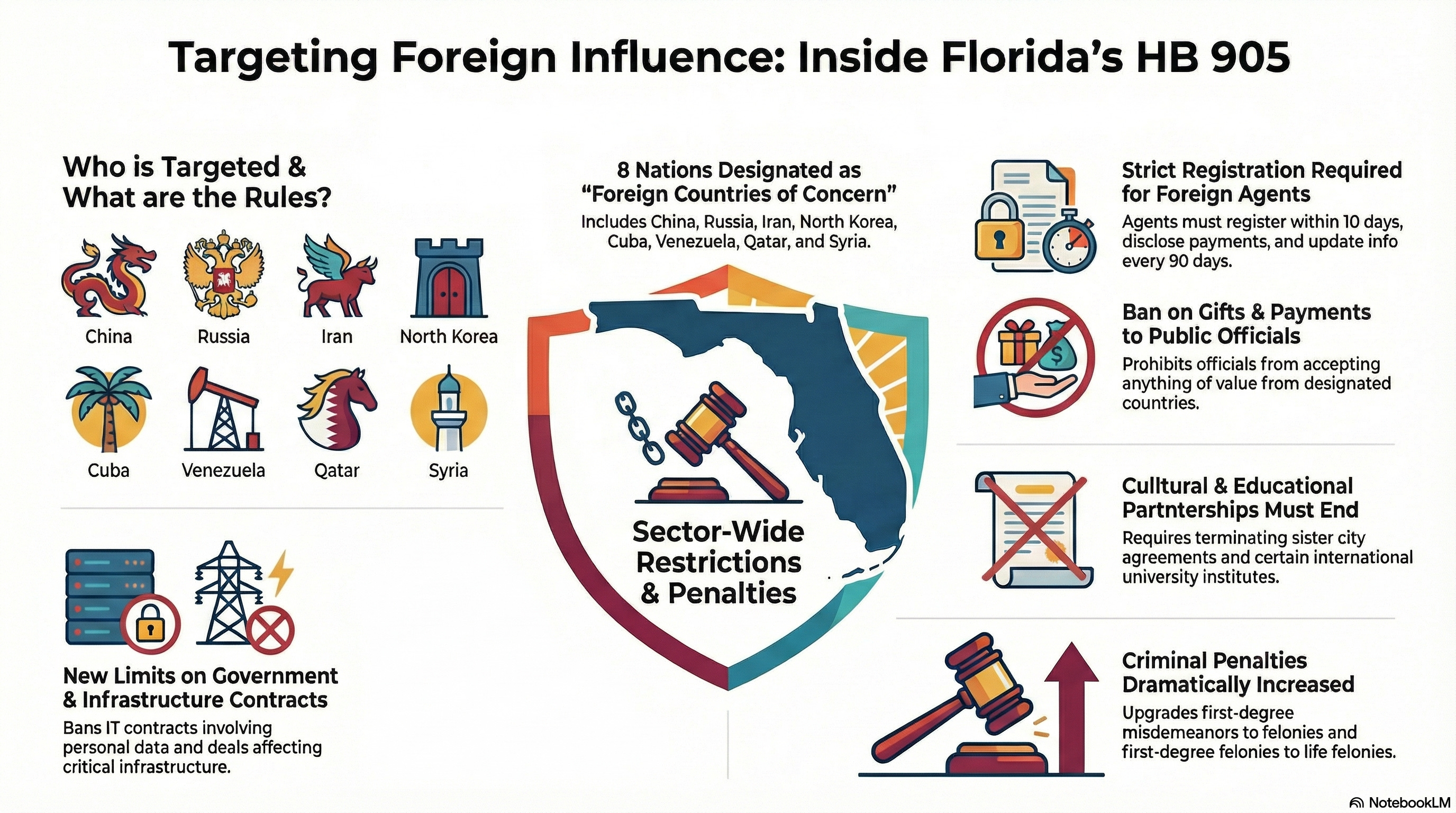
The bill also enhances criminal penalties for offenses committed to benefit foreign governments or terrorist organizations. A first-degree misdemeanor would be upgraded to a third-degree felony, while first-degree felonies would become life felonies with mandatory minimum sentences of 15 years. The legislation also creates a new crime: unauthorized enforcement of foreign law, making it a felony to investigate or monitor Florida residents on behalf of foreign governments.
The Commission on Ethics must update training programs by November 1, 2026, to include education on foreign influence campaigns, specifically citing the Chinese Communist Party’s “United Front” strategy as an example of tactics officials should recognize and report.
Why Florida Is Targeting Foreign Influence Now
Florida’s aggressive stance reflects both its strategic vulnerabilities and political priorities. As the third most populous state and a critical swing state, Florida presents an attractive target for foreign influence operations.
The state’s rapid economic growth has attracted substantial foreign investment, particularly in real estate and critical infrastructure. Chinese entities have invested heavily in Florida properties over the past decade, while the state hosts vital assets like the Port of Miami, one of the nation’s busiest cargo facilities.
Governor Ron DeSantis has made combating foreign influence—especially from China—a political centerpiece. In May 2023, Florida enacted Senate Bill 264, which prohibits Chinese nationals from buying land within 10 miles of military installations and critical infrastructure. That same month, DeSantis signed legislation banning the China-linked TikTok on government devices and networks.
With HB 905 just filed, it faces a long legislative journey through committee hearings and floor votes before potentially reaching the governor’s desk. The bill represents Florida’s latest effort to insulate state operations from what lawmakers view as malign foreign influence. As other states watch Florida’s approach, HB 905 could become a template for similar legislation nationwide.
I wonder why Iraq and Turkey were omitted? I agree with the idea in general, but it sets a precedent, and with a change in the direction of political winds, Israel could easily be added to the list. Already, some in Congress are pushing to eliminate dual citizenship.
How will this affect part time Florida residents like Tucker Carlson? He is on the Qatar payroll, and lauds the leaders of Venezuela, Iran, and Russia.
https://m.youtube.com/watch?v=BmdcPausxZw