


Jewish Onliner is an independent publication. If you find our work valuable, please consider becoming a paid subscriber. You can also subscribe to us on WhatsApp and Telegram. Follow us on Instagram, Discord, and X.
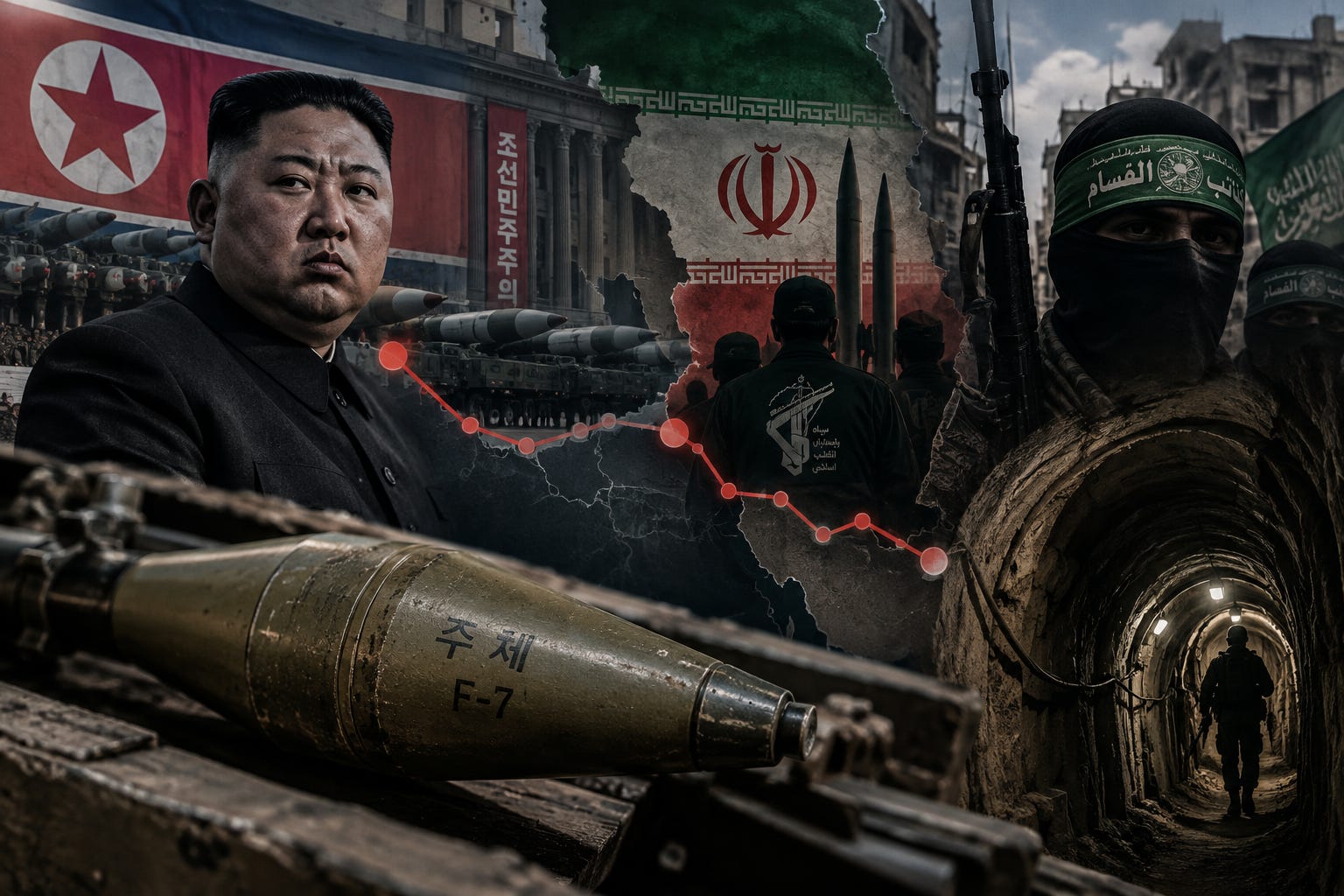
On September 8, a federal court held Iran and North Korea jointly and severally liable to American plaintiffs over seven terrorist attacks, including Hamas and Palestinian Islamic Jihad’s October 7, 2023 assault on Israel, in a ruling that details a largely overlooked North Korean role involving training, weapons and underground-warfare assistance.
In a memorandum opinion, U.S. District Judge Leonie Brinkema granted default judgment on liability in a case brought by 47 U.S. nationals, including people killed or injured in seven terrorist attacks between 2019 and 2023 and immediate family members of the victims. The court concluded that the plaintiffs had established Iran and North Korea’s liability under the terrorism exception to the Foreign Sovereign Immunities Act.
The October 7 portion of the ruling is particularly striking. Brinkema wrote that Hamas and Palestinian Islamic Jihad jointly carried out the attack that severely wounded American plaintiffs Bernadette and Nir Brauner. According to the court, Iran provided funds, weapons, recruitment assistance and incentive payments to operatives involved in the attack. North Korea, the opinion states, provided training to Hezbollah, Hamas and PIJ operatives involved in the attack, as well as weapons or weapon components and “tunnel-building assistance.”


The underlying complaint is even more explicit. It alleges that North Korea aided the October 7 attack by providing training to operatives from Hezbollah, Hamas and PIJ, supplying weapons including rocket-propelled grenade launchers, and providing assistance related to tunnel construction. Because Iran and North Korea did not answer the lawsuit, those allegations were uncontested. The court nevertheless found that the plaintiffs had presented an adequate legal and factual basis to establish liability and held the two governments jointly and severally liable for the plaintiffs’ injuries and deaths.
A Decades-Old North Korean Pipeline
North Korea’s ties to Middle Eastern militant movements predate Hamas itself, while its military relationship with Iran stretches back to the early 1980s.
The complaint, summarized by Brinkema, describes Pyongyang as Iran’s “most powerful nation-state partner” and traces decades of cooperation involving missile development, weapons, military training and assistance to Iran, the Islamic Revolutionary Guard Corps and Hezbollah.
The opinion recounts allegations that North Korean military personnel were dispatched to southern Lebanon in the early 2000s, where they used Pyongyang’s expertise to help develop underground military installations and an extensive network of tunnels. It also describes North Korean training provided to the IRGC and Hezbollah that allegedly flowed through Iran’s broader network of proxies.
That history has previously reached American courts. In a 2014 federal decision involving Hezbollah’s 2006 war against Israel, a U.S. district court found by “clear and convincing evidence” that North Korea had materially supported Hezbollah. The court identified weapons, military training and assistance constructing underground military infrastructure among the support supplied by Pyongyang.
A Congressional Research Service report similarly documented reports that North Korean trainers were sent to southern Lebanon to instruct Hezbollah personnel in constructing underground military facilities. The report also detailed longstanding North Korean weapons relationships with Iran and Syria and reported on the movement of North Korean arms believed to be destined for Hezbollah and Hamas.
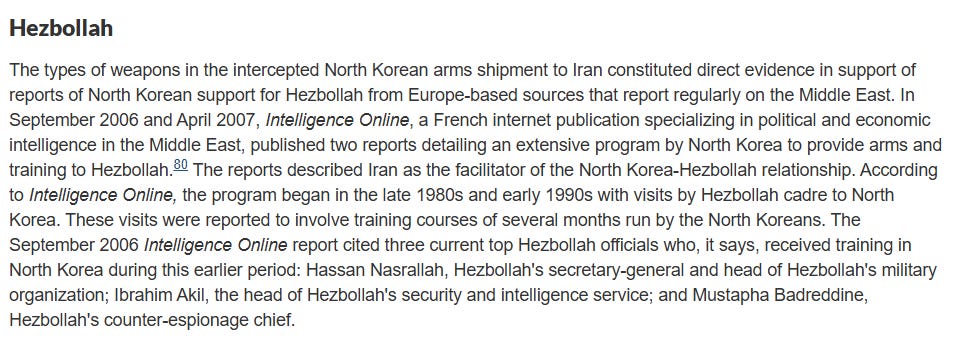
North Korea’s role has also been partly transactional. Analysis by 38 North identified financial gain as an important motivation behind Pyongyang’s arms trade while noting that its relationships with militant organizations have often developed through allied states. Heavily sanctioned and motivated in part by revenue, North Korea has used weapons exports and military expertise for both financial and geopolitical purposes.
Iran has served as a crucial link. Decades of military cooperation between Tehran and Pyongyang created channels through which missile technology, weapons and military knowledge could move into an Iranian network that includes Hezbollah and Palestinian terrorist organizations.
North Korean Weapons in Hamas’ Arsenal
South Korea’s National Intelligence Service confirmed in January 2024 that Hamas had used a North Korean-made F-7 rocket-propelled grenade launcher and released an image showing Korean markings inside the weapon’s fuse. A subsequent CSIS analysis cited the intelligence finding and noted Israeli reports of North Korean weapons recovered following the October 7 attack.
![A photo of North Korean F-7 RPG that is believed to have been supplied to North Korea. [NATIONAL INTELLIGENCE SERVICE/YONHAP]](https://substackcdn.com/image/fetch/$s_!DOPj!,f_auto,q_auto:good,fl_progressive:steep/https%3A%2F%2Fsubstack-post-media.s3.amazonaws.com%2Fpublic%2Fimages%2Fa985def7-eb5d-4405-b917-ed010b5e700d_960x440.jpeg "A photo of North Korean F-7 RPG that is believed to have been supplied to North Korea. [NATIONAL INTELLIGENCE SERVICE/YONHAP]")
The September ruling places October 7 at the end of a much older military network connecting Pyongyang, Tehran, Hezbollah and Palestinian terrorist organizations, and holds North Korea legally responsible for material support that the court determined contributed to attacks against the American plaintiffs.
Iran and North Korea did not appear to defend the lawsuit, resulting in a default proceeding. But under the Foreign Sovereign Immunities Act, the court could not grant judgment merely because the governments failed to respond. Brinkema wrote that the plaintiffs still had to establish their claims with evidence satisfactory to the court and that the court was required to determine whether an adequate legal and factual basis existed.
The court ultimately granted the plaintiffs’ motion for default judgment on liability and granted their damages motion in part. Brinkema ordered punitive damages equal to compensatory damages and imposed statutory post-judgment interest.
Spiderweb of bad actors